A team at TU Wien, led by Benjamin Koch from the Institute for Theoretical Physics, has advanced the search for a unified theory linking quantum physics and gravitation through a novel analysis of geodesics. The study applies the principles of quantum physics to the metric—a measure of spacetime curvature—introducing probability distributions to traditionally defined positions and momenta. This approach investigates deviations from established results within Einstein’s general relativity, potentially offering measurable criteria to distinguish between competing quantum gravity theories like string theory or loop quantum gravity and bringing researchers closer to identifying the correct model of nature.
Quantum Geodesics and Spacetime Curvature
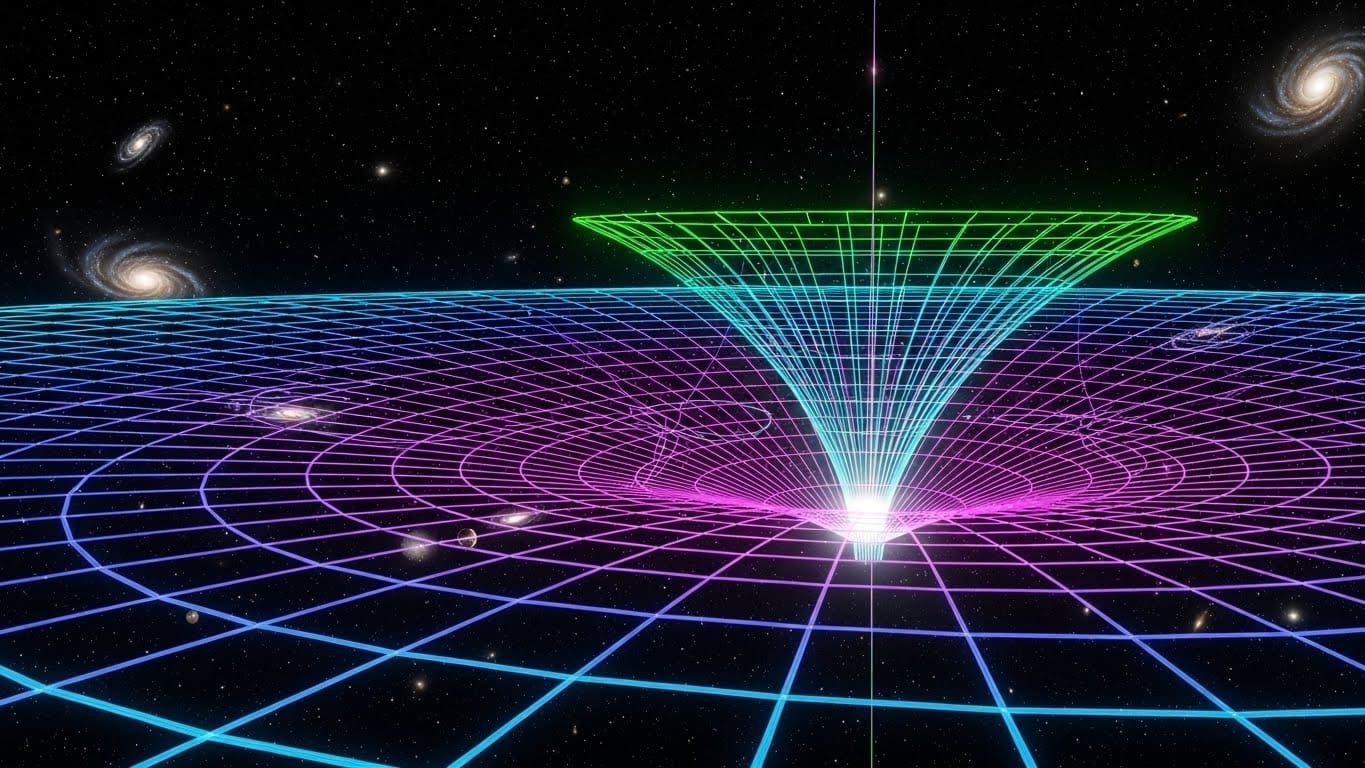
Researchers at TU Wien have developed a new approach linking quantum physics and gravitation by examining “quantum geodesics.” Traditional geodesics describe the shortest path between two points in spacetime, curving due to mass. This new work quantizes the metric – a measure of spacetime curvature – applying rules of quantum physics where position and momentum are probabilistic, not fixed. The resulting “q-desic equation” predicts particles won’t always follow the shortest path, offering a potential observable for testing quantum gravity theories.
The team found minimal deviation between quantum and classical geodesics in ordinary gravitational fields—about 10-35 meters. However, incorporating the cosmological constant (dark energy) into the q-desic equation revealed significant differences. These deviations occur at both very small and very large distances, with substantial differences emerging at scales around 1021 meters. Earth’s orbit around the Sun shows little difference, but cosmological scales do.
This work, published in Physical Review D, provides a novel mathematical approach and opens new avenues for comparing theory with observation. Researchers suggest that these quantum corrections on large scales could offer insights into unsolved cosmic puzzles, like galaxy rotation speeds. The q-desic equation potentially provides an observable “slipper” to help identify the correct theory of quantum gravity, distinguishing viable approaches from incorrect ones.
Linking Quantum Physics and General Relativity
Researchers at TU Wien have developed a new approach to link quantum physics and general relativity by focusing on “q-desics”—quantum versions of geodesics, the shortest paths objects take through spacetime. Traditionally, geodesics define movement based on spacetime curvature, but this team applied quantum rules to the metric—a measure of that curvature—resulting in an equation that predicts particles don’t always follow the shortest path. This introduces a potentially observable difference between classical and quantum gravity predictions, a crucial step towards testing quantum gravity theories.
The team found minimal deviation between q-desics and classical geodesics when considering only ordinary gravitation, with differences as small as 10-35 meters. However, incorporating the cosmological constant—responsible for the universe’s accelerated expansion—created significant differences. These deviations are particularly noticeable at extremely large distances (around 1021 meters), offering a potential way to differentiate between viable and incorrect quantum gravity approaches, where current observations present puzzles.
This work, published in Physical Review D, offers a new way to compare theory with observation. Unlike previous approaches, the q-desic equation suggests observable quantum corrections on cosmological scales, potentially shedding light on unsolved mysteries like galaxy rotation speeds. The team believes this could be a crucial “slipper” – a measurable observable – to identify the correct theory of quantum gravity, allowing researchers to distinguish between competing models.
It’s a bit like the Cinderella fairy tale,” says Benjamin Koch from the Institute for Theoretical Physics at TU Wien. “There are several candidates, but only one of them can be the princess we are looking for. Only when the prince finds the slipper can he identify the real Cinderella.
Benjamin Koch
The q-Desic Equation and Trajectory Deviations
The team at TU Wien developed the q-desic equation, a novel approach linking quantum physics and gravitation. This equation describes particle trajectories in a quantum spacetime, differing from classical geodesic predictions. Specifically, it examines how particles move when spacetime curvature is replaced with a quantum-mechanically fuzzy version, challenging the established understanding of shortest paths between two points. The research mathematically determines if a metric operator can be replaced by its expectation value, a key step in applying quantum rules to spacetime.
Initially, the difference between q-desic and classical geodesic paths was found to be minimal – deviations of approximately 10-35 meters – rendering experimental observation improbable. However, incorporating the cosmological constant (dark energy) into the q-desic equation revealed significant differences. These deviations become substantial at length scales around 1021 meters, potentially offering observable distinctions on cosmological scales where major puzzles in general relativity remain unsolved.
This work published in Physical Review D, presents a new way to compare theory with observation. While Earth’s orbit sees minimal difference, the q-desic equation predicts different particle trajectories on vast cosmological scales, potentially offering insight into phenomena like galaxy rotation speeds. The development of this equation is viewed as a promising step towards identifying a measurable observable – a “slipper” – to differentiate between competing theories of quantum gravity and pinpoint the correct approach.
Observable Predictions and Cosmological Scales
A new approach from TU Wien links quantum physics and gravitation, potentially offering observable predictions for testing quantum gravity theories. The team focused on “q-desics”—the quantum version of geodesics, which describe the paths objects take through curved spacetime. They mathematically determined how a small object would behave in a quantum gravitational field, revealing that particles may not always follow the shortest path as predicted by classical geodesics. This offers a way to infer quantum properties of spacetime by observing particle trajectories.
The research indicates minimal differences between q-desics and classical geodesics in ordinary gravitation, with deviations around 10-35 meters. However, incorporating the cosmological constant—responsible for the universe’s accelerated expansion—creates substantial deviations. While unobservable at small distances, these differences become significant at scales of approximately 1021 meters, offering a potential way to test quantum gravity on large cosmological scales where general relativity faces unresolved puzzles.
This work, published in Physical Review D, provides a new perspective for comparing theory with observation. The researchers suggest that these quantum corrections on large scales could lead to a better understanding of cosmic phenomena, like the rotation speeds of spiral galaxies—a current puzzle in cosmology. They believe this approach could help identify viable quantum gravity theories, essentially finding the “slipper” that fits the correct theory.