For centuries, scientists and philosophers have been fascinated by the mysteries of quantum physics and consciousness. The intersection of these two fields has led to groundbreaking ideas and hypotheses that challenge traditional views of reality. At its core, this phenomenon revolves around the observer effect, where the act of observing a quantum system affects its outcome. This concept has sparked intriguing discussions about the role of consciousness in shaping our understanding of the world.
As we delve into the realm of quantum physics, we find ourselves entwined with philosophical traditions that view consciousness as primary and co-creative. The idea that reality is shaped by observation raises fundamental questions about the nature of consciousness and its relationship to the universe. Is it the act of observation or the conscious observer that collapses the wave function? This conundrum has sparked a new wave of research, pushing the boundaries of our understanding of reality itself.
The connection between quantum physics and consciousness offers a rich and multifaceted area of study that has the potential to revolutionize our understanding of the universe. As scientists and philosophers continue to explore this complex issue, they may uncover new insights into the human experience and our place within it. The future of research in this field promises to be exciting, with breakthroughs potentially emerging in neuroscience, psychology, and philosophy.
Quantum physics, a branch of physics that deals with the behavior of matter and energy at an atomic and subatomic level, has fascinated many researchers and thinkers. One of the most intriguing aspects of quantum physics is its potential connection to consciousness, which has led to philosophical and scientific speculation about the nature of reality.
One of the most famous aspects of quantum
One of the most famous aspects of quantum mechanics is the observer effect, which refers to the phenomenon where the act of observing or measuring a quantum system affects its outcome. In experiments like the double slit experiment, particles such as photons or electrons behave like waves when not observed but act like particles when observed. This seems to suggest that observation collapses the wave function of a particle into a definite state.
Some interpretations of this phenomenon, particularly the Copenhagen interpretation, have led to the idea that the observer’s consciousness plays a crucial role in determining reality. While mainstream physics typically explains this in terms of the interaction between measuring devices and particles, certain physicists and philosophers have proposed that consciousness might play a fundamental role in collapsing the wave function and bringing the universe into a determinate state.
This notion resonates with philosophical traditions, particularly in Eastern thought, where consciousness is seen as primary and co-creating or perceiving reality. For instance, Vedantic philosophy and Buddhist teachings suggest that the observer and observed are interconnected, and that reality is shaped by perception. Quantum mechanics’ observer effect mirrors this by implying that reality is at least partially shaped by observation.
The question remains: Is it the act of observation or the conscious observer that collapses the wave function? If consciousness is involved, this could imply that consciousness plays a fundamental role in shaping reality. This idea has been explored in various philosophical and scientific contexts, including the concept of panpsychism, which posits that consciousness is a fundamental and ubiquitous aspect of the universe.
Certain aspects of quantum physics resonate with philosophical
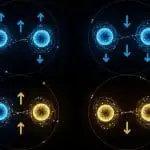
Certain aspects of quantum physics resonate with philosophical and metaphysical ideas about the nature of consciousness, leading to intriguing hypotheses and thought experiments. For instance, the concept of entanglement, where two particles become connected in such a way that their properties are correlated regardless of distance, has been interpreted as a manifestation of non-locality, which challenges our classical understanding of space and time.
The role of consciousness in quantum physics remains a topic of debate among physicists and philosophers. Some argue that consciousness is an emergent property of complex systems, while others propose that it is a fundamental aspect of the universe, akin to space and time. This question has significant implications for our understanding of reality and the nature of consciousness.
The potential connection between quantum physics and consciousness raises important questions about the nature of reality and our place within it. If consciousness plays a fundamental role in shaping reality, this could imply that our perceptions and experiences are not just passive observations but active contributors to the unfolding of the universe.
In conclusion, the connection between quantum physics and consciousness offers a new perspective on reality, one that challenges our classical understanding of space, time, and matter. While the implications of this idea are still being explored, it is clear that the intersection of quantum physics and consciousness has the potential to revolutionize our understanding of the universe and our place within it.
Publication Date: 2024-10-25
Authors: Surendra Sherchan
Source: Nepal Journal of Health Sciences
DOI: https://doi.org/10.3126/njhs.v4i1.71060