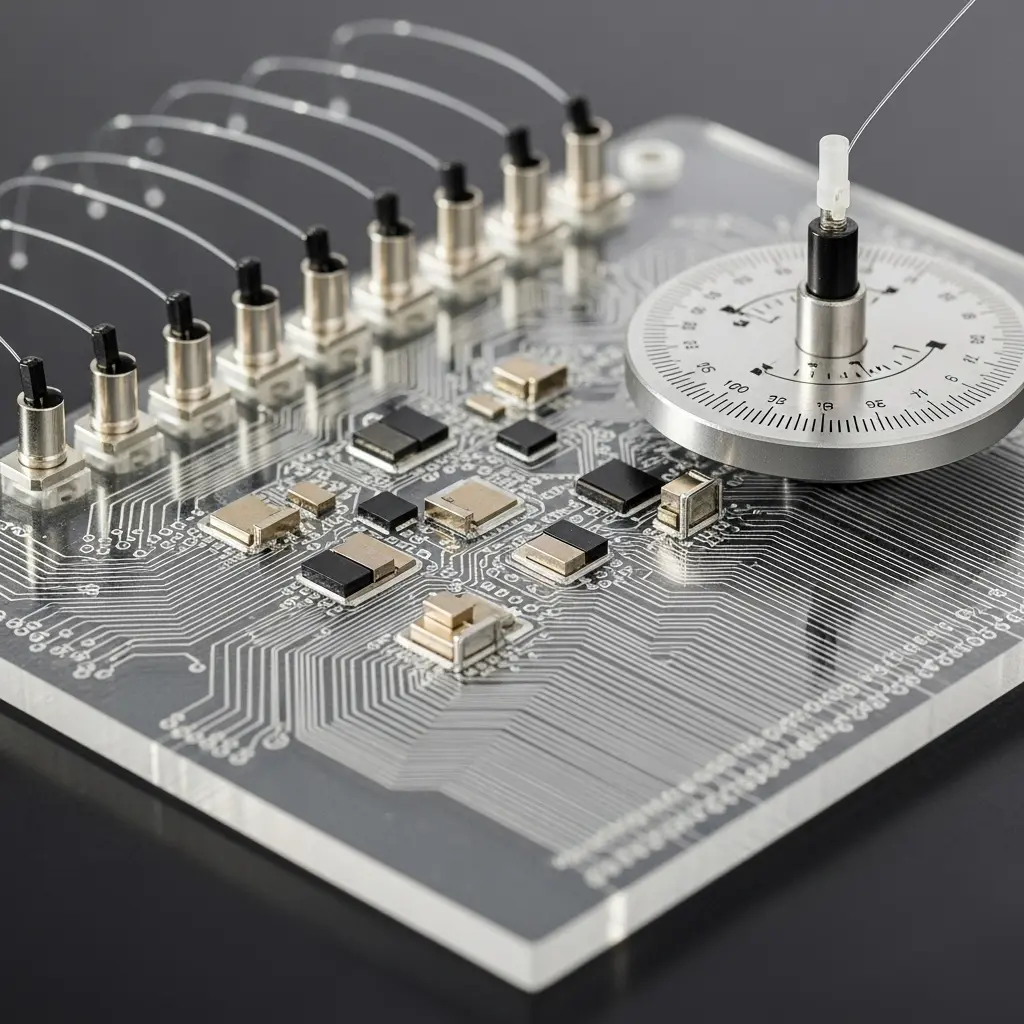
Berry’s phase, a geometric effect arising from the evolution of quantum systems, holds promise for robust quantum computation, but simulating it remains a significant challenge. Steven Abel, Iwo Wasek, and Simon Williams, all from Durham University, now demonstrate a method for observing this phenomenon using photonic quantum computers. Their work establishes a continuous-variable quantum algorithm that simulates charged particles experiencing changing fields, and crucially, achieves this using only standard linear optical components. This allows the team to experimentally verify the existence of Berry’s phase on the Quandella Ascella platform, and furthermore, they extend the framework to handle more complex, rapid changes, paving the way for more resilient quantum technologies by cancelling out common sources of error.
Angular momentum evolves under the influence of an adiabatically changing magnetic field vector. The construction, formulated within the continuous-variable quantum computation setting, utilises only passive linear-optical operations, specifically beam splitters and phase shifts, which function identically in single-photon photonic architectures. This enables experimental realisation on the Quandella Ascella platform, where the Berry’s phase phenomenon is observed through interferometric measurement. The framework also generalises to accommodate more rapid, non-adiabatic evolution, and by concatenating Aharonov, Anandan cycles for opposing magnetic fields, the team demonstrates the engineering of a circuit in which dynamical phases and leading non-geometric errors cancel by symmetry.
Continuous Variable Simulation of Quantum Field Theory
Scientists are leveraging continuous-variable quantum computing, a technique employing the continuous properties of light, to simulate quantum field theory, the theoretical framework describing fundamental particles and forces. This approach offers a promising pathway to overcome computational limitations hindering the study of complex quantum systems. Researchers are exploring how continuous variables, unlike the discrete bits used in conventional quantum computers, can model real-time dynamics within quantum field theory. The team utilises the Wigner function, a mathematical tool representing quantum states, to ensure the validity of their simulations.
Several software platforms, including Strawberry Fields, Perceval, and Qumode, facilitate the development and execution of these continuous-variable quantum computations. Current research projects focus on simulating phenomena such as false vacuum decay, scattering processes, and the behaviour of quantum field theories on near-term quantum devices. This work aims to provide new insights into particle physics, cosmology, and materials science. The ongoing development of these tools and techniques promises to unlock new possibilities for exploring the fundamental laws of nature.
Berry’s Phase Simulation via Linear Optics
Scientists have demonstrated a continuous-variable quantum computing algorithm capable of simulating Berry’s phase, a subtle quantum phenomenon associated with the orbital angular momentum of particles in changing magnetic fields. The research successfully implements this simulation using only passive linear-optical operations, specifically beam splitters and phase shifts, making it compatible with existing single-mode architectures and enabling experimental validation on the Quandella Ascella quantum platform. Experiments revealed the presence of Berry’s phase through interferometric measurement, confirming the theoretical predictions and showcasing the algorithm’s functionality. The team prepared specific quantum states representing particles with orbital angular momentum and subjected them to a time-varying magnetic field.
By simulating the slow evolution of this field, scientists measured the induced phase change on the quantum state, isolating the Berry phase from the dynamical phase accumulated during the evolution. Detailed analysis of the lowest energy state, termed the “donut state” due to its density profile, showed its orientation follows the changing magnetic field, inducing a measurable Berry phase. The Wigner function, a quantum mechanical probability distribution, was calculated for these states, providing further insight into their behaviour and validating the simulation. Furthermore, the research extends the framework to non-adiabatic evolution, where the system changes more rapidly. By concatenating cycles designed for opposing magnetic fields, scientists engineered a circuit where dynamical phases and leading errors cancel by symmetry, leaving only the intrinsically robust geometric phase contribution. This advancement enhances the accuracy and reliability of the simulation, paving the way for more complex quantum simulations and potentially enabling the study of novel quantum phenomena.
Berry’s Phase Simulation via Continuous Variables
This research demonstrates a continuous-variable quantum computing algorithm capable of simulating Berry’s phase, a geometric phenomenon exhibited by charged particles with orbital angular momentum subject to changing magnetic fields. The team successfully implemented this simulation using linear optical operations, making it compatible with existing photonic quantum computers, and experimentally verified the results on the Quandella Ascella platform through interferometric measurement. This achievement extends the understanding of how geometric phases can be simulated and observed in CVQC systems. Furthermore, the researchers generalised their framework to encompass non-adiabatic evolution, where changes occur more rapidly, and developed a method to cancel out unwanted dynamical and non-geometric errors by exploiting symmetry within the quantum circuit. This error mitigation strategy enhances the robustness of the geometric phase measurement, isolating the intrinsically reliable contribution from Berry’s phase. The study confirms the theoretical basis for simulating Berry’s phase using CVQC and provides a pathway for exploring more complex quantum phenomena.
🗞 Berry’s phase on photonic quantum computers
🧠 ArXiv: https://arxiv.org/abs/2511.19598