Quantum interactions between photons hold immense promise for advancing technologies beyond the reach of classical physics, yet controlling these interactions remains a significant challenge. Chaojie Wang, Xutong Li, and Xiuyi Ma, along with their colleagues at various institutions, now demonstrate a novel method for dynamically controlling photon-photon interactions using a phase change material, vanadium dioxide. Their research reveals that by manipulating the material’s transition between insulating and metallic states, scientists can precisely tune the way photons interfere with each other, introducing complex and previously unattainable control over their interactions. This achievement offers an alternative pathway to explore quantum light interactions and paves the way for more sophisticated quantum technologies, including advanced quantum simulation and computation.
Vanadium Dioxide Dynamically Controls Photon Interactions
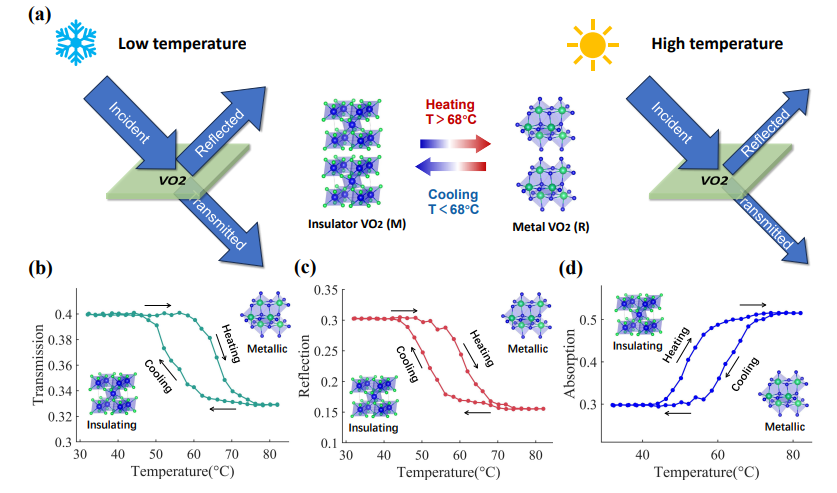
Scientists have achieved a breakthrough in controlling how photons interact, opening new avenues for quantum technologies. The team demonstrated a novel method for manipulating quantum interference using vanadium dioxide, a material that dramatically changes its optical properties when heated. This research establishes a powerful tool for exploring fundamental quantum mechanics and developing more sophisticated quantum devices. The study centers on harnessing the unique properties of vanadium dioxide thin films, which transition between insulating and metallic states around 68°C, allowing researchers to dynamically control the behavior of photons passing through it.
The team fabricated a vanadium dioxide thin film and integrated it into a setup designed to observe Hong-Ou-Mandel interference, a quantum phenomenon where identical photons either combine or separate at a beam splitter. Crucially, the researchers demonstrated the ability to switch between different types of operations by precisely controlling the temperature of the vanadium dioxide film. This control allows them to manipulate how entangled photons interact, effectively tuning the strength and nature of their connection. The ability to introduce these specialized operations is particularly significant, as they are essential for solving complex computational problems beyond the reach of conventional computers.
Furthermore, the tunable absorption properties of the vanadium dioxide film offer a novel approach to isolating and stabilizing specific quantum states, enhancing the purity and resilience of quantum entanglement, a critical resource for quantum communication and computation. This work validates a promising pathway for integrating phase change materials into quantum physics, opening up new possibilities for programmable photonic platforms and advanced quantum technologies. Experiments reveal that by precisely controlling the temperature of a vanadium dioxide thin film, they can manipulate the interaction between entangled photons. The critical transition temperature for this material was measured at 68°C, allowing researchers to switch between different types of operations using an electrically driven heater. This tunability allows for control over the coalescence and anti-coalescence of photons within a Hong-Ou-Mandel interference setup. Furthermore, the research shows that tunable absorption of anti-symmetric entangled photons in the vanadium dioxide film provides a novel method for isolating and stabilizing desired entanglement states, offering a versatile mechanism for state selection through photon-photon interaction.
Vanadium Dioxide Dynamically Controls Photon Entanglement
This research establishes that by carefully manipulating the properties of vanadium dioxide, scientists can finely tune quantum interference and introduce specialized operations, which are crucial for advanced quantum technologies. The team successfully demonstrated control over the effective interaction between entangled photons, paving the way for more sophisticated quantum state engineering. These findings offer an alternative to traditional methods of manipulating light and have significant implications for quantum information processing tasks, including quantum simulation and computation. The ability to dynamically control photon-photon interactions using these operations could lead to the development of novel quantum gates and programmable photonic circuits.
Furthermore, the researchers suggest potential applications beyond computation, envisioning benefits for areas like molecular vibronic spectra and complex wave function analysis. The authors acknowledge that imperfections in the optical components and environmental noise introduced slight deviations in their experimental results, and propose that using doped vanadium dioxide or employing vanadium dioxide metasurfaces could address these limitations and further enhance reflective components. Future research will likely focus on refining these materials and exploring the full potential of this approach for building large-scale, programmable quantum information platforms.
🗞 Dynamical control of quantum photon-photon interaction with phase change material
🧠 ArXiv: https://arxiv.org/abs/2510.16305