The interplay of light and matter within quantum systems drives fascinating phase transitions, and a team led by Bao-Yun Dong, Ying Liang, and Stefano Chesi from Chongqing University and Beijing Normal University now investigates these transitions in a novel platform using driven Rydberg arrays. Their work explores a generalized Dicke-Ising model, where precisely controlled interactions between atoms and light reveal a rich landscape of critical phenomena, offering insights into the fundamental behaviour of quantum materials. By developing an advanced computational method, the researchers determine the scaling laws governing photon emission and demonstrate how atomic interactions suppress light production within the system. This achievement not only clarifies the nature of phase transitions in this model, but also establishes a pathway towards controlling and harnessing quantum phenomena for future technologies.
This research focuses on how collective interactions and external driving influence quantum many-body phenomena. By combining analytical techniques with numerical simulations, they characterise the system’s behaviour and reveal the existence of novel quantum phases and transitions, including a shift from a ferromagnetic to a paramagnetic state induced by the driving field. This driven Rydberg array provides a versatile platform for studying complex quantum dynamics. The driving field effectively tunes the system’s parameters, leading to distinct quantum phases characterised by different order parameters and correlations.
Researchers identify a critical driving strength at which a quantum phase transition occurs, marked by a divergence in susceptibility and a change in the energy gap. The impact of anisotropy on the phase diagram reveals a rich interplay between the transverse field, longitudinal interactions, and driving field. This work provides a comprehensive characterisation of the quantum phase diagram and identifies novel quantum phases.
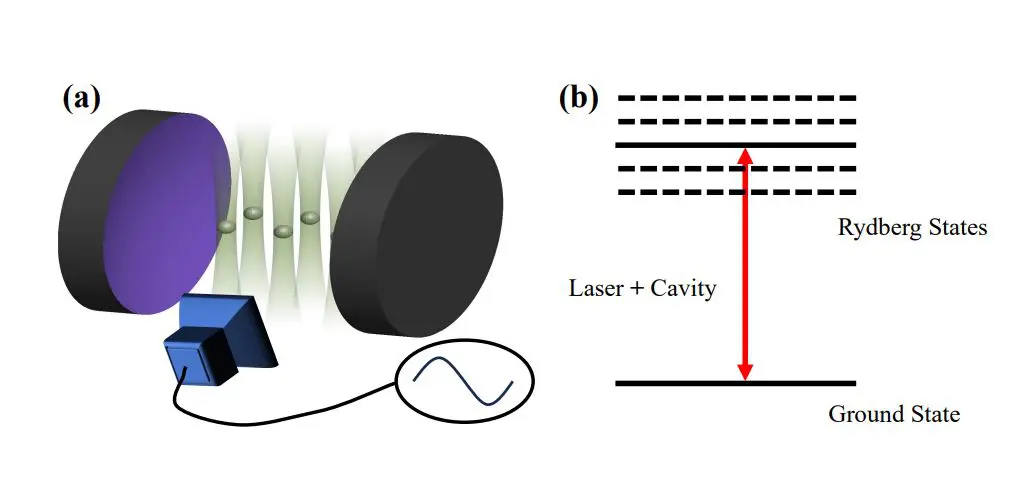
This research explores a generalized Dicke-Ising model realised with an array of Rydberg atoms, driven by microwave electric fields and coupled to an optical cavity. This platform allows for precise tuning of the anisotropy parameter, and the model exhibits a rich landscape of phase transitions and critical phenomena, arising from the interplay of rotating-wave, counter-rotating-wave, and Ising interactions. Scientists develop an improved quantum Monte Carlo algorithm that explicitly tracks the quantum state of the optical cavity, allowing them to determine the scaling laws of the photon number through data collapse.
Rydberg Atoms and Quantum System Simulation
This research explores quantum optics, many-body physics, and the simulation of quantum systems using various techniques. Scientists focus on light-matter interactions, particularly phenomena like spontaneous emission, superradiance, and the Jaynes-Cummings model. A significant portion of the work details using systems like Rydberg atoms and cavity quantum electrodynamics to simulate other quantum systems, a major area of current research in quantum information science. The emergence of collective behaviour in systems of many interacting quantum particles is a recurring theme. Key concepts include the Jaynes-Cummings model, which describes the interaction between a single atom and a single light mode, and Rydberg atoms, which possess strong interactions making them useful for quantum simulation. Cavity quantum electrodynamics enhances light-matter interactions, while superradiance describes the collective emission of light from many excited atoms. Researchers utilise Quantum Monte Carlo to solve quantum many-body problems, and Tensor Networks to represent and manipulate high-dimensional quantum states.
Rydberg Atoms Reveal Criticality and Blockade Effects
This research details a comprehensive investigation into a generalized Dicke-Ising model realised with Rydberg atoms coupled to an optical cavity, driven by microwave electric fields. Scientists successfully demonstrated a tunable anisotropy parameter within the model, revealing a complex landscape of critical phenomena arising from the interplay of rotating-wave, counter-rotating-wave, and Ising interactions. An improved Monte Carlo algorithm, designed to explicitly track the cavity’s quantum state, enabled precise determination of scaling laws for photon number in the superradiant phase. The study confirms the vanishing of parity symmetry in finite-size simulations and highlights the suppression of cavity occupation due to Rydberg blockade effects.
Notably, the team found that stronger fluctuations induced by counter-rotating wave terms slightly favour the superradiant solid phase over an alternative solid state. Through careful analysis, researchers established that transitions from certain phases to the superradiant phase are first-order, while transitions to those phases from the superradiant state are second-order, regardless of the anisotropy parameter. This research provides a detailed understanding of light-matter interactions in Rydberg atom arrays and establishes a platform for exploring complex quantum many-body physics.
🗞 Quantum phase transitions of the anisotropic Dicke-Ising model in driven Rydberg arrays
🧠 ArXiv: https://arxiv.org/abs/2511.22230