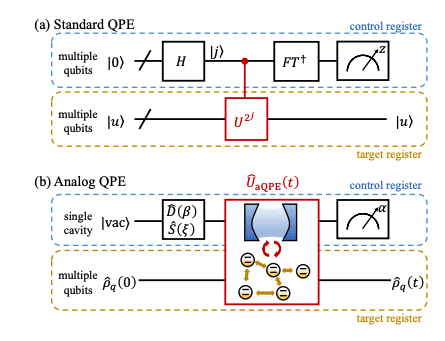
Researchers demonstrate an analogue quantum phase estimation protocol, aQPE, to determine eigenenergies using continuous time evolution and cavity measurement. This approach circumvents the limitations of deep circuits and complex entangling gates, utilising established cavity tomography techniques and a physically realisable architecture for the XY model.
Determining the eigenvalues, or energies, of a quantum system is fundamental to many areas of physics and increasingly important for realising the potential of quantum computation. Current digital approaches to this problem, however, face limitations due to the complexity of the quantum circuits required. Researchers at National Taiwan University and the National Center for Theoretical Sciences, led by Wei-Chen Lin and Chiao-Hsuan Wang et al, now present an alternative, analog method for quantum phase estimation. Their work, detailed in the article “Analog Quantum Phase Estimation with Single-Mode Readout”, utilises continuous time evolution and a single-mode cavity measurement to extract eigenenergies, potentially offering a more resource-efficient and scalable approach for near-term quantum platforms. The team demonstrate the feasibility of their scheme by applying it to the XY model, a complex quantum system whose ground-state energy problem is known to be computationally challenging.
Determining the eigenvalues, or energies, of a quantum system remains fundamental across many areas of physics and is increasingly important for realising the potential of quantum computation. Researchers now present an analog quantum phase estimation (aQPE) protocol that efficiently determines these energies using continuous-time evolution and single-mode cavity measurement, offering a promising alternative to traditional digital methods. This innovative approach circumvents the need for deep quantum circuits and multi-qubit entangling gates, instead encoding eigenvalue information as conditional rotations within the cavity’s phase space and enabling readout using established cavity tomography techniques.
Researchers Wei-Jun Hu, Xiao-Hua Wu, and colleagues at the University of Science and Technology of China demonstrate the feasibility of this approach by engineering a Hamiltonian specifically designed to implement aQPE for the XY model, a well-known model in condensed matter physics. The XY model’s ground-state energy problem is classified as QMA-complete, meaning it represents one of the most computationally challenging problems in quantum complexity theory, and successfully implementing aQPE for this model demonstrates the potential of the protocol to tackle complex quantum systems. This work establishes a resource-efficient and scalable framework for implementing phase estimation on near-term quantum platforms, potentially surpassing the limitations of purely digital approaches.
The method relies on continuous-time evolution, unlike digital quantum algorithms which proceed in discrete steps, allowing the system to evolve naturally over time and potentially offering advantages in terms of speed and resource efficiency. The single-mode cavity measurement acts as a crucial interface between the quantum system and the classical readout apparatus, allowing researchers to infer the eigenvalues of the target Hamiltonian by carefully analysing the phase and amplitude of the light emitted from the cavity. Cavity tomography is a technique used to reconstruct the quantum state of the electromagnetic field within the cavity, providing a detailed characterisation of the cavity’s quantum properties.
Furthermore, the approach benefits from the inherent scalability of circuit electrodynamics, as superconducting circuits, which form the basis of many current quantum computing platforms, can be readily fabricated and interconnected, allowing for the creation of increasingly complex quantum systems. The researchers draw upon established theoretical frameworks, including those developed by Kosterlitz and Thouless regarding phase transitions and by Lieb, Schultz, and Mattis concerning spin systems, to underpin their approach and ensure its theoretical soundness. References to work by Barouch, McCoy, and Dresden on solvable lattice models further solidify the theoretical foundation and demonstrate the connection to established results in condensed matter physics.
The proposed architecture is compatible with existing circuit electrodynamics technology, specifically superconducting circuits, which is crucial for near-term implementation as it allows researchers to leverage existing infrastructure and expertise. By offering a resource-efficient and scalable framework for phase estimation, this work provides a promising pathway towards realising quantum advantage on near-term quantum platforms and tackling computationally intractable problems.
Unlike digital methods which rely on discrete gate operations, this analog scheme exploits the continuous dynamics inherent in quantum systems, allowing for a more resource-efficient estimation process and potentially reducing the demands on qubit coherence and gate fidelity. The protocol effectively translates the problem of eigenvalue determination into a measurement of the cavity’s quantum state, simplifying the experimental requirements and reducing the demands on qubit coherence and gate fidelity.
Eigenvalue estimation represents a fundamental challenge in demonstrating quantum advantage, yet current digital implementations are constrained by circuit complexity and operational demands. Researchers now present an analog quantum phase estimation (aQPE) protocol that determines the eigenenergies of a target Hamiltonian through continuous-time evolution and single-mode cavity measurement, offering a viable route towards practical quantum computation.
The core innovation lies in utilising a single-mode cavity as a readout mechanism, leveraging established cavity tomography techniques to extract the encoded eigenvalue information and simplifying the experimental requirements.
👉 More information
🗞 Analog Quantum Phase Estimation with Single-Mode Readout
🧠 DOI: https://doi.org/10.48550/arXiv.2506.15668