Quantum-centric Supercomputing is revolutionizing the landscape of machine learning by blending the strengths of quantum and classical computing. While Quantum Machine Learning (QML) has demonstrated potential in various applications, significant challenges hinder its practical adoption. A recent paper by Taiwanese researchers has highlighted how parameter-efficient learning can be achieved with QML (Quantum Machine Learning)
Two significant bottlenecks exist. Data encoding overhead occurs where large datasets require impractically deep quantum circuits. Quantum resource dependency means inference remains reliant on quantum hardware.
A novel approach, Quantum Parameter Adaptation (QPA), addresses these issues effectively. It leverages quantum neural networks (QNNs) to generate classical model weights only during training. This decouples inference from quantum hardware, making QML practical for real-world applications. A recent
By introducing quantum-enhanced parameter generation into fine-tuning techniques, QPA dramatically reduces trainable parameters while maintaining or improving model performance.
The Quantum Leap in Machine Learning Efficiency
Quantum computing offers an exponentially large Hilbert space, allowing the encoding of complex relationships with fewer parameters than classical methods. This theoretical advantage has long intrigued researchers, but scaling QML to practical applications has remained a challenge. Traditional QML methods rely on parameterized quantum circuits (PQCs) for training, often facing difficulties with large dataset encoding and deep circuit requirements.
QPA presents a hybrid quantum-classical approach that:
- 1. Uses QNNs to generate parameters for classical neural networks.
- 2. Eliminates the need for quantum computing during inference.
- 3. Enables scalable parameter-efficient learning by leveraging quantum state properties.
This approach has demonstrated remarkable efficiency in fine-tuning large language models (LLMs). It includes models like GPT-2 and Gemma-2. QPA significantly reduces the parameter count while preserving or improving performance.
Fine-Tuning Large Language Models: The Computational Challenge
The rise of large language models (LLMs), such as GPT-3, LLaMA-2, and Gemini, has transformed natural language processing. Still, fine-tuning these models remains prohibitively expensive due to the sheer number of parameters involved. Conventional fine-tuning requires updating a vast number of weights, which demands enormous computational resources.
To address this, Parameter-Efficient Fine-Tuning (PEFT) methods have been developed. These include Low-Rank Adaptation (LoRA), Weight-Decomposed Low-Rank Adaptation (DoRA), Prefix-Tuning (PT), and Adapters. These techniques significantly reduce the number of trainable parameters by introducing task-specific updates rather than modifying the entire model. However, even PEFT methods have room for optimization, particularly in reducing parameter size further without sacrificing performance.
QPA enhances these techniques by employing a quantum-generated parameter adaptation strategy. This method exploits quantum principles to generate PEFT parameters more efficiently.
How QPA Revolutionizes Parameter-Efficient Learning
Quantum Parameter Generation: The Core Idea
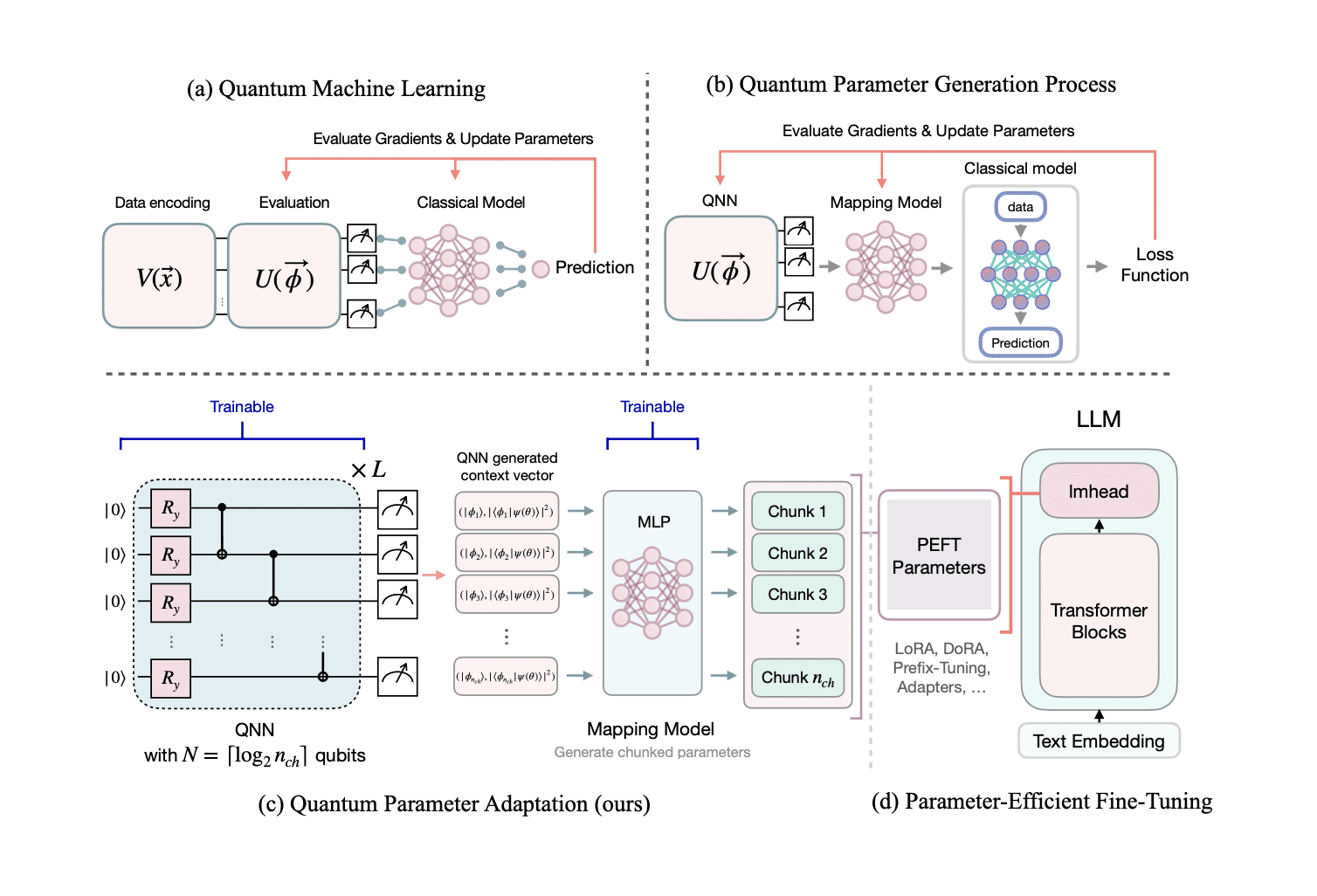
Instead of training all neural network parameters, QPA introduces a quantum parameter generation process, where a QNN generates fine-tuning parameters for a classical model. The key innovation is that these quantum-generated parameters replace manually trained PEFT parameters, reducing the computational cost.
This process involves:
- Using a QNN with a polynomial number of parameters to map quantum states to classical model weights.
- Employing a multi-layer perceptron (MLP) as a classical mapping model to transform quantum measurement results into usable parameters.
- Updating only a small set of quantum parameters, which drastically reduces the total parameter count.
Performance Gains in LLM Fine-Tuning
Experimental results demonstrate that QPA significantly outperforms traditional PEFT methods in terms of parameter efficiency.
- For GPT-2, QPA reduces the number of trainable parameters to 52.06% of LoRA’s parameter count while achieving a 0.75% performance gain in text generation tasks.
- For Gemma-2, QPA achieves a more dramatic reduction, bringing trainable parameters down to 16.84% of LoRA’s count, with a marginal 0.07% improvement in perplexity.
This quantum-assisted compression enables fine-tuning without sacrificing model effectiveness, making it a viable solution for scaling large AI systems.
Breaking the Barrier of Quantum-Dependent Inference
A major drawback of traditional QML approaches is their reliance on quantum hardware during inference. This requirement makes deployment costly and impractical, as quantum computing resources remain scarce.
QPA circumvents this problem by:
- Using quantum resources only during training.
- Ensuring that the final fine-tuned model is purely classical.
- Allowing inference to be performed on standard hardware.
This hybrid quantum-classical synergy enables companies and researchers to benefit from quantum computing without the challenges of real-time quantum inference.
Scaling QPA: From Small Models to Large-Scale Applications
Until now, quantum parameter generation techniques have primarily been tested on small-scale models (typically under 1 million parameters). QPA scales this approach to LLMs with billions of parameters, proving its practicality for real-world AI applications.
In this work, QPA was applied to Gemma-2 (2B parameters) and GPT-2 (80M parameters), marking a 1785× scale-up compared to previous quantum-assisted methods. This showcases QPA’s potential to bridge the gap between quantum computing and deep learning at a practical scale.
Technical Implementation of QPA
Quantum Circuit-Based Compression
The QPA framework utilizes quantum circuit-based compression to generate trainable parameters efficiently. By leveraging quantum states, it maps high-dimensional parameter spaces to a compact representation, requiring fewer trainable weights.
A parametric quantum circuit (PQC) with N qubits and L layers is used to generate measurement probabilities. These probabilities are then processed by a classical MLP, which produces the final PEFT parameters.
Batching for Large-Scale Adaptation
A key innovation of QPA is batched parameter generation, which reduces qubit requirements. Instead of requiring log2(number of parameters) qubits, QPA chunks model weights into smaller sets, allowing parameter generation with as few as 4–11 qubits.
This memory-efficient approach ensures that QPA remains feasible even on near-term quantum hardware.
Gradient-Based Training
QPA updates quantum parameters using gradient-based learning. The loss function gradients are computed with respect to the quantum parameters, allowing efficient optimization of QNN-generated parameters for PEFT tasks.
Future Implications and Next Steps
Expanding Beyond LLMs
While QPA has been tested on language models, its applications extend beyond NLP. Future research can explore its use in computer vision, reinforcement learning, and scientific simulations, where parameter efficiency is equally critical.
Quantum Hardware Integration
While QPA has been demonstrated using quantum simulations, the next step is to test it on real quantum hardware. Advances in fault-tolerant quantum computing will further enhance the efficiency of QPA, making quantum-generated parameter adaptation even more powerful.
Conclusion: A Quantum-Classical Synergy for AI’s Future
Quantum Parameter Adaptation (QPA) revolutionizes parameter-efficient learning by integrating quantum-generated parameters into classical fine-tuning techniques. By leveraging quantum computing during training while ensuring classical inference, QPA presents a scalable, cost-effective solution for optimizing LLMs.
This ICLR paper represents the first example of how quantum machine learning can assist in the fine-tuning of classical LLMs. It offers a clear computational advantage. This demonstrates the practical utility of quantum methods in real-world AI applications. QPA sets a new benchmark for hybrid quantum-classical AI systems by significantly reducing trainable parameters while maintaining or improving performance.
This Innovation paves the way for broader adoption of quantum-assisted learning in deep learning. It offers a viable and resource-efficient path for the next generation of AI models. QPA leads in quantum-classical hybrid AI. As quantum computing progresses, it makes quantum machine learning practical. It is scalable and ready for real-world deployment.
The authors of this work are Chen-Yu Liu, Chao-Han Huck Yang, Hsi-Sheng Goan, and Min-Hsiu Hsieh. We are affiliated with National Taiwan University, Georgia Institute of Technology, Hon Hai (Foxconn) Research Institute, and the National Center for Theoretical Sciences, Taiwan.