The pursuit of controlling motion at the quantum level has taken a significant step forward with the first demonstration of a disk-shaped optomechanical resonator cooled to its quantum ground state of motion. Andrea Barbero, Samuel Pautrel, Bertrand Evrard, and colleagues at Université Paris Cité and Université Paris-Saclay achieved this breakthrough by cooling a gigahertz-frequency mechanical resonator to a point where its excitation falls below a single quantum of energy, known as a phonon. This achievement represents a crucial advance for optomechanics, a field exploring the interaction between light and mechanical systems, and opens new possibilities for exploring fundamental physics and developing ultra-sensitive sensors. The team quantified this extraordinarily low level of motion using a technique called Brillouin sideband spectroscopy, carefully measuring the scattering of light to reveal the resonator’s phonon occupancy and demonstrating a suppression of energy absorption indicative of reaching the quantum ground state.
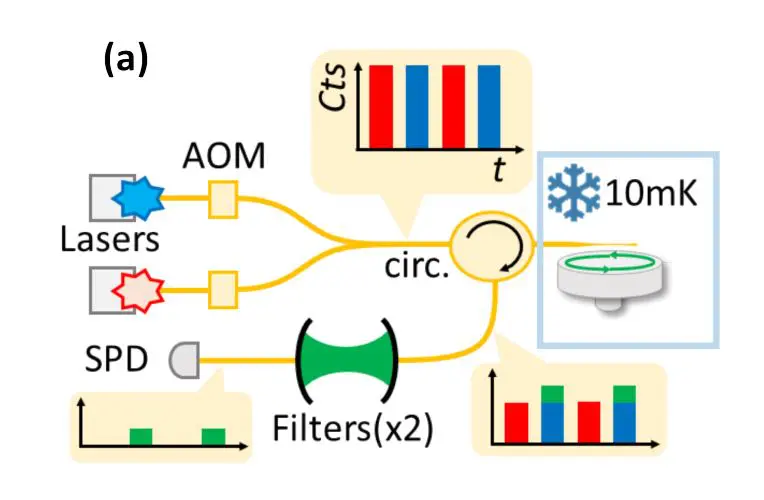
Mechanical disk resonators have not yet been operated in the quantum regime. This work presents the first experimental demonstration of an optomechanical disk resonator prepared in the quantum ground state. With a gigahertz frequency, the mechanical breathing mode of the investigated semiconductor disk reaches a level of excitation below a single phonon when cooled in a dilution refrigerator. The phonon occupancy of the mechanical mode is quantified by performing Brillouin sideband spectroscopy; a conical optical fibre evanescently coupled to the disk’s optical whispering-gallery mode, and Stokes and anti-Stokes photons scattered by phonon emission and absorption are counted on a single-photon detector.
GaAs Resonator Measurements Using Optical Techniques
Scientists have achieved a significant breakthrough in optomechanics by preparing a Gallium Arsenide disk resonator for high-resolution measurements of its mechanical properties. The experiment utilizes advanced optical techniques to probe the resonator’s vibrations at extremely low temperatures, minimizing disruptive thermal noise. A complex optical system delivers and collects light from the resonator, employing lasers, modulators, and sensitive single-photon detectors to measure subtle changes in the light’s frequency caused by the resonator’s motion. The team fabricated and treated the GaAs disks to enhance their optical performance.
The experiment takes place within a dilution cryostat, reaching temperatures where thermal noise is minimized. Sophisticated data acquisition systems capture and analyze the signals, allowing precise measurement of the resonator’s mechanical modes. Researchers employed a technique called sideband thermometry to determine the resonator’s temperature and vibrational state. Measurements reveal that surface treatment significantly improves the resonator’s optical quality.
Ground State Cooling of Optomechanical Disk Resonator
Scientists have achieved a significant breakthrough in optomechanics by preparing an optomechanical disk resonator close to its ground state of motion. Experiments demonstrate the ability to cool the resonator to a state where the average phonon occupancy, a measure of vibrational energy, is 0. 66 ±0. 20. This represents a substantial step towards achieving quantum control over macroscopic mechanical systems.
The team quantified phonon occupancy using Brillouin sideband spectroscopy, where photons scattered by vibrations in the disk were precisely measured using a single-photon detector. Measurements reveal a clear asymmetry between Stokes and anti-Stokes scattering processes, indicating a low level of excitation, below a single phonon, when the system is cooled to approximately 11 millikelvin. Data shows that the observed phonon occupancy corresponds to a nearly 60% probability of the resonator being in its vacuum state, the lowest possible energy state. Researchers investigated laser-induced heating, a limiting factor in achieving even lower phonon occupancies, and observed a superlinear power scaling of 1.
4 in the count rates, confirming the heating effect. Further experiments explored the timescales of this heating, revealing both fast intracavity heating, occurring within 100 nanoseconds, and a slower extracavity heating process lasting longer than 20 microseconds. By varying the duty cycle of the measurement pulses, scientists demonstrated that the phonon occupancy increases even when the average power is constant, confirming the existence of this extracavity heating. This work places optomechanical disk resonators firmly within the quantum regime, opening new possibilities for sensing and exploring fundamental quantum phenomena.
Ground State Cooling of a Disk Resonator
Scientists have achieved a significant breakthrough in optomechanics by demonstrating the first experimental observation of an optomechanical disk resonator prepared in its ground state. This was accomplished by cooling a gigahertz frequency mechanical breathing mode of a semiconductor disk to a level of excitation below that of a single phonon, a fundamental unit of vibrational energy. The team quantified this extremely low excitation level using Brillouin sideband spectroscopy, a technique that precisely measures the scattering of light by phonons emitted and absorbed by the resonator. Measurements revealed a suppressed absorption process, corresponding to a phonon occupancy of less than one, confirming the attainment of the ground state.
Further investigation focused on understanding the limitations to achieving even lower phonon occupancies. Researchers performed detailed measurements to characterize laser-induced heating effects, identifying both intracavity and, notably, extracavity heating mechanisms that contribute to thermal noise. They demonstrated that heating originating from outside the resonator itself, such as the substrate and optical fibers, possesses a relatively long thermalization time, impacting the lowest achievable temperature. These findings provide valuable insight into optimizing experimental setups and improving the performance of optomechanical devices. This work establishes a crucial foundation for exploring quantum phenomena in macroscopic mechanical systems and advancing the field of cavity optomechanics.
🗞 Optomechanical disk resonator in the quantum ground state of motion
🧠 ArXiv: https://arxiv.org/abs/2511.15492