

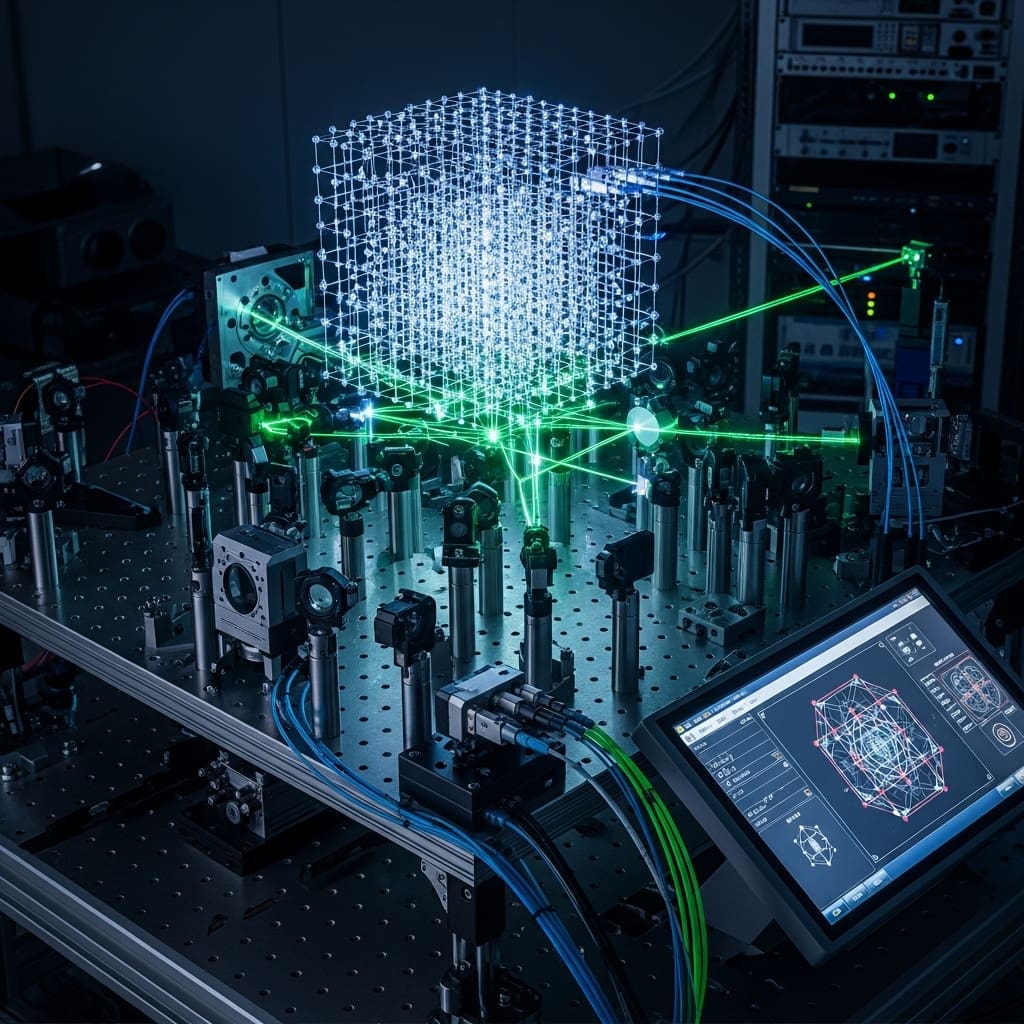
Quantum computing promises to revolutionise computation across numerous fields, and neutral atom processors are rapidly becoming a leading hardware platform in this exciting race. Matteo Grotti, Sara Marzella, Gabriella Bettonte, and colleagues from the University of Bologna, CINECA Quantum Lab, and E4 Computer Engineering demonstrate the growing practical potential of these systems, which leverage the unique properties of Rydberg interactions to achieve scalability and flexibility. Their work surveys the current capabilities and emerging applications of neutral atom computers, highlighting advancements in hardware and circuit optimisation that improve performance. This research showcases how these processors can tackle complex problems in areas ranging from materials science and drug discovery to machine learning, paving the way for a new era of computational possibilities.
Neutral atom quantum processors, leveraging the interactions of Rydberg atoms, are attracting considerable interest due to their potential for scalability, flexible qubit connectivity, and suitability for solving complex optimization challenges. This research surveys the current capabilities, standards, and applications of neutral atom quantum computers, detailing recent hardware advancements and optimization techniques that improve circuit fidelity and performance, and reviewing their use as quantum simulators, both with classical and quantum hardware.
Rydberg Atoms for Quantum Simulation and Computing
This text provides a broad overview of research areas at the intersection of quantum computing, quantum simulation, machine learning, and cold atom physics, specifically focusing on Rydberg atoms. Research centers on utilizing highly excited Rydberg states to create strong interactions and qubits. Quantum simulation is a major application, with researchers exploring how to simulate complex physical systems, such as materials and condensed matter, using Rydberg atom arrays. Quantum annealing and optimization are also key areas, with researchers building coherent quantum annealers for solving optimization problems and exploring algorithms like the Quantum Approximate Optimization Algorithm (QAOA).
Variational Quantum Algorithms (VQAs) are a prominent approach for leveraging near-term quantum devices, and Rydberg atoms are being investigated as a platform for these algorithms. Qubit control and measurement are essential for all quantum computing approaches, with advancements in parallel readout and high-fidelity control of Rydberg qubits. Researchers are also exploring topological quantum computing, specifically the Toric Code, as a potential implementation using Rydberg atoms, and investigating both digital and analog quantum simulation approaches. Machine learning plays an increasing role, with research into Quantum Machine Learning (QML) and the potential for quantum neural networks.
Graph learning techniques, including graph kernels and transformers, are being applied to analyze Rydberg atom array connectivity and interactions. Classical machine learning algorithms, such as random forests, are also being considered for potential quantum enhancements. The core physical principle enabling strong interactions between Rydberg atoms is the Rydberg blockade. Optical lattices and dipole traps are used to trap and arrange these atoms. Key experimental techniques include parallel readout and achieving high-fidelity control over individual qubits. Overall, research trends emphasize hybrid quantum-classical approaches, leveraging the capabilities of near-term quantum devices, and addressing challenges related to scalability, connectivity, error correction, and applying these technologies to materials science and optimization problems.
Neutral Atom Qubit Performance Exceeds Classical Limits
Researchers have demonstrated the remarkable capabilities of neutral atom computers, achieving significant milestones in quantum computation and simulation. Experiments show these systems can effectively prepare highly entangled states, competing with state-of-the-art classical simulations using up to 60 qubits. This proves neutral atom devices are suitable for tackling problems beyond the reach of classical computers with high fidelity. The all-to-all connectivity of Rydberg atom processors demonstrably increases the fidelity of several algorithms, including the Deutsch-Josza, Bernstein-Vazirani, hidden shift, and Quantum Fourier Transform, surpassing the performance of systems with nearest-neighbor connectivity in both fidelity and circuit depth.
A newly devised protocol enables the implementation of arbitrary local rotations and measurements, effectively probing entanglement in physical models like the SSH and XY models. Simulations of the Ising model with transverse field and the Hubbard model, accounting for potential errors, show a practical quantum advantage over current classical methods, with errors on observables upper-bounded by 1%. Significant progress has been made in improving gate fidelity, crucial for complex quantum algorithms. In 2015, a CZ gate achieved 99. 5% fidelity by mitigating Doppler-shifts noise with a sequence of counterpropagating lasers.
Researchers prepared a |W⟩ entangled state with 97% fidelity, extending its lifetime to approximately 36 microseconds through a dynamical decoupling protocol. Analog protocols have reached CCZ gate fidelities of 97. 3% and Bell pair preparations with 98% fidelity, subsequently improved to 99. 5% and 97. 9% for GHZ state preparation.
Recent advancements have achieved Bell’s state corrected fidelities of 99. 85% and gate fidelities exceeding 99. 5% in low-temperature regimes. Quantum Error Correction codes, including the repetition code, Steane code, and surface codes, have been directly applied to neutral atoms platforms. Machine Learning-based algorithms have also been employed to correct noise in quantum simulations, with a Reinforcement Learning protocol successfully adjusting simulated noise pulses. Artificial Neural Networks have been trained to predict noise parameters, showing promise for further refinement. These results highlight neutral atoms as a promising candidate for robust gate implementation with long coherence times.
Optimised Rydberg Atom Register Mapping Achieved
Recent advances demonstrate the growing potential of neutral atom quantum computing as a pathway to enhanced computational capabilities. Researchers have detailed significant progress in both the hardware and optimisation techniques for these systems, which utilise the quantum properties of neutral atoms to perform calculations. By trapping and cooling atoms, typically rubidium or strontium, and arranging them in defined structures, scientists create quantum registers capable of encoding and manipulating information. A key feature of this approach lies in the strong interactions between atoms when excited to Rydberg states, enabling the creation of highly entangled states crucial for quantum computation.
This work highlights improvements in register mapping, which optimises the arrangement of qubits to enhance circuit fidelity and performance. Benchmarks of neutral atom platforms reveal their increasing capabilities in tackling complex problems across diverse fields, including simulating many-body physics, modelling molecules for pharmaceutical research, and enhancing machine learning algorithms. Researchers acknowledge that challenges remain in mitigating noise sources and implementing robust quantum error correction. Future research directions include further refinement of hardware components and the development of more sophisticated error mitigation strategies to unlock the full potential of neutral atom quantum computing.
👉 More information
🗞 Practical Use Cases of Neutral Atoms Quantum Computers
🧠 ArXiv: https://arxiv.org/abs/2510.18732

