Quantum optimization presents a potentially transformative approach to solving complex problems, offering the possibility of dramatically faster solutions than classical methods. Jonas Stein, Maximilian Zorn, and Leo Sünkel, from the Institut für Informatik at LMU Munich, alongside Thomas Gabor et al., investigate the Quantum Approximate Optimization Algorithm (QAOA), a leading technique in this field, and demonstrate its capabilities for tackling industrially relevant challenges. Their work explores how QAOA can be implemented using quantum circuits, efficiently simulating complex models and learning optimal parameters through a technique called the parameter shift rule, as exemplified by a practical application to the Maximum Cut problem. Significantly, the researchers also show how to incorporate constraints into the algorithm, ensuring solutions adhere to specific requirements, and outline a broader framework, the Variational Quantum Eigensolver, that builds upon QAOA’s strengths, paving the way for advancements despite ongoing challenges in quantum computation.
Advanced QAOA Strategy Using Custom Mixers
Advanced Strategies for Quantum Optimization Algorithms
Strategically initializing QAOA with problem-specific information and designing custom mixers can lead to provable convergence and outperform classical Max-Cut algorithms, even with fewer computational steps. The team also explored using QAOA to solve Boolean Satisfiability (SAT) problems, finding evidence suggesting that QAOA can achieve a scaling advantage over classical algorithms for certain intractable cases. Formulating problems using Polynomial Unconstrained Binary Optimization (PUBO) can outperform Quadratic Unconstrained Binary Optimization (QUBO) when using QAOA for continuous optimization tasks.
Researchers investigated problem-inspired ansätze, designed based on the specific structure of the problem, and layered ansätze, utilizing strategic entangling gates and circuit depth, to balance expressibility and trainability. Machine learning techniques, including evolutionary algorithms, reinforcement learning, and neural architecture search, were explored to automate the discovery and optimization of quantum circuit ansätze. Both QAOA and VQE are hybrid algorithms, leveraging the strengths of both classical and quantum computation, and the way a problem is formulated significantly impacts QAOA’s performance. Machine learning techniques hold promise for automating the design of more effective quantum circuits, and robust benchmarking methods are essential for evaluating the performance of quantum optimization algorithms.
Adiabatic Evolution via Suzuki-Trotter Discretization
Discretizing Ideal Adiabatic Quantum Evolution
Dissecting Ideal Evolution for Practical Quantum Simulation
This study pioneers a method for approximating solutions to complex optimization problems by dissecting the ideal, but impractical, adiabatic quantum evolution process. Researchers divided this continuous evolution into a series of discrete steps, approximating the total evolution operator using a product of exponentials and employing the Suzuki-Trotter approximation. By treating the parameters governing the duration of each evolutionary step as adjustable variables, the researchers tailored the time evolution speed to the spectral properties of the Hamiltonian, allocating more evolution time to regions where the energy gap between ground and excited states is small. This adaptive approach minimizes transitions out of the ground state, adhering to the principles of the adiabatic theorem, and allows for potentially better performance with fewer evolutionary layers.
To translate this theoretical framework into a practical algorithm, the study details a quantum circuit implementation. Researchers focused on constructing circuits that realize the time evolution operators for both the “mixer” and “cost” Hamiltonians, central to the QAOA, and leveraging techniques for Hamiltonian simulation. The work demonstrates how complex Hamiltonians can be decomposed into simpler components, expressed as sums of Pauli strings, allowing for efficient simulation on quantum computers. Researchers showed that any Hermitian operator can be represented as a linear combination of these Pauli strings, forming a basis for Hermitian matrices, and enabling the implementation of quantum evolution using quantum gates. The team measured the impact of short time steps on simulation accuracy, utilizing the Suzuki-Trotter decomposition.
Achieving Simulation Accuracy Through Hamiltonian Scaling
Achieving Reliable Results Through Hamiltonian Scaling
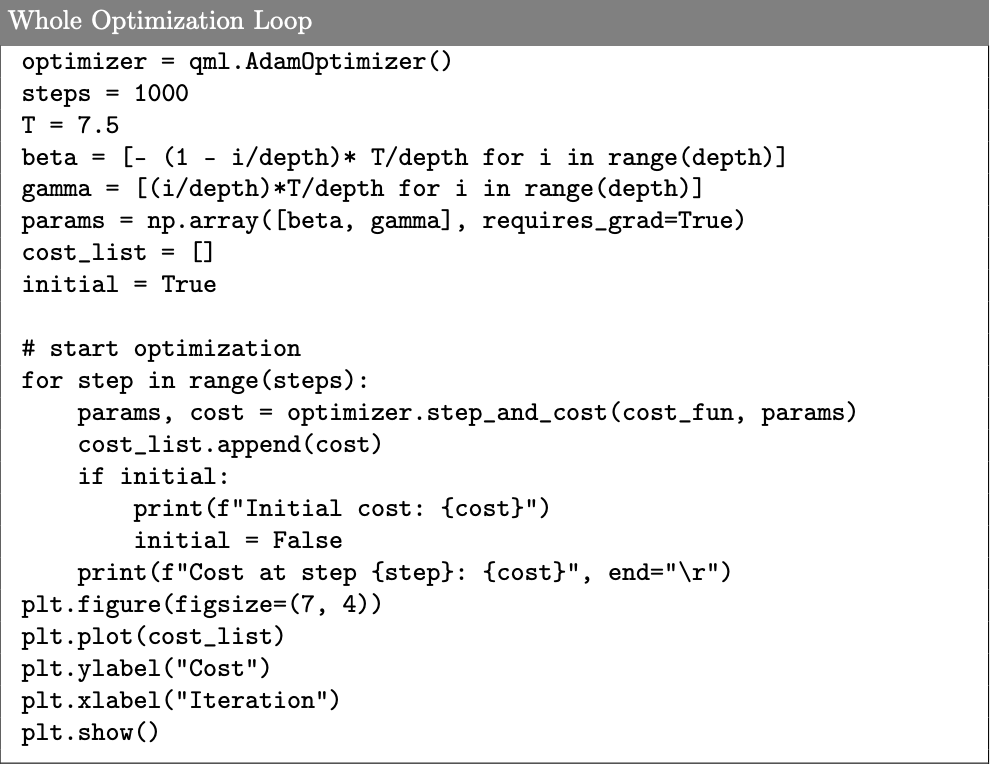
Results demonstrate that this approach becomes increasingly accurate as the time step decreases, allowing for reliable simulation of longer periods. A crucial finding reveals that rescaling the Hamiltonian based on its largest eigenvalue is necessary to ensure accurate results. Further investigations focused on implementing the mixer Hamiltonian using the transverse-field Ising Hamiltonian, simplifying the quantum circuit implementation with single-qubit rotations. The team demonstrates how QAOA can be effectively implemented using Hamiltonian simulation and parameter training via the parameter shift rule, showcasing an implementation for the Maximum Cut problem. Furthermore, the work introduces a method for incorporating constraints into QAOA using Grover mixers, which restrict the search space to only valid solutions, avoiding the need for penalty terms in the cost function. By initializing the quantum state with an equal superposition of valid states and employing a mixer that preserves feasibility, the algorithm efficiently explores the solution space.
Overcoming Hardware Noise and Qubit Limitations
The practical deployment of these algorithms is constrained by the inherent noise and limited qubit connectivity of current Noisy Intermediate-Scale Quantum (NISQ) hardware. Algorithms must therefore be robust enough to operate with high levels of decoherence, necessitating advanced error mitigation techniques such as zero-noise extrapolation or probabilistic error cancellation. These methods, while imperfect, are crucial for extracting meaningful results from near-term quantum processors and distinguishing genuine quantum advantage from mere statistical fluctuation.
Achieving the theoretical promise of exponential speedup requires not only increased qubit counts but also dramatically enhanced coherence times and gate fidelity, moving beyond the current limitations of superconducting or trapped-ion architectures. The resource analysis for many optimization problems suggests that the required circuit depth scales rapidly, necessitating novel quantum compilation strategies that efficiently map logical operations onto physically restricted hardware topologies. Addressing the physical gap between ideal theoretical circuits and real-world device constraints remains a primary engineering hurdle.
Furthermore, the choice between different computational formulations—such as QUBO versus PUBO—introduces complexities in the cost function gradient, impacting the stability of the classical optimization loop that steers the quantum circuit parameters. Optimal problem encoding often requires sophisticated penalty terms to enforce physical or logical constraints rigorously. Proper benchmarking must therefore evaluate not just the speed of convergence, but the resilience of the encoded objective function against numerical instability and the inherent sparsity of the resulting Hamiltonian matrix.