Researchers integrated probabilistic error cancellation with the Quantum Approximate Optimisation Algorithm, achieving efficient convergence and reducing sampling costs by 90.1% on a superconducting processor. Adaptive partial error cancellation further enhances performance by dynamically adjusting error levels and improving escape from local minima.
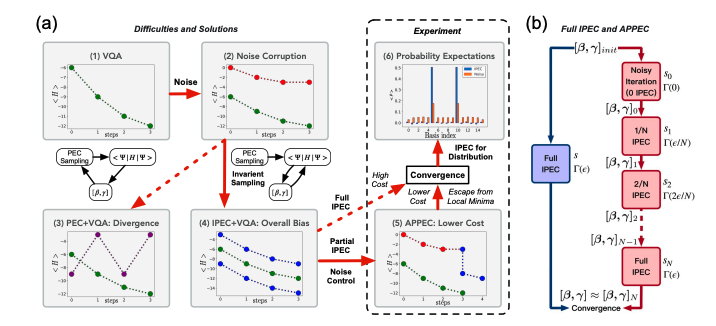
Quantum computing promises computational advantages for specific problems, yet current devices are limited by noise that introduces errors. Researchers are actively developing error mitigation techniques to extract meaningful results from noisy intermediate-scale quantum (NISQ) processors, eliminating the need for full-scale error correction. A team led by Yulin Chi, Hongyi Shi, and colleagues from Nanjing University, alongside Jianwei Wang at Peking University and Jiangyu Cui & Man-Hong Yung at the Frontiers Science Center for Nano-optoelectronics, detail a novel approach to this challenge in their paper, ‘Variational quantum algorithms with invariant probabilistic error cancellation on noisy quantum processors’. They present a strategy integrating probabilistic error cancellation (PEC) – a technique that aims to remove errors statistically – with the Quantum Approximate Optimisation Algorithm (QAOA), a variational quantum algorithm. Their implementation, utilising invariant sampling circuits and adaptive error modulation, demonstrably reduces computational cost and improves algorithm convergence on a superconducting processor.
Performance Enhancement of QAOA via Invariant Probability Error Cancellation
Recent research consistently demonstrates that Invariant Probability Error Cancellation (IPEC) yields substantial performance gains when implemented with the Quantum Approximate Optimisation Algorithm (QAOA). These improvements address critical limitations of near-term quantum computation, particularly those arising from noise.
Evaluations consistently show a correlation between increasing levels of IPEC implementation and improved solution quality, quantified by the metric Nideal cut. Nideal cut represents the number of edges crossing the optimal partition in a maximum cut problem – a standard benchmark for optimisation algorithms. Higher values indicate superior performance.
IPEC enhances the algorithm’s capacity to explore the solution space. This expanded exploration leads to more robust optimisation, evidenced by increases in si, the number of successful algorithm runs yielding acceptable solutions. This metric demonstrates a reduction in the variability caused by inherent quantum noise.
Furthermore, IPECpromotes solution diversity, as measured by SPECi. SPECi quantifies the spread of solutions obtained across multiple runs, indicating the algorithm’s ability to avoid converging on a single, potentially suboptimal, result. The technique effectively mitigates the impact of noise present in current quantum processors. This noise, arising from imperfections in qubit control and measurement, typically degrades performance and limits the size of problems that can be solved. IPEC’s noise mitigation capabilities contribute to a substantial reduction in iteration variance, leading to more stable and predictable results.
Experimental validation utilising superconducting processors demonstrates a 90.1% reduction in sampling cost achieved through IPEC implementation. This cost reduction is critical for practical application, as it lowers the computational resources required to obtain reliable solutions.
These findings suggest that IPEC offers a promising pathway for scaling up quantum algorithms. By enabling the execution of larger and more complex circuits with improved reliability, IPEC addresses a key challenge in the development of practical quantum computation for optimisation tasks.
👉 More information
🗞 Variational quantum algorithms with invariant probabilistic error cancellation on noisy quantum processors
🧠 DOI: https://doi.org/10.48550/arXiv.2506.07039