Quantum key distribution systems, promising secure communication, face growing threats from light-injection attacks, which attempt to compromise the system by injecting unwanted light signals. Min Chen, Hong-Yan Song, and Jia-Lin Chen, along with colleagues at the University of Science and Technology of China and Anhui Asky Quantum Technology CO., LTD, now demonstrate a novel defence against these attacks. Their research introduces an ‘optical fuse’ based on the photorefractive effect within a compact lithium niobate microring resonator, offering a highly sensitive and broadband defence mechanism. This innovative device automatically attenuates quantum signals when attacked, significantly suppressing the potential for secret key rate reduction and bolstering the overall security of quantum communication networks.
On-Chip Defence Against Light Injection Attacks
This research presents a novel approach to defending Quantum Key Distribution (QKD) systems against light injection attacks, a significant threat to secure communication. The team developed an on-chip defense mechanism that leverages the photorefractive effect within thin-film lithium niobate microresonators, effectively acting as an optical switch or attenuator. When illuminated, this material alters its refractive index, dynamically reducing signal strength, and attenuating injected attack signals more strongly than legitimate QKD signals. This compact, efficient, and scalable solution offers effective attack suppression, potential for broadband operation, and a fast response to threats, representing a valuable contribution to quantum communication security.
Photorefractive Microring for QKD Attack Defence
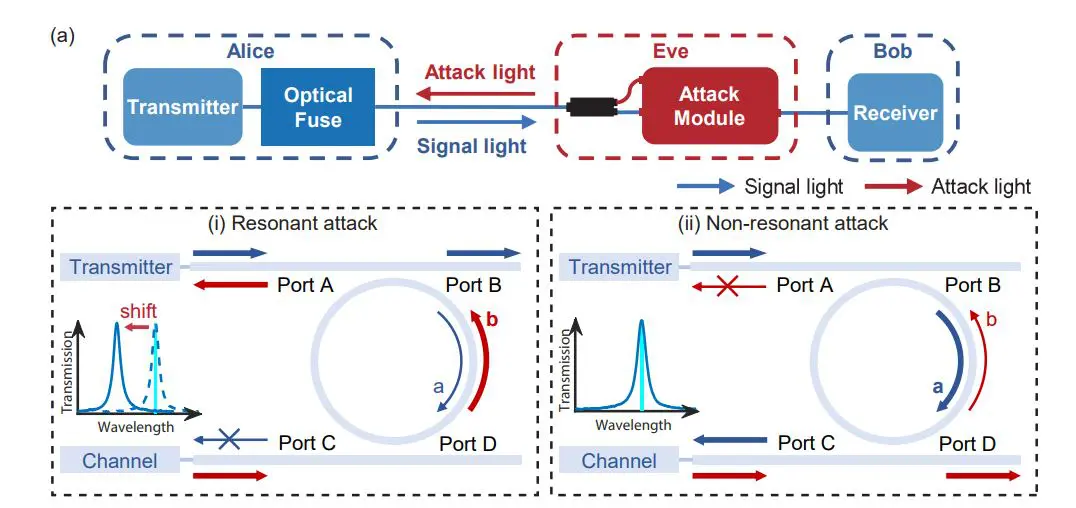
Researchers engineered an integrated attack sensing and automatic response unit for QKD systems, utilizing the photorefractive effect within a thin-film lithium niobate microring resonator. This innovation addresses vulnerabilities to light-injection attacks and overcomes limitations of conventional defenses. The system operates in two modes, providing comprehensive protection against both resonant and non-resonant attacks. Under resonant attack conditions, the unit automatically attenuates quantum signal transmission when attack power exceeds tens of microwatts, hindering information theft. For non-resonant attacks, it functions as a high-performance filter, rejecting the attack light before it reaches the transmitter. Experimental validation within a commercial QKD system demonstrated its ability to autonomously sense attacks and defend against broadband light-injection threats.
Broadband Attack Rejection in Quantum Key Distribution
This work presents an integrated attack sensing and automatic response unit designed to enhance the security of QKD systems against light-injection attacks. Utilizing the photorefractive effect within a thin-film lithium niobate microring resonator, the unit provides a highly sensitive and broadband defense mechanism. Experiments demonstrate a high rejection ratio against non-resonant injected light, effectively blocking eavesdropping attempts while maintaining stable signal transmission, and significant attenuation of signal transmission under resonant attack at an attack power of 5 dBm. Further testing within a commercial QKD system, operating over a 30km distance, revealed a stable key rate and a low error rate, even with measurable attenuation at low attack power.
Photonic Resonator Secures Quantum Key Distribution
This research demonstrates a new approach to securing QKD systems against light-injection attacks, employing the photorefractive effect within a thin-film lithium niobate microring resonator. The team successfully designed and experimentally validated an integrated unit capable of autonomously attenuating quantum signal transmission when exposed to resonant attack light exceeding tens of microwatts, effectively suppressing the secret key rate. Importantly, the unit also exhibits a high rejection ratio against non-resonant attacks, providing a robust defense across a broader range of threats, and achieves a microwatt-level response threshold, four orders of magnitude lower than existing integrated optical limiters. Experimental validation within a commercial high-speed QKD system confirms its compatibility with current technology and suggests potential benefits for advanced implementations.
🗞 Optical fuse based on the photorefractive effect for defending the light-injection attacks of quantum key distribution
🧠 ArXiv: https://arxiv.org/abs/2512.10205