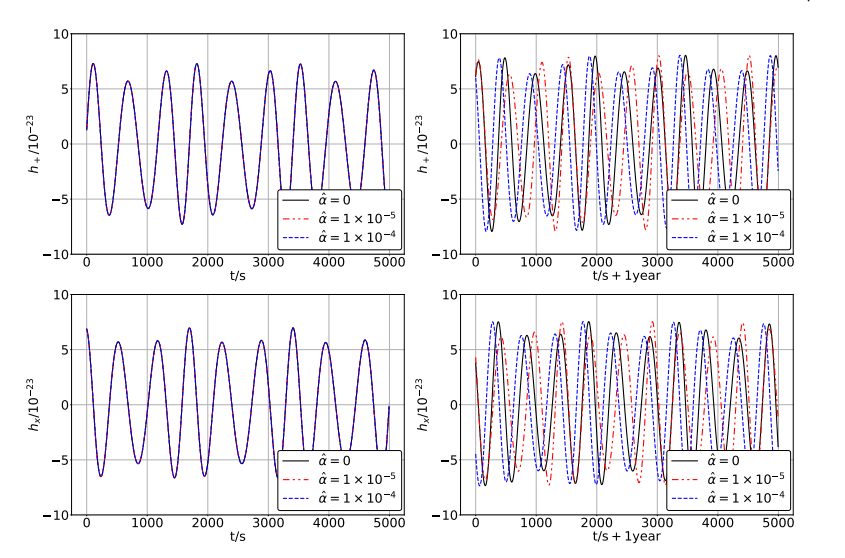
The subtle deviations from classical predictions in the behaviour of black holes remain a key area of investigation for physicists, and new research from Sen Yang, Yu-Peng Zhang, and Li Zhao, with Yu-Xiao Liu, all at Lanzhou University, demonstrates a pathway to testing these predictions with unprecedented accuracy. The team explores how extreme mass-ratio inspirals, where a small object spirals into a supermassive black hole, can reveal the presence of corrections to standard black hole theory, specifically within the framework of loop quantum gravity. Their analysis shows that the orbital evolution of these inspirals is affected by these corrections, leading to measurable changes in the emitted gravitational waves, and importantly, that even small deviations produce distinguishable effects in the signals. This work suggests that future space-based detectors, such as the Laser Interferometer Space Antenna (LISA), possess the sensitivity to probe these strong-field gravitational effects and establish constraints far exceeding those currently available from observations of black hole shadows.
By analysing the gravitational waves emitted during the inspiral phase, the team aims to place observational limits on the quantum properties of these black holes, such as their minimum radius and the strength of quantum deformations. The approach involves constructing accurate waveform templates that incorporate quantum corrections to standard general relativistic waveforms, and comparing these templates to signals detectable by current and future gravitational wave observatories. The team develops a theoretical framework for modelling how quantum effects alter the spacetime geometry around the black hole, utilising a modified metric that accounts for quantum behaviour near the event horizon.
The analysis considers eccentric orbits, which are more common in astrophysical scenarios than circular orbits, requiring a more complex treatment of the orbital dynamics and waveform generation. The research demonstrates that gravitational wave observations, particularly from detectors like the Laser Interferometer Gravitational-Wave Observatory and the Einstein Telescope, have the potential to constrain the quantum deformation parameter to values significantly smaller than the classical Schwarzschild radius. The Einstein Telescope, with its enhanced sensitivity and broader frequency range, will be crucial for probing the quantum nature of black holes and potentially detecting deviations from the predictions of classical general relativity. This research provides a theoretical foundation for future observational studies and opens up new avenues for exploring the interplay between quantum mechanics and gravity in the strong-field regime.
LISA Detects Extreme Mass Ratio Inspirals
This is a comprehensive overview of research related to gravitational waves, particularly those from Extreme Mass Ratio Inspirals, and their potential use in testing general relativity and probing the nature of black holes. Accurate waveform models are crucial for detecting and characterizing these signals, and estimating the expected number of detectable EMRI events is vital for mission planning. A newer area of research focuses on wet EMRIs, where the compact object is still surrounded by an accretion disk, potentially offering additional information. The research investigates how EMRIs can be used to test general relativity in the strong-field regime and map the spacetime around black holes, including measuring their mass and spin.
A significant focus is on searching for deviations from the Kerr metric and exploring alternative theories of gravity. The research also explores theoretical frameworks and techniques, including methods for generating accurate gravitational waveforms, such as numerical relativity and post-Newtonian approximations. The use of multipole expansions to describe the gravitational field of black holes is also highlighted. Finally, the research considers the astrophysical context and related phenomena, emphasizing the importance of understanding the dynamics of stars and compact objects in galactic centres, and the role of accretion disks around supermassive black holes. The goal is to use gravitational waves from EMRIs to unlock the secrets of black holes, test the limits of general relativity, and potentially discover new physics beyond our current understanding.
Quantum Corrections Detectable in Black Hole Inspirals
This research demonstrates that subtle deviations from classical black hole predictions, stemming from quantum corrections to the Oppenheimer-Snyder model, can be detected through the observation of extreme mass-ratio inspirals. By modelling the orbital evolution of these systems and generating the corresponding gravitational waveforms, scientists have shown that even small quantum correction parameters measurably alter the inspiral’s dynamics. The team employed a numerical method to simulate the orbital decay caused by gravitational radiation, accurately predicting how these corrections would manifest in detectable signals. The analysis reveals that future space-based detectors, such as LISA, possess the sensitivity to probe these quantum effects in the strong-field regime, potentially placing constraints on the quantum correction parameter significantly tighter than those currently derived from observations of black hole shadows or gravitational lensing.
🗞 Constraints on quantum Oppenheimer-Snyder black holes with eccentric extreme mass-ratio inspirals
🧠 ArXiv: https://arxiv.org/abs/2509.24835