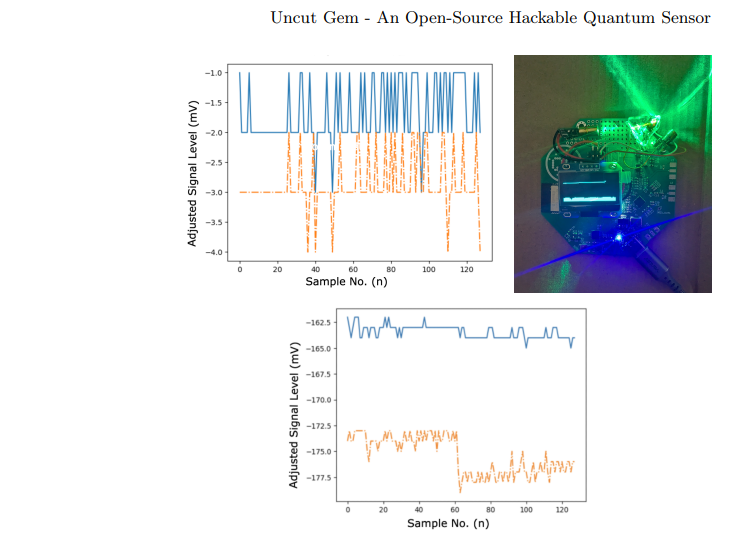
Quantum sensing stands to revolutionise fields from medical imaging to materials science, but access to this technology remains limited by cost and complexity. Mark Carney and Victoria Kumaran, from Quantum Village Inc. in Delaware, USA and London, UK, are changing this with a fully open-source, hackable quantum sensor platform. Their design utilises readily available components and open-source firmware, creating a modular and cost-effective system that dramatically lowers the barriers to entry for researchers, educators, and innovators. This achievement empowers a wider community to explore and advance quantum technologies, fostering both education and groundbreaking discoveries through a truly open and collaborative approach.
Open-Source Diamond Sensor for Magnetometry
This research details the development of Uncut Gem, a fully open-source quantum sensor utilizing nitrogen-vacancy (NV) centers in diamond for magnetometry. The project aims to democratize access to quantum sensing technology by providing a hackable and customizable platform. The sensor leverages the unique quantum properties of NV centers, defects within the diamond lattice, to detect magnetic fields with high sensitivity. By making both the hardware design and software openly available, the team encourages community contribution and rapid innovation in this emerging field. Key features include a modular, 3D-printed setup, readily available components, and open-source software for complete control and customization. This sensor holds potential for diverse applications, including precise magnetic field sensing, biomedical imaging, navigation, materials science, and educational research.
Open-Source Diamond Sensor Platform for Magnetometry
The research team engineered a fully open-source sensor platform centered around nitrogen-vacancy (NV) center diamond magnetometry, dramatically lowering the barriers to entry for quantum sensing technologies. Recognizing the high costs of existing setups, they meticulously designed a system utilizing readily available, consumer components and open-source firmware developed within the Arduino environment. This approach reduces costs, ensures portability, and fosters a community-driven development ethos. The sensor relies on diamonds containing NV centers, defects that exhibit unique quantum properties sensitive to magnetic fields.
Scientists characterized the energy levels within these defects, demonstrating a resonant frequency directly proportional to the applied magnetic field. They excite these NV centers with green light and apply microwaves, allowing for precise magnetic field measurements. The team prioritized software control through careful hardware design, simplifying the system and maximizing reconfigurability.
NV Diamond Magnetometry, Open Source Platform Demonstrated
This work details a fully open-source sensor platform utilizing nitrogen-vacancy (NV) center diamond magnetometry, designed to broaden access to this technology through a cost-effective and customizable system. The sensor relies on diamonds exhibiting a strong response to light, with unique energy level splits sensitive to magnetic fields. Researchers precisely characterized these energy levels, confirming that the primary influence on their splitting is the strength and orientation of the applied magnetic field. To achieve high sensitivity, the team excites the NV centers with green light and applies microwaves, sweeping across a specific frequency range to detect changes in the resonant frequency. The electronic design incorporates a photodiode and amplifier to detect the light emitted by the NV centers, and an ESP32 microcontroller to control the experiment and process the data.
Open-Source Quantum Sensor Platform Demonstrated
This work demonstrates a fully open-source, hackable quantum sensor platform based on nitrogen-vacancy (NV) center diamond magnetometry, significantly lowering the barriers to entry for researchers and educators. The completed system, released with fully accessible schematics, parts lists, software, and build instructions, costs approximately £115, with a single-board variant available for under $100. The authors acknowledge the need for further characterization across multiple diamond samples to refine performance metrics. Future development will focus on incorporating machine learning techniques to improve data analysis and exploring potential applications in medical technology, industrial sensing, and low-cost positioning systems, with investigations into adapting the design for space-based applications also planned.
🗞 Uncut Gem – An Open-Source Hackable Quantum Sensor
🧠 ArXiv: https://arxiv.org/abs/2509.18329