The Quantum NonDemolition Measurement (QNDM) approach is a new method for efficiently estimating the gradients or Hessians of a quantum observable, a key step in minimizing the cost function associated with a quantum observable. The QNDM approach requires fewer resources than the current Direct Measurements (DM) approach, making it more efficient, especially in small dimensional systems. This method could make the implementation of Variational Quantum Algorithms on near-term quantum computers more feasible, potentially accelerating the application of quantum computing to complex optimization problems. The QNDM approach was validated through a detailed numerical study and full computational simulations.
What is the Quantum NonDemolition Measurement Approach?
The Quantum NonDemolition Measurement (QNDM) approach is a novel method for efficiently estimating the gradients or Hessians of a quantum observable. This is a crucial step in minimizing the cost function associated with a quantum observable. The QNDM approach is an alternative to the current state-of-the-art method and is found to be more efficient, requiring fewer resources in evaluating the derivatives of a cost function. This efficiency is evident in small dimensional systems and is likely to increase for practical implementations and more realistic situations.
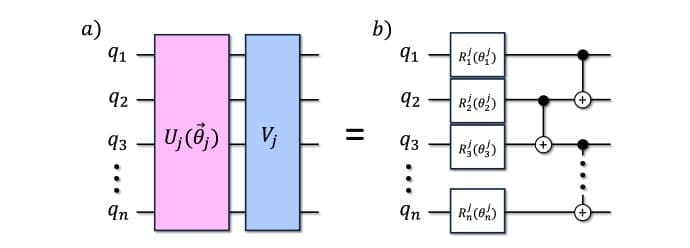
The QNDM approach involves extracting information about the derivative with a single measurement of a quantum observable. This is achieved by coupling a quantum detector to the original quantum system, storing the information about the value of the derivative of the cost function in the phase of the detector. The phase is then measured to extract this information.
The QNDM approach is a valuable alternative for implementing Variational Quantum Algorithms on near-term quantum computers. It has significant implications in quantum optimization algorithms, given that the majority of Variational Quantum Algorithms can be formulated within this framework.
How Does the QNDM Approach Compare to the Direct Measurements Approach?
The Direct Measurements (DM) approach is the most straightforward and commonly used method to obtain the gradient of the cost function. It involves running a quantum circuit and measuring a quantum observable at a certain point in the parameter space. The procedure is then repeated, changing the circuit parameters slightly along each direction separately. For every point in the parameter space, the DM approach requires two observable measurements to determine each component of the gradient.
In contrast, the QNDM approach extracts information about the derivative with a single measurement of a quantum observable. A detailed comparison between the two methods reveals that the QNDM approach has a substantial advantage over the DM approach, even for cases with limited complexity. The resource-saving will increase for more practical and interesting problems of intermediate dimension.
What are the Implications of the QNDM Approach for Quantum Computing?
Quantum computers are likely to have a significant impact on complex optimization problems such as drug molecular and material design in the midterm timescale. These problems share a common structure: given a cost function that represents a physical quantity of interest, the goal is to find its minimum. The scheme to approach these problems in a quantum computer is a hybrid quantum-classical one, where Variational Quantum Algorithms (VQA) can be naturally implemented.
The QNDM approach offers a more efficient way to calculate the gradient of the cost function, a key step in this process. By reducing the resources needed to evaluate the derivatives of a cost function, the QNDM approach makes the implementation of Variational Quantum Algorithms on near-term quantum computers more feasible. This could accelerate the application of quantum computing to complex optimization problems, potentially leading to breakthroughs in fields such as drug molecular and material design.
How was the QNDM Approach Tested and Validated?
The QNDM approach was validated through a detailed numerical study, which accounted for all the resources needed to implement the QNDM approach with a fixed accuracy. The study compared these resources to those required by the current state-of-the-art method. The theoretical analysis was followed by full computational simulations, comparing the total resources needed in the two approaches to estimate the derivative of the cost function directly from their implementations.
The results showed that the QNDM approach has a substantial advantage over the DM approach, even for cases with limited complexity. The resource-saving will increase for more practical and interesting problems of intermediate dimension. The codes to calculate derivatives with QNDM used within this study are accessible via GitHub.
What is the Future of the QNDM Approach?
The QNDM approach has significant implications for quantum optimization algorithms and the implementation of Variational Quantum Algorithms on near-term quantum computers. Given its efficiency and resource-saving advantages over the DM approach, the QNDM approach is likely to become a valuable tool in the field of quantum computing.
As quantum computing continues to evolve and tackle more complex optimization problems, the QNDM approach’s benefits will likely become even more pronounced. Future research will likely focus on further refining the QNDM approach and exploring its potential applications in various fields.
Publication details: “A Novel Approach to Reduce Derivative Costs in Variational Quantum
Algorithms”
Publication Date: 2024-04-02
Authors: G. Minuto, Simone Caletti and Paolo Solinas
Source: arXiv (Cornell University)
DOI: https://doi.org/10.48550/arxiv.2404.02245