

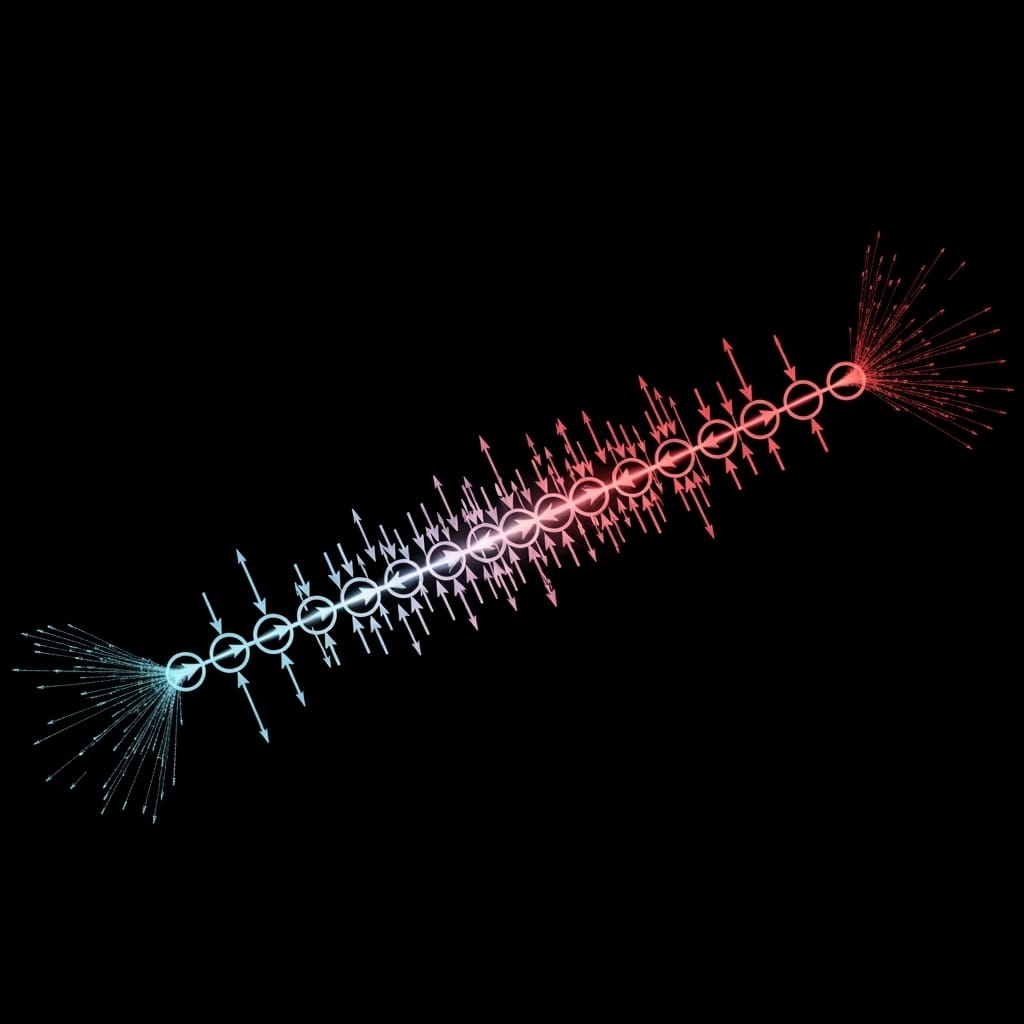
Open quantum spin chains represent a fascinating area of research in condensed matter physics, and understanding their behaviour when subjected to non-reciprocal dissipation is a significant challenge. Alice Marché, Hironobu Yoshida, and Alberto Nardin, alongside Hosho Katsura and Leonardo Mazza from Université Paris-Saclay and The University of Tokyo, have now developed a theoretical framework to address this problem. Their work utilises the time-dependent generalized Gibbs ensemble to characterise these open systems, offering a novel approach to understanding how energy flows within them. By deriving equations governing the evolution of the system’s properties, the researchers demonstrate a method for calculating both magnetization and current dynamics, moving beyond previous limitations based on simpler models. This advancement promises to unlock a deeper understanding of non-reciprocal quantum systems and their potential applications.
In the regime of weak dissipation the system is fully characterised by its rapidity distribution, and we derive a closed set of coupled differential equations governing their time evolution. This theoretical framework allows for an analytical understanding of the dynamics under these specific conditions, offering insights beyond those obtainable from purely numerical methods. We validate the accuracy of this theory by benchmarking the results against numerical simulations, demonstrating a strong correspondence between analytical predictions and computational findings. Using this framework, we investigate the impact of non-reciprocal dissipation on the steady state properties and transient dynamics of the quantum spin chain.
Non-Reciprocal Quantum Systems and Open Dynamics This research
This is a bibliography for a research paper or review article on non-reciprocal systems, open quantum systems, and related topics like the Generalized Gibbs Ensemble (GGE) and quench dynamics. The references cover themes including non-reciprocal systems, where interactions are not symmetric in time or space, and open quantum systems, which interact with an environment leading to dissipation and decoherence. They also explore the GGE, a theoretical framework for describing the steady state of isolated, interacting quantum systems after a quench, alongside quench dynamics and the effects of dissipation on quantum dynamics and the emergence of new phases. Specific topics covered include lossy quantum gases, integrable models, time-dependent GGE, phase transitions in dissipative systems, and non-Hermitian physics. References also delve into topological amplification, quantum criticality, reaction-diffusion dynamics, digital quantum computers, and Hilbert transforms. This bibliography represents a comprehensive overview of current research in the field of non-equilibrium quantum physics, with a particular emphasis on the role of non-reciprocity and dissipation.
Non-Reciprocal Dissipation Defines Spin Chain Dynamics Scientists have
Scientists have developed a theoretical approach using a time-dependent generalized Gibbs ensemble to study open quantum spin chains exhibiting non-reciprocal dissipation. The research focuses on systems where interactions are not symmetrical, and explores how these systems evolve when energy is lost to the environment. Experiments revealed that in the regime of weak dissipation, the system’s behaviour is fully defined by its rapidity distribution, allowing the team to derive a set of coupled differential equations that describe how this distribution changes over time. The study builds upon previous work that identified anomalous power-law exponents governing the decay of certain properties in these systems, and seeks to provide a more complete theoretical understanding of this behaviour.
Researchers benchmarked the accuracy of their t-GGE approach against numerical simulations, confirming its ability to predict the system’s evolution with high fidelity. This detailed analysis addresses previously observed inconsistencies in power-law exponents, offering a more robust explanation for the observed decay rates. Measurements confirm the team’s approach can describe the physics of non-reciprocal open quantum spin chains beyond simpler models based on non-interacting fermions. The work demonstrates the ability to accurately model complex quantum systems with asymmetric interactions and energy dissipation, delivering a theoretical tool capable of predicting the time evolution of quantum states in these systems.
Non-Reciprocal Dissipation and Magnetization Dynamics Explained Open spin
This work presents a theoretical description of open spin chains with non-reciprocal dissipation, employing a time-dependent generalized Gibbs ensemble approach. Researchers derived a set of coupled differential equations that accurately characterise the system’s evolution in the weak dissipation regime, validated through comparison with numerical simulations. This framework allows for the computation of magnetization density and current dynamics, revealing relationships between these two quantities. The study addresses previously identified anomalous power-law exponents, offering a theoretical foundation beyond analyses limited to non-interacting fermions. By modelling non-reciprocal interactions through dissipation, the authors demonstrate an alternative route to understanding these quantum systems. Future research could explore the behaviour of the system under stronger dissipation, and extend the model to investigate more complex spin chain configurations or alternative dissipation mechanisms.
👉 More information
🗞 Open quantum spin chains with non-reciprocity: a theoretical approach based on the time-dependent generalized Gibbs ensemble
🧠 ArXiv: https://arxiv.org/abs/2601.08606


