

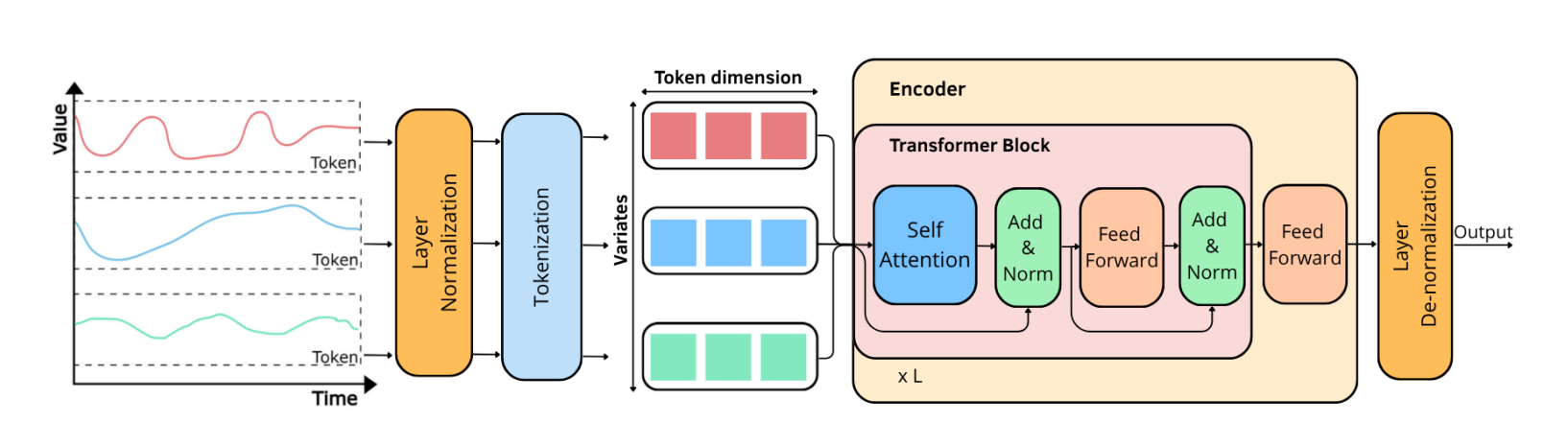
Multivariate time-series forecasting, the prediction of future values based on multiple interconnected variables, presents a significant challenge for many fields, from finance to environmental monitoring. Sandra Ranilla-Cortina, Diego A. Aranda, and Jorge Ballesteros, alongside Jesus Bonilla, Nerea Monrio, and Elías F. Combarro, have developed new quantum neural network architectures to address this problem. Their work extends existing quantum circuit models, previously limited to single variables, to handle complex relationships between multiple time-series. The team introduces the iQTransformer, a novel architecture incorporating self-attention mechanisms, which allows for a more natural representation of these interdependencies, and demonstrates that these quantum-enhanced models achieve competitive or superior forecasting accuracy with fewer parameters and faster training than current classical methods on both synthetic and real-world data. This research highlights the potential of quantum computing to provide efficient and scalable solutions for increasingly complex forecasting tasks.
Quantum Forecasting of Multivariate Time Series
This research investigates the use of quantum machine learning for predicting future values of multiple, interacting time series, a task known as multivariate time-series forecasting. Scientists aimed to move beyond traditional quantum machine learning applications and explore how quantum models can handle the complexities of real-world scenarios. The team compared several quantum architectures against standard classical methods, with a focus on a novel hybrid model called the iQTransformer. The core of the quantum models lies in variational quantum circuits, quantum programs with adjustable parameters optimized to perform specific tasks.
Forecasting multiple variables simultaneously presents a greater challenge than predicting a single variable due to the potential for complex interactions between them. The iQTransformer combines a powerful deep learning architecture, the Transformer, with a quantum self-attention neural network, a quantum circuit designed to enhance the model’s ability to capture these relationships. Researchers explored several quantum architectures, including designs that process each time series independently, those that create compact representations of the input data, and encoder-decoder formulations. They also investigated techniques like data re-uploading to improve the expressiveness of the quantum circuits and quantum recurrent neural networks designed to handle sequential data.
These models were benchmarked against classical deep learning models, including one-dimensional convolutional neural networks and standard Transformers. Experiments using both a synthetic chaotic system and real-world data from the ITER fusion project demonstrated that the iQTransformer consistently outperformed all other models. The iQTransformer achieved the best results across both datasets, demonstrating faster convergence during training and requiring fewer adjustable parameters. It also maintained better performance over longer prediction horizons compared to classical convolutional neural networks.
The findings suggest that quantum machine learning, and specifically the iQTransformer, holds significant promise for improving multivariate time-series forecasting. This work highlights the potential benefits of hybrid quantum-classical approaches, where quantum circuits enhance specific aspects of classical models. This could lead to valuable tools for applications including financial forecasting, weather prediction, industrial process control, and fusion energy research.
Quantum Forecasting Outperforms Classical Models
Scientists have achieved a breakthrough in multivariate time-series forecasting by adapting variational quantum circuit models for use with multiple interdependent variables. Researchers extended and benchmarked several quantum and hybrid architectures to systematically evaluate their ability to model cross-variable dependencies, paving the way for more accurate predictions in complex systems. Experiments demonstrate that these quantum-based models can achieve performance comparable to, and in some cases exceeding, state-of-the-art classical baselines while requiring fewer training steps. The team introduced the iQTransformer, a hybrid architecture integrating a quantum self-attention mechanism within the iTransformer framework, providing a quantum-native approach to capture inter-variable dependencies.
This design combines the inverted tokenization strategy of the iTransformer with quantum self-attention, overcoming a key limitation of prior quantum machine learning approaches. Comprehensive empirical evaluation was performed on both a synthetic three-channel dataset and a real-world seven-channel operational energy dataset, providing robust validation of the new models. Results show that quantum-based models may achieve performance comparable to or exceeding that of classical baselines, while requiring fewer training steps, demonstrating a significant step towards practical quantum forecasting. The iQTransformer, in particular, showcases the potential of quantum-enhanced architectures as a promising direction to advance efficient and scalable forecasting in complex multivariate scenarios. Scientists successfully extended variational quantum circuit models, traditionally applied to single variables, to handle multiple, interconnected time series. The team benchmarked several quantum approaches, including independent and dense channel designs, alongside classical models like convolutional neural networks and a transformer architecture. Building upon these foundations, researchers introduced the iQTransformer, a hybrid quantum-classical model integrating a quantum self-attention mechanism within a transformer framework.
Evaluations on both synthetic and real-world datasets, including data from the ITER fusion project, demonstrate that the iQTransformer achieves forecasting accuracy comparable to, and in some cases exceeding, established classical methods. Importantly, the iQTransformer accomplishes this with fewer adjustable parameters and faster convergence, suggesting potential efficiency gains. The findings highlight the promise of quantum-enhanced models for practical forecasting scenarios, offering a balance between capturing complex correlations and maintaining scalability. This work represents a promising step towards scalable and interpretable multivariate forecasting with quantum-enhanced models.
🗞 Quantum Neural Network Architectures for Multivariate Time-Series Forecasting
🧠 ArXiv: https://arxiv.org/abs/2510.21168


