

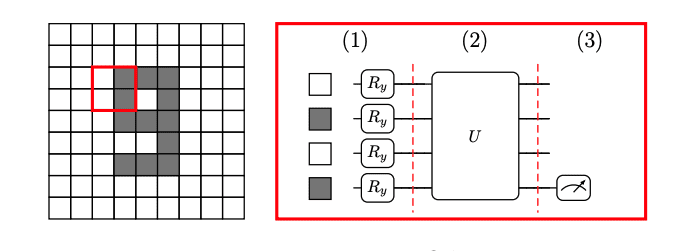
Researchers from the University of Bonn, Bayer AG, and Forschungszentrum Jülich have developed an innovative approach to implementing Quantum Convolutional Neural Networks (QCNNs) that overcomes current hardware limitations. Their work demonstrates that properly designed QCNNs can outperform classical Convolutional Neural Networks (CNNs) in image classification tasks, even on today’s noisy intermediate-scale quantum (NISQ) devices.
The team tackled one of the main challenges in quantum machine learning: efficiently encoding high-dimensional data onto quantum systems with limited qubits. They introduced a novel “fragment encoding” scheme that significantly reduces input dimensionality, enabling a QCNN with just 49 qubits to directly process 28×28 pixel MNIST images without requiring classical pre-processing or dimensionality reduction techniques. This represents a major advancement for quantum image processing, as previous approaches required prohibitive qubit counts or extensive classical pre-processing.
The researchers also developed an automated framework based on Bayesian optimization to identify optimal parameterized quantum circuits (PQCs) for QCNNs. These optimized circuits were evaluated based on expressibility (ability to explore solution space), entanglement (incorporation of encoded information), and complexity (resource requirements). Their systematic approach consistently discovered circuits that outperformed those from previous research.
Two distinct QCNN architectures were investigated: a hybrid QCNN that performs measurements after each kernel application (reducing qubit requirements but sacrificing global entanglement effects), and a fully quantum mechanical QCNN utilizing fragment encoding. Comparative experiments across various classification tasks showed that the fully quantum approach consistently outperformed both hybrid QCNNs and classical CNNs, particularly in binary classification tasks.
Most importantly, the researchers validated their approach on IBM’s Heron r2 quantum processor with 156 qubits, achieving 96.08% classification accuracy for distinguishing digits 0 and 1, compared to 71.74% for an optimized classical CNN under identical training conditions. The quantum model demonstrated faster convergence and lower test loss despite operating with compressed input. This represents one of the first successful implementations of image classification on real quantum hardware that outperforms classical counterparts.
These results are particularly significant because they were achieved despite minimal optimization of the QCNN architecture and with substantial hardware constraints. The clear pattern of improvement with increased qubit count suggests even greater potential advantages as quantum hardware advances. The research demonstrates that quantum advantages in machine learning may be attainable even on current NISQ devices, opening new possibilities for quantum-enhanced image classification and other machine learning applications.
👉 More information
🗞 Efficient Quantum Convolutional Neural Networks for Image Classification: Overcoming Hardware Constraints
🧠 DOI: https://doi.org/10.48550/arXiv.2505.05957


