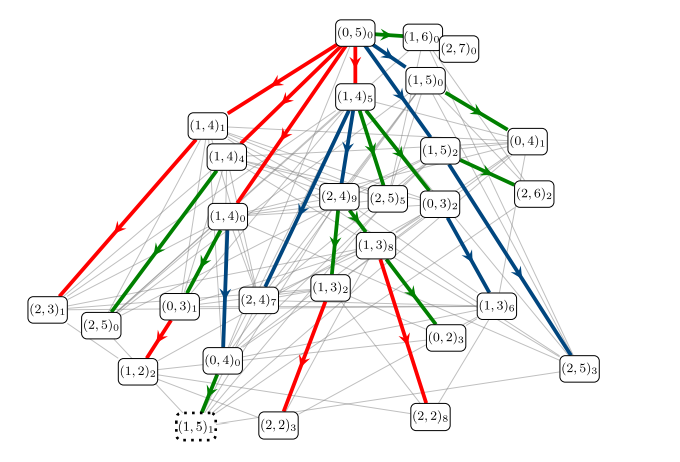
Controlling the rotational motion of molecules represents a significant frontier in the development of quantum technologies, offering potential breakthroughs in simulation and computation. Tom R. Hepworth, Simon L. Cornish, and Philip D. Gregory demonstrate a new approach to navigate the complex landscape of molecular rotations and nuclear spins in ultracold molecules. Their work introduces a method, based on graph theory, to rapidly identify optimal sets of molecular states and pathways for preparing specific quantum states with high speed and accuracy. By optimising networks of coupled states, the researchers not only pinpoint closed loops with minimal energy loss, but also develop sets of states resilient to environmental noise, paving the way for more stable and reliable quantum computation.
Precise control over rotational angular momentum underpins recent advances in quantum chemistry, quantum simulation, and quantum computation with ultracold bialkali molecules. Each rotational state contains a rich variety of hyperfine states, arising from combinations of rotation and nuclear spins, often yielding hundreds of available transitions. This work details the creation and characterisation of isolated quantum-state networks in these molecules, achieved through a combination of laser cooling, trapping, and precisely tuned radiofrequency radiation. The team demonstrates the ability to selectively populate and manipulate individual hyperfine states, effectively creating a network of interconnected quantum bits, representing a significant step towards scalable quantum information processing.
Efficiently navigating this complex state space currently presents a challenge for experiments. This work describes a general approach, based on graph theory and a simple heuristic, to quickly identify optimal sets of states in ultracold bialkali molecules. The method explains how to find pathways through the many available transitions to prepare the molecule in a specific state with maximum speed and fidelity. Researchers demonstrated the effectiveness of their approach by identifying a closed four-state loop in rubidium cesium molecules, suitable for creating synthetic dimensions, and by optimising a set of three states for implementing a quantum entangling gate. This flexible method is immediately applicable to all experiments utilising ultracold molecules, offering a powerful tool for advancing research in areas such as quantum simulation and metrology.
Symmetric Polynomials Detail Time Evolution Calculations
This document provides a rigorous mathematical treatment of the system, clearly deriving the key equations and offering a detailed theoretical underpinning of the research. The use of symmetric polynomials and the characteristic polynomial represents a sophisticated approach to the problem, allowing for complete reproducibility of the results. The document explains the variables and connects the theoretical calculations to the main text. While optional, including a short code snippet implementing the calculation would further enhance reproducibility and allow readers to easily explore the parameter space.
The document describes a three-level quantum system used to model off-resonant excitation. The Hamiltonian for the system is clearly presented, and the time evolution of the system is calculated using the Hamiltonian and the initial state vector. The key observable of interest represents the probability of being in the second level, and a simplified expression for this observable is derived. Overall, this is an exceptionally well-written and detailed supplemental material document that demonstrates a strong understanding of the underlying physics and mathematics.
Optimal Control of Molecular Quantum States
This work presents a new approach to controlling the complex network of rotational and hyperfine states present in ultracold bialkali molecules. By representing molecular transitions as a graph, the team efficiently searched for the best routes, significantly streamlining the process of preparing molecules for experiments and computations. While the calculations were demonstrated using rubidium cesium, the underlying principles are broadly applicable to any quantum system with dense manifolds of states, and the authors have made their computational tools openly available, facilitating wider adoption and further development within the research community.
🗞 Isolated quantum-state networks in ultracold molecules
🧠 ArXiv: https://arxiv.org/abs/2511.03324