Quantum networks promise revolutionary advances in communication and computation, but realising scalable, multiuser connectivity demands systems that integrate diverse quantum technologies. Hayden Miller from Brown University, Caitao Zhan, Michael Bishof, and colleagues at Argonne National Laboratory, along with Prem Kumar from Northwestern University and Han Xu, now present a powerful simulation framework that accurately models these complex, heterogeneous networks. Their work overcomes the practical challenges of building and testing such systems by providing a virtual environment for exploring network designs and optimising performance. Through extensive simulations, the team identifies key bottlenecks unique to heterogeneous quantum networks and maps the trade-off between data rate and fidelity, paving the way for more efficient and robust quantum communication infrastructure.
Heterogeneous Quantum Networks and Entanglement Distribution
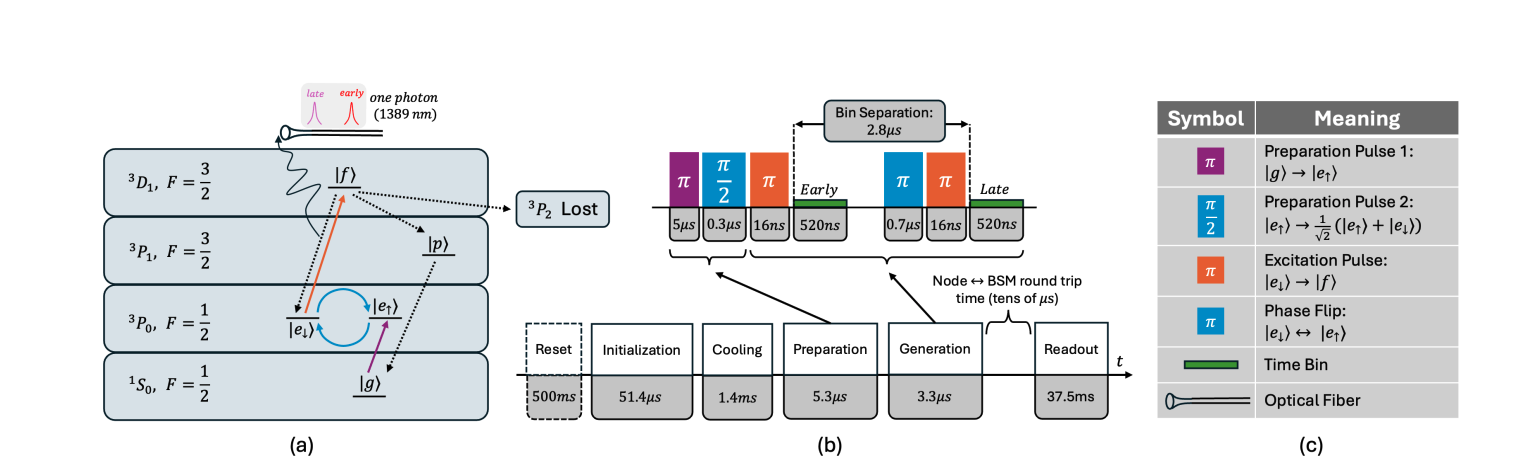
Researchers are developing the foundations for a future quantum internet, addressing the challenges of long-distance quantum communication, entanglement distribution, and network architecture. This work focuses on building and simulating networks composed of different types of quantum nodes, such as neutral atoms and superconducting qubits, a more realistic approach than assuming a single type of node. The team utilizes the SeQUeNCe discrete-event simulator to model the behavior of quantum network components and protocols, allowing them to test designs without building physical hardware. A core component of the research involves Ytterbium atoms, used as quantum memories and potentially for entanglement generation, alongside superconducting qubits, representing a different type of quantum information processing unit.
Crucially, a quantum frequency converter bridges the gap between the frequencies used by these different nodes, enabling communication between them. The team also implements Bell State Measurements, essential for entanglement swapping and establishing long-distance entanglement using quantum repeaters to overcome the limitations of direct transmission. The research focuses on key performance metrics including entanglement generation rate, fidelity, and network throughput. Simulations explore various scenarios, including direct entanglement between Ytterbium atoms, entanglement between Ytterbium atoms and superconducting qubits, and a network where a Ytterbium atom acts as a quantum repeater.
By varying key parameters like component efficiency, noise levels, and coherence times, scientists gain insights into their impact on network performance. This work builds upon existing quantum network simulators and acknowledges ongoing experimental efforts to build real-world quantum networks. Future research directions include incorporating quantum error correction to improve network robustness, developing dynamic routing protocols that adapt to changing network conditions, and designing control algorithms to optimize performance in real-time. The team also plans to investigate the scalability of the network architecture and address the security challenges of quantum networks, as well as exploring integration with existing classical networks and incorporating more realistic noise models into simulations. This research represents a significant contribution to the field, providing valuable insights into the challenges and opportunities of building a future quantum internet.
Heterogeneous Quantum Network Simulation Framework Developed
This work pioneers a comprehensive simulation framework for heterogeneous quantum networks, built upon the SeQUeNCe discrete-event simulator. Researchers engineered faithful device models for two distinct quantum platforms, Ytterbium atoms and a microwave memory, enabling detailed exploration of network performance under realistic conditions. The Ytterbium model accurately simulates the atom’s cooling, preparation, and excitation processes, incorporating parameters such as reload time and atom loss probabilities, and accounts for potential atom state loss during initialization. This model precisely calculates photon generation based on atomic properties.
Scientists also developed a detailed microwave memory model, incorporating parameters like coherence time and transducer noise, to simulate photon generation and transduction. The simulation accurately models the impact of transducer efficiency and noise on photon fidelity. A quantum frequency converter model was also implemented, accounting for conversion efficiency and the potential for noise photon generation. These individual component models were then integrated within SeQUeNCe to simulate complex network interactions. To facilitate entanglement generation, the team customized SeQUeNCe’s built-in classes, overriding methods to precisely model the entanglement process.
The simulation verifies successful entanglement by checking for specific signals, and initiates photon emission at the start of a defined time window. Entanglement swapping between remote nodes was implemented by reusing and adapting existing SeQUeNCe classes, ensuring accurate simulation of complex network topologies. The simulation framework allows for partial quantum state tomography, providing a lower bound on entanglement fidelity and enabling detailed analysis of network performance.
Heterogeneous Quantum Network Performance and Fidelity Limits
This work presents a framework for simulating heterogeneous quantum networks, combining distinct platforms like Ytterbium atoms and microwave resonators, to explore designs and justify implementation decisions. Researchers developed faithful device models and implemented entanglement protocols that account for differences in clock rates and the losses inherent in quantum frequency conversion. Extensive simulations mapped the relationship between entanglement rate and fidelity, identifying bottlenecks unique to heterogeneous systems and enabling reproducible evaluation of future designs. For a Ytterbium-Ytterbium link, simulations revealed that fidelity remained consistently high, limited primarily by detector dark counts and atomic trap loss.
Entanglement rate increased rapidly with photon collection efficiency, demonstrating an optimal balance between reload time and atom trapping probability. Increasing the time window width further increased the rate, though this also increased susceptibility to noise. Investigating a Ytterbium-microwave resonator link, scientists observed that increasing quantum frequency conversion efficiency improved both fidelity and rate. Conversely, increasing either quantum frequency conversion or transducer noise decreased fidelity while increasing rate, highlighting the impact of noise on entanglement quality.
Finally, simulations of remote entanglement between two microwave resonators via a Ytterbium repeater demonstrated that transmon coherence time significantly impacts fidelity. With default parameters, the system achieved a rate of approximately 2Hz, while near-ideal conditions yielded 7Hz. Crucially, increasing coherence time improved fidelity, demonstrating that transmon decoherence is a major limiting factor in this architecture. These results confirm the importance of optimizing coherence times for successful quantum repeater operation.
Heterogeneous Quantum Networks, Entanglement and Fidelity Mapping
This work presents a comprehensive framework for simulating heterogeneous quantum networks, combining models of distinct quantum platforms, specifically, Ytterbium atoms and transmons, within the SeQUeNCe discrete-event simulator. Researchers developed faithful device models and implemented entanglement generation and swapping protocols that account for differences in clock rates and the losses inherent in quantum frequency conversion. Through extensive simulations of Ytterbium-Ytterbium and Ytterbium-transmon links, and a combined Ytterbium-transmon-Ytterbium network, the team mapped the relationship between entanglement rate and fidelity. The simulations identified key bottlenecks unique to heterogeneous systems and demonstrated that increased coherence times can tangibly improve fidelity, particularly when one link in a network is slower to establish entanglement.
The resulting open-source and extensible models enable reproducible evaluation of future designs and protocols for quantum networks. The authors acknowledge that the fidelity formula used provides a lower bound on actual fidelity, and future work could focus on refining this metric. Further research directions include exploring more complex network topologies and investigating the impact of different error correction strategies within heterogeneous quantum systems.
🗞 Simulation of a Heterogeneous Quantum Network
🧠 ArXiv: https://arxiv.org/abs/2512.04211