

The demand for sustainable and reliable communication networks continues to grow, particularly for the expanding Internet of Things, and researchers are now exploring radically new approaches to power and signal reception. Qihao Peng, from the 5G and 6G Innovation Centre, alongside Qu Luo, Zheng Chu, and colleagues, present a novel architecture that combines wireless power transfer with a unique receiver based on Rydberg atoms. This work details a system where base stations transmit data conventionally, but receive uplink signals from IoT devices using these highly sensitive atomic receivers, potentially eliminating the need for batteries in those devices. By jointly optimising signal transmission and power harvesting, the team demonstrates a pathway towards self-sustaining wireless networks capable of reliably detecting even the weakest signals, representing a significant step towards truly pervasive and environmentally friendly communication.
Rydberg Atoms Enable Wireless Power Transfer
This research explores a new approach to wireless communication, leveraging Rydberg atoms as receivers to build energy-efficient systems. The work focuses on combining Rydberg atom-based receivers with advanced wireless architectures, such as Massive Multiple-Input Multiple-Output (MIMO), to improve spectral efficiency, coverage, and reliability, particularly for applications demanding high reliability and low latency, like industrial IoT. Scientists investigate how these systems can simultaneously transfer power and information, enabling devices to harvest energy from the received signal and operate without batteries. Scientists are developing accurate models to understand the behavior of Rydberg atom receivers, considering their sensitivity and limitations.
They are also designing signal processing algorithms specifically tailored to these receivers, focusing on techniques for demodulation, channel estimation, and interference mitigation. A key area of investigation is optimizing resource allocation, including power and bandwidth, to maximize system performance. This interdisciplinary research, at the intersection of physics, electrical engineering, and computer science, presents a novel approach to wireless communication with the potential for significant breakthroughs, particularly for energy-constrained applications. While challenges remain in building and controlling Rydberg atom-based receivers and developing efficient signal processing algorithms, the research suggests promising directions for future work, including exploring quantum-inspired techniques and developing more sophisticated algorithms.
Hybrid Wireless Power and Information Transfer
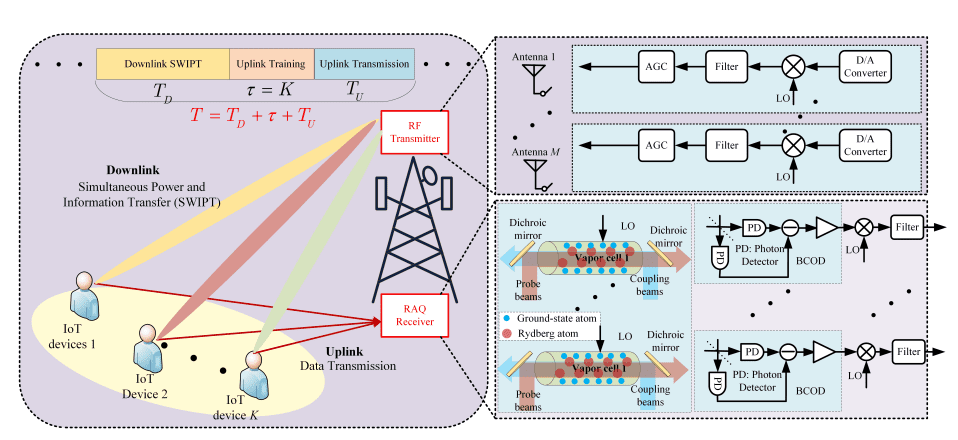
Scientists engineered a new wireless communication architecture integrating simultaneous wireless power and information transfer (SWIPT) with multiple-input multiple-output (MIMO) technology, utilizing a base station equipped with both conventional radio frequency (RF) transmission and a Rydberg atomic receiver (RAQR). To maximize the system’s data rate, the team addressed a complex optimization problem by deriving mathematical bounds on achievable rates for both uplink and downlink communication. These bounds provided a foundation for an iterative algorithm, leveraging approximation techniques and geometric programming to efficiently solve the problem. The method involves an iterative process where the algorithm refines solutions across multiple iterations, ensuring convergence by bounding the objective function and utilizing the feasible rate region. Scientists validated these theoretical developments through Monte Carlo simulations, investigating the impact of channel estimation accuracy and signal quality on system performance, and demonstrating the advantages of the RAQR-MIMO system over conventional RF MIMO.
Rydberg Receiver Enables Battery-Free IoT Communication
This research presents a novel wireless communication architecture integrating simultaneous wireless information and power transfer (SWIPT) with multiple-input multiple-output (MIMO) technology and a Rydberg atomic receiver (RAQR). The team demonstrates a system capable of reliably detecting extremely weak signals from Internet of Things (IoT) devices powered solely by harvested energy, enabling truly battery-free operation. Scientists achieved this by combining conventional radio frequency (RF) transmission for downlink communication with the RAQR for receiving the uplink signal. The team developed mathematical bounds for achievable rates and harvested energy under linear precoding and detection, revealing fundamental tradeoffs between downlink energy allocation, uplink pilot power, and payload power.
Monte Carlo simulations validated the accuracy of these bounds, confirming their utility for system design. Furthermore, the researchers formulated a joint uplink-downlink optimization problem to maximize the sum rate, subject to SWIPT and feasibility constraints. This complex problem was solved using alternative optimization and geometric programming techniques, ensuring a locally optimal solution. Experiments demonstrate that the proposed algorithm consistently outperforms benchmark schemes in terms of sum rate, particularly in low-power regimes. Specifically, the RAQR system can reduce pilot power, improving energy efficiency. This breakthrough delivers a promising solution for battery-free IoT devices without sacrificing spectral efficiency, paving the way for sustainable and energy-efficient wireless networks.
Rydberg Receivers Enable Wireless Powering and Data
This research demonstrates a novel approach to wireless communication and power delivery, integrating Rydberg atomic receivers with a simultaneous wireless information and power transfer system. By combining these technologies, the team has developed a method for enabling battery-free operation of Internet of Things devices, sustaining communication without reliance on traditional power sources. The core achievement lies in a jointly designed transmission scheme and power-splitting strategy that maximizes the sum data rate, even when devices harvest energy from the wireless signal. The researchers formulated a complex, non-convex optimization problem to address this challenge and successfully developed an iterative algorithm, based on approximation and geometric programming, to find effective solutions.
Through rigorous analysis and simulations, they confirmed the accuracy of their derived mathematical bounds and demonstrated that their proposed algorithms outperform existing benchmark schemes, particularly in scenarios with limited power availability. The results indicate that this integrated system can reliably detect weak signals from energy-harvesting devices, paving the way for truly self-powered wireless networks. Future work could focus on mitigating the effects of signal attenuation with improved antenna design or more efficient energy harvesting techniques. The team also suggests exploring alternative optimization algorithms to further refine the performance of the system and reduce computational complexity, potentially enabling real-time implementation in practical wireless networks.
👉 More information
🗞 From Active to Battery-Free: Rydberg Atomic Quantum Receivers for Self-Sustained SWIPT-MIMO Networks
🧠 ArXiv: https://arxiv.org/abs/2510.15784

