The increasing threat of quantum computing to current encryption methods drives the need for fundamentally new approaches to secure communication networks. Ane Sanz, Asier Atutxa, and David Franco, from the University of the Basque Country, alongside their colleagues, address this challenge with an innovative key management framework designed for scalable, quantum-safe networks. Their research introduces a system that moves beyond point-to-point quantum key distribution by establishing a network architecture capable of securely connecting multiple nodes over long distances. This work overcomes limitations in current technology by integrating Software-Defined Networking principles and creating a ‘Quantum Security Controller’ which dynamically discovers secure relay paths and manages key distribution, representing a significant step towards practical, large-scale quantum-secured communication networks.
Scalable QKD Networks With SDN Control
This research comprehensively assesses a new approach to building large-scale Quantum Key Distribution (QKD) networks, focusing on scalability and interoperability. The team successfully integrates Software-Defined Networking (SDN) and standardized Application Programming Interfaces (APIs) to create a practical and forward-looking design, demonstrating strong expertise in QKD, networking, and security. The work articulates the challenges of deploying extensive QKD networks and proposes a solution based on SDN and standardized APIs. The technical details of the proposed architecture, including the use of REST APIs and the control plane design, are well-explained, and adherence to existing standards, such as those defined by ETSI, increases the likelihood of real-world adoption.
Further analysis of scalability is crucial, quantifying how the performance of the control plane scales with the number of QKD nodes and users. A cost analysis of deploying and maintaining the proposed QKD network, including hardware, software, and personnel costs, would also be valuable. A thorough comparison to other QKD network architectures and solutions would help to highlight the advantages of this approach.
Dynamic QKD Network with Centralised Control
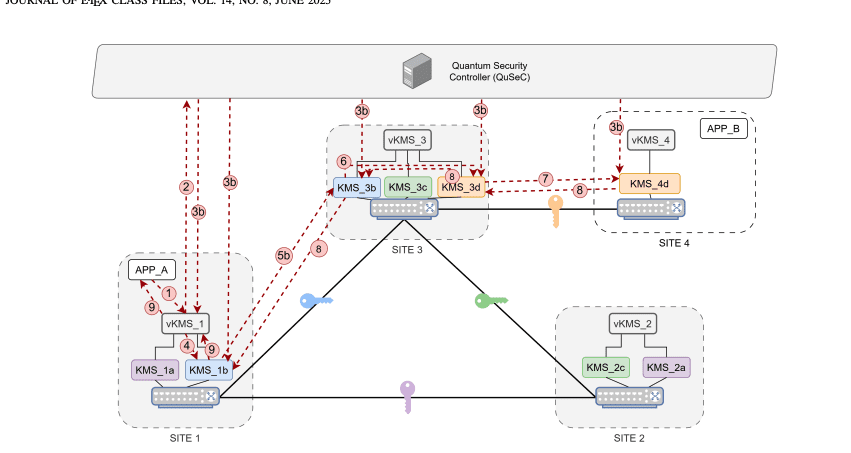
This research pioneers a novel network architecture for Quantum Key Distribution (QKD) designed to overcome limitations in scalability and dynamic path establishment. Recognizing the restricted transmission distance of QKD and the need for multi-node networks, the team developed a system integrating Software-Defined Networking (SDN) principles with high-level virtual Key Management Systems (vKMS) deployed in each node, and a new entity called the Quantum Security Controller (QuSeC). The core innovation lies in centralizing network control and abstracting complexity from individual KMSs and applications, enabling dynamic multi-hop key delivery. Scientists engineered a system where each node hosts multiple KMS instances, and the vKMS serves as a front-end, managing these KMSs and shielding users from the complexities of identifying the correct KMS for key requests.
This vKMS then communicates with the QuSeC, a centralized controller possessing a global view of the network topology and status. When an application requests a secure session, the vKMS queries the QuSeC, which computes the optimal end-to-end (E2E) relay path, considering network conditions and applying security policies. This approach moves beyond static routing, enabling dynamic path discovery and adaptation in complex network topologies. The team implemented a system capable of handling both linear and partial mesh network configurations, addressing the limitations of existing QKD deployments. In partial mesh topologies, where multiple QKD nodes co-locate, the QuSeC coordinates relay paths dynamically, allowing for flexible and efficient key distribution.
Researchers designed the system to minimize operational complexity for applications and KMSs, while ensuring scalability as the number of nodes and key requests increases. This was achieved by centralizing path discovery and relay management within the QuSeC, abstracting these functions from the individual node components. This work represents a significant advancement in QKD network design, offering a programmable and scalable solution for secure communication in increasingly complex network environments. By integrating SDN principles and a centralized control plane, the team has created a system capable of overcoming the limitations of traditional trusted relay approaches and enabling the widespread deployment of secure, multi-hop QKD networks.
SDN and vKMS Enable Extended QKD Networks
This research presents a novel network architecture designed to address key management challenges in Quantum Key Distribution (QKD) systems, enabling secure communication across extended networks. Researchers developed a system integrating Software-Defined Networking (SDN) principles with high-level virtual Key Management Systems (vKMS) deployed in each node, and a new entity called the Quantum Security Controller (QuSeC). The vKMS effectively manages multiple KMSs within a node, shielding users from the complexities of identifying the correct KMS for key requests. The QuSeC plays a crucial role in path discovery, receiving requests from vKMSs and computing end-to-end (E2E) relay paths while enforcing security policies.
This innovative approach allows for the establishment of secure connections without requiring pre-installation of relay paths, simplifying integration in trusted relay scenarios. The team demonstrated a practical, standards-aligned solution for E2E key delivery, supporting a broad range of network topologies and providing extensibility for future advancements in KMS interoperability and controller intelligence. While the system requires querying the QuSeC for every key request, even for direct paths, the researchers acknowledge a potential performance overhead, proposing caching mechanisms at the vKMS level to reuse recent path computations, reducing latency and controller load. This work delivers a significant advancement in QKD network management, offering a scalable and adaptable solution for secure communication infrastructure. The architecture’s adherence to existing standards further enhances its potential for widespread adoption and integration into future quantum networks.
SDN Architecture Scales Quantum Key Distribution
This research presents a novel network architecture designed to address the challenges of scalability and key management in quantum key distribution (QKD) networks. Recognizing the limitations of current QKD systems, particularly over long distances, the team integrated principles of Software-Defined Networking (SDN) to create a more flexible and efficient system. The core of their approach lies in the introduction of virtual Key Management Systems (vKMS) within each node and a new entity called the Quantum Security Controller (QuSeC). These vKMSs simplify key requests by abstracting the complexities of locating the correct KMS, while the QuSeC dynamically computes end-to-end relay paths based on network status and security policies.
👉 More information
🗞 Toward quantum-safe scalable networks: an open, standards-aware key management framework
🧠 ArXiv: https://arxiv.org/abs/2509.09453