

Quantum satellite networks represent a vital step towards global quantum communication, and researchers are now tackling the complex challenge of efficiently scheduling these resources. Ashutosh Jayant Dikshit from Binghamton University, Naga Lakshmi Anipeddi and Deirdre Kilbane from South East Technological University, alongside Prajit Dhara from RTX BBN Technologies, Saikat Guha from the University of Maryland, and Leandros Tassiulas, demonstrate a new framework for optimising satellite-to-ground station assignments. This work addresses realistic limitations, including resource constraints, entanglement fidelity requirements, and environmental factors like atmospheric loss and weather, while also incorporating the benefits of inter-satellite links. The team’s approach allows for a balance between maximising entanglement distribution and ensuring fair access for all ground stations, and importantly, establishes a benchmark for evaluating future transmission scheduling policies in this emerging field.
Fair Entanglement Allocation for Quantum Networks
This research investigates the optimization of satellite-based quantum networks for distributing entanglement, a crucial resource for quantum communication and computation. The core problem is how to efficiently and fairly allocate resources, specifically satellite time and entanglement generation, to maximize the overall performance of a global quantum network. Challenges include limited satellite capacity, dynamic network conditions caused by changing atmospheric conditions and user demands, and the need to ensure equitable access for all users, alongside the requirement for solutions that can scale to a large number of users and satellites. The researchers developed and evaluated scheduling policies designed to optimize entanglement distribution, balancing performance with fairness.
They propose a framework for allocating satellite resources based on user demands and network conditions, conducting extensive simulations under realistic conditions, considering atmospheric attenuation and user locations. The work also defines metrics to quantify fairness and models the entire system, including satellite characteristics, atmospheric effects, and user demands, to provide a realistic evaluation of their solutions. The research relies heavily on simulations to model the complex dynamics of a satellite quantum network, using realistic atmospheric models incorporating signal attenuation due to absorption and scattering, alongside weather data to simulate varying conditions. The characteristics of entanglement sources, including generation rate and fidelity, are also modeled.
Realistic satellite orbits and trajectories are considered in the simulations, and optimization algorithms are employed to determine the optimal scheduling policies. The research demonstrates that the proposed scheduling policies outperform existing approaches in terms of entanglement rate and fairness. Realistic atmospheric modeling is crucial for accurate performance evaluation, and fairness metrics are essential for ensuring equitable access to the quantum network. The choice of scheduling policy depends on the specific network conditions and user demands, and the use of advanced entanglement sources can significantly improve network performance.
This research has significant implications for the development of a global quantum internet, enabling secure communication channels and distributed quantum computing. It also facilitates scientific discovery by enabling researchers to share quantum resources and collaborate on experiments. Future work could focus on developing more sophisticated scheduling algorithms, investigating the use of quantum repeaters to extend network range, and addressing the challenges of quantum error correction in a satellite environment. This work provides a valuable contribution to the field of quantum communication and represents a step towards realizing the vision of a global quantum internet.
Satellite Entanglement Scheduling via Integer Programming
Researchers developed a sophisticated optimization framework to address the challenge of scheduling entanglement distribution via satellite networks, enabling long-distance quantum communication. The study formulates the problem as an integer linear program, meticulously accounting for realistic constraints including limited satellite and ground station resources, and the need for fairness in access. This allows scientists to analyze the tradeoffs between maximizing entanglement distribution rate and ensuring equitable access for all users. The framework incorporates detailed models of atmospheric losses, weather conditions, and background noise, all of which significantly impact the fidelity of entangled photons during transmission.
To accurately simulate real-world conditions, the team integrated external weather data directly into the optimization model, quantifying atmospheric attenuation and incorporating it into the program to predict entanglement fidelity. Furthermore, the study accounts for the complexities introduced by multi-satellite relays, utilizing inter-satellite links to extend network reach and improve connectivity. The optimization framework allows researchers to benchmark the performance of different transmission scheduling policies, providing a valuable tool for evaluating and improving network efficiency. By precisely modeling system constraints and environmental factors, the study achieves a high level of realism, enabling accurate predictions of entanglement distribution rates and fairness metrics. The team validated the approach through simulations, demonstrating its ability to identify optimal scheduling strategies under various conditions and assess the impact of different network configurations. This detailed methodology provides a foundation for designing and deploying practical, long-distance quantum communication networks utilizing satellite infrastructure.
Satellite Entanglement Scheduling with Network Relays
This work presents a comprehensive framework for scheduling quantum entanglement distribution via satellite networks, addressing the complexities of long-distance quantum communication. Researchers formulated and solved the satellite network scheduling problem by optimizing assignments of satellite-to-ground station pairs, accounting for realistic system and environmental constraints. The framework considers limited satellite and ground station resources, fairness requirements, and entanglement fidelity thresholds, while also incorporating atmospheric losses, weather conditions, and background noise. Importantly, the study extends beyond single satellite links to incorporate the complexities of multi-satellite relays enabled via inter-satellite links.
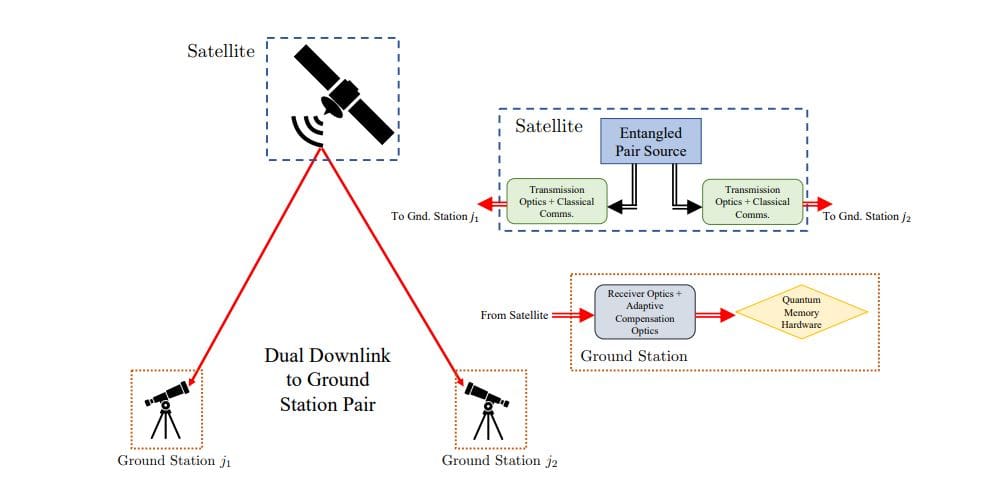
The team developed an integer linear programming based optimization framework capable of supporting multiple scheduling objectives, allowing for analysis of tradeoffs between maximizing total entanglement distribution rate and ensuring fairness across ground station pairs. Simulation results demonstrate the framework’s ability to effectively manage entanglement distribution in a two-satellite relay scenario. Specifically, the study models the dual downlink configuration, where each satellite utilizes a spontaneous parametric down-conversion based entangled pair source to generate entangled photons. Researchers meticulously modeled channel loss, a critical factor in free-space optical transmission, by studying the properties of the quantum state after it passes through a bosonic pure loss channel.
The team accounted for elevation angle limits, ensuring successful photon reception at ground stations by considering terrain obstructions. Measurements confirm that the framework accurately predicts entanglement distribution rates under varying conditions, providing a benchmark tool for evaluating other potential transmission scheduling policies. This work delivers a significant advancement in the field of satellite-based quantum communication, paving the way for future global quantum networks.
Optimized Entanglement Scheduling For Satellite Networks
This work presents a new optimization framework for scheduling quantum entanglement distribution in satellite networks, addressing a key challenge in long-distance quantum communication. Researchers formulated the scheduling problem as an integer linear program, allowing for evaluation of competing objectives such as maximizing entanglement rate and ensuring fairness among ground stations. The model incorporates realistic constraints including limited satellite resources, atmospheric effects, and background noise, alongside the complexities introduced by utilising inter-satellite links for relaying entanglement.
👉 More information
🗞 Scheduling in Quantum Satellite Networks: Fairness and Performance Optimization
🧠 ArXiv: https://arxiv.org/abs/2512.07108

