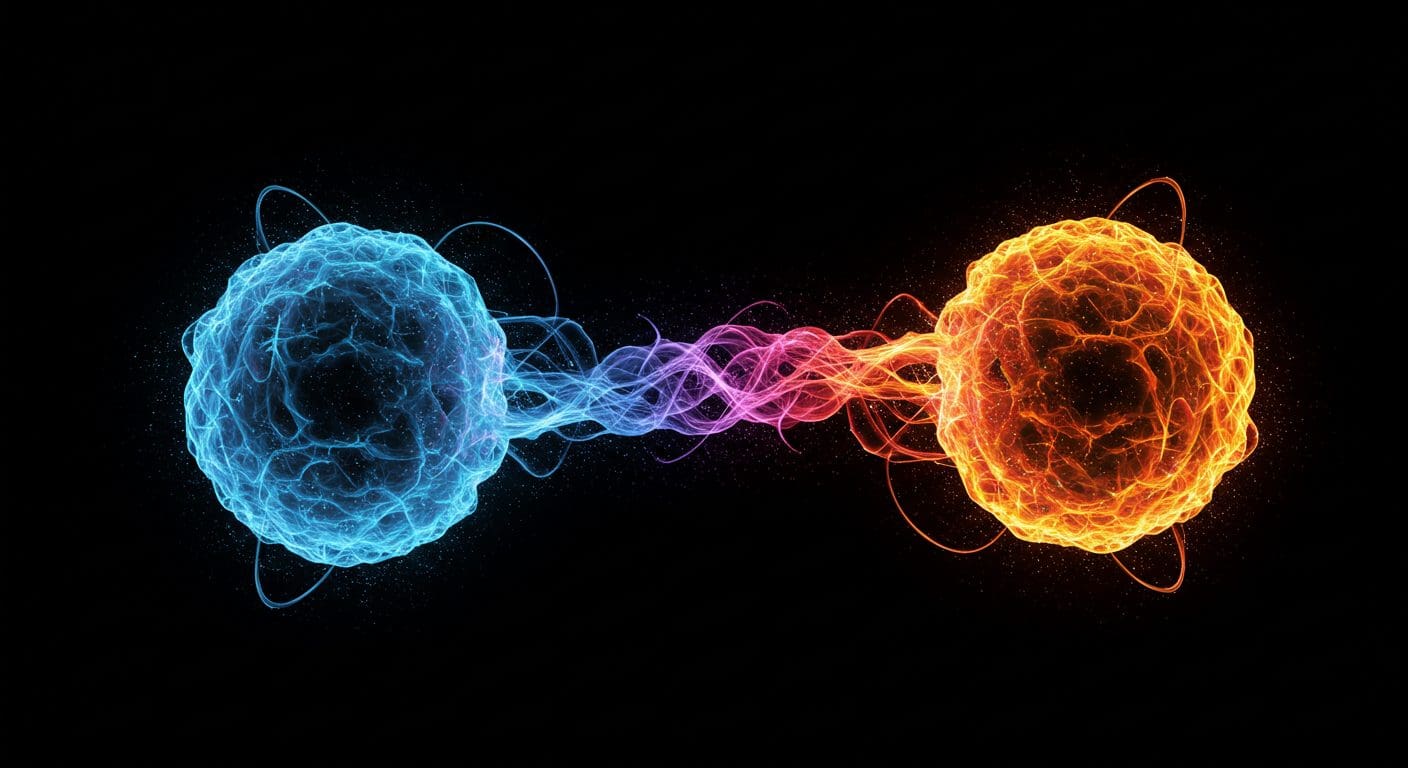
The pursuit of understanding correlations beyond those permitted by classical physics continues to drive research into the foundations of quantum mechanics and its potential applications in quantum technologies. Recent investigations extend this exploration beyond traditional Bell non-locality, focusing on scalable network structures and the subtle ways in which quantum entanglement manifests within them. Researchers are now characterising ‘non n-locality’, a property exhibited by networks where correlations arise not from direct entanglement, but from complex interactions within the network topology. This work, detailed in ‘Revealing Hidden Non n-Locality In n-Local Star Network’ by Kaushiki Mukherjee of Government Girls’ General Degree College, Kolkata, and Biswajit Paul of Balagarh Bijoy Krishna Mahavidyalaya, Hooghly, demonstrates how filtering operations within star-shaped networks can reveal these non-classical correlations, even when individual components exhibit only limited quantum properties. The study establishes a framework for sequential networks utilising stochastic local operations with classical communication (SLOCC), and highlights the advantage of employing non-separable filters within these networks to generate and detect non n-locality, a phenomenon not observable in simpler Bell scenarios.
Quantum networks actively extend investigations into non-classicality beyond traditional tests of Bell-CHSH non-locality, employing scalable architectures to explore novel phenomena and characterise non-n-locality through the incorporation of filtering operations within star-shaped n-local networks. Researchers demonstrate a framework for sequential networks capable of generating non-n-local correlations via stochastic local operations assisted with classical communication (SLOCC), a process where quantum states are manipulated locally, and information about these manipulations is exchanged classically. Crucially, this work establishes that effectiveness in these sequential networks does not necessitate Bell-CHSH non-locality in every individual two-qubit state distributed within the network, when considering transformations permissible under SLOCC. This finding broadens the scope of potential network configurations and relaxes previously held constraints on achieving non-locality.
The research rigorously proves that no separable local filter, when applied to an n-local network comprised solely of Bell-local states, reveals non-n-locality, even when considering transformations up to SLOCC operations. A separable filter is one whose effect on the quantum system can be described as independent actions on individual qubits, while a Bell-local state is one that does not violate Bell inequalities. This highlights a critical requirement for non-separable filters to unlock this phenomenon and underscores the importance of entanglement, or more generally, non-classical correlations, in enabling non-local behaviour.
Interestingly, the investigation identifies instances where non-separable multi-qubit local filters, employed by a central node, offer a demonstrable advantage over their separable counterparts, a benefit directly attributable to the specific topology of star-shaped n-local networks. This advantage cannot be replicated within the standard Bell scenario, which typically involves two spatially separated parties. The Bell scenario focuses on testing correlations between two parties, whereas n-local networks allow for more complex interconnected structures.
These findings underscore the unique capabilities of networked quantum systems and demonstrate the importance of network structure in facilitating non-locality, providing a pathway towards designing practical quantum communication protocols that leverage network topology and SLOCC operations to generate and distribute non-local correlations. The research highlights the potential for scalable quantum networks to exhibit non-classical behaviour even without relying on fully entangled states throughout the network, opening avenues for more resource-efficient quantum technologies.
👉 More information
🗞 Revealing Hidden Non n-Locality In n-Local Star Network
🧠 DOI: https://doi.org/10.48550/arXiv.2506.19026