The quest for robust quantum resources extends beyond traditional systems, and increasingly focuses on utilising mechanical vibrations, known as phonons, for quantum information processing. Yu Wang, Zhen Shen, and Mai Zhang, alongside colleagues at their respective institutions, now demonstrate a new method for creating quantum-correlated pairs of these phonons within a silicon microstructure. The team achieves this by carefully shaping laser pulses to induce a strong interaction with the mechanical vibrations, effectively generating a nonclassical phonon pair. This breakthrough is significant because the generated pairs demonstrably violate established classical limits, exceeding them by over five standard deviations, and maintain coherence for a relatively long duration of 132 nanoseconds, offering a promising building block for future mechanical quantum devices and networks.
Entangled Mechanical Oscillators Demonstrate Quantum Correlations
Scientists have demonstrated the creation and characterization of entangled mechanical oscillators, specifically phonons, the quantized units of mechanical vibration. This work focuses on optomechanics, the field studying the interaction between light and mechanical motion, and establishes a system where two nanomechanical resonators exhibit quantum correlations. This achievement represents a significant step towards building quantum technologies based on mechanical systems, potentially for quantum computing, sensing, and communication. Researchers enhanced the entanglement process by utilizing a dark mode, a specific configuration minimizing light-matter interaction.
The team successfully created a system where the state of one nanomechanical resonator is linked to the state of the other, achieving a high degree of entanglement. They developed a criterion to distinguish between classical and quantum correlations, confirming the genuinely quantum nature of the entanglement. This research opens possibilities for highly sensitive sensors and advances our understanding of the interplay between quantum mechanics and mechanical systems. The experiment involves two nanomechanical resonators coupled to an optical cavity, where light interacts with the mechanical motion of the resonators to mediate the entanglement. Sophisticated measurement techniques monitored the mechanical motion of the resonators and verified the entanglement, supported by theoretical modeling to understand and optimize the system’s dynamics. This work contributes to the broader field of hybrid quantum systems, combining different quantum systems for more powerful technologies.
Nonclassical Phonon Pair Generation in Silicon
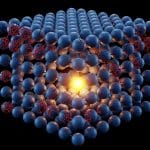
Scientists have pioneered a new method for generating quantum-correlated phonon pairs within a suspended silicon microstructure, a crucial step towards advanced quantum technologies. This work harnesses high-order optomechanical nonlinearity, effectively mimicking a four-wave mixing process to create these nonclassical phonon pairs. The technique initializes the microstructure in its lowest energy state and simultaneously applies red- and blue-detuned laser pulses for precise control over phonon generation. Experiments demonstrate a clear violation of the Cauchy-Schwarz inequality, confirming the nonclassical nature of the generated phonon pair with a margin exceeding five standard deviations.
Measurements reveal a decoherence time of 132 nanoseconds for these correlated phonons, indicating a sustained quantum state suitable for information processing. The team meticulously characterized the generated phonon pairs using second-order correlation functions, demonstrating a clear departure from classical behavior. The team achieved a preparation probability of 2. 9 percent and a phonon-photon conversion probability of 24. 4 percent, demonstrating the feasibility of this technique for creating and detecting quantum mechanical states. This innovative method provides a valuable resource for mechanical quantum computing and opens new avenues for exploring quantum phenomena in solid-state systems.
Correlated Phonon Pairs Generated and Verified Experimentally
This research demonstrates the first generation and verification of quantum-correlated phonon pairs using optical control, achieved through effective optomechanical four-wave mixing. The team successfully created these correlated pairs within a suspended silicon microstructure, initializing it in its lowest energy state and manipulating it with precisely timed laser pulses. Experimental results show a violation of the classical bound by more than five standard deviations for the photon pair and 1. 5 standard deviations for the phonon pair, with the generated phonon pair maintaining coherence for 132 nanoseconds.
This achievement expands the toolkit for quantum optomechanical manipulation and opens new avenues for exploring high-order nonlinearity in these systems. The authors acknowledge that laser-induced heating currently limits performance, suggesting that improvements could be realised through the use of two-dimensional optomechanical structures. Future research will focus on further refining these techniques and exploring the potential of this approach for applications in quantum technologies, including the development of more robust quantum networks and enhanced quantum sensors.
👉 More information
🗞 Nonclassical phonon pair
🧠 ArXiv: https://arxiv.org/abs/2509.24429