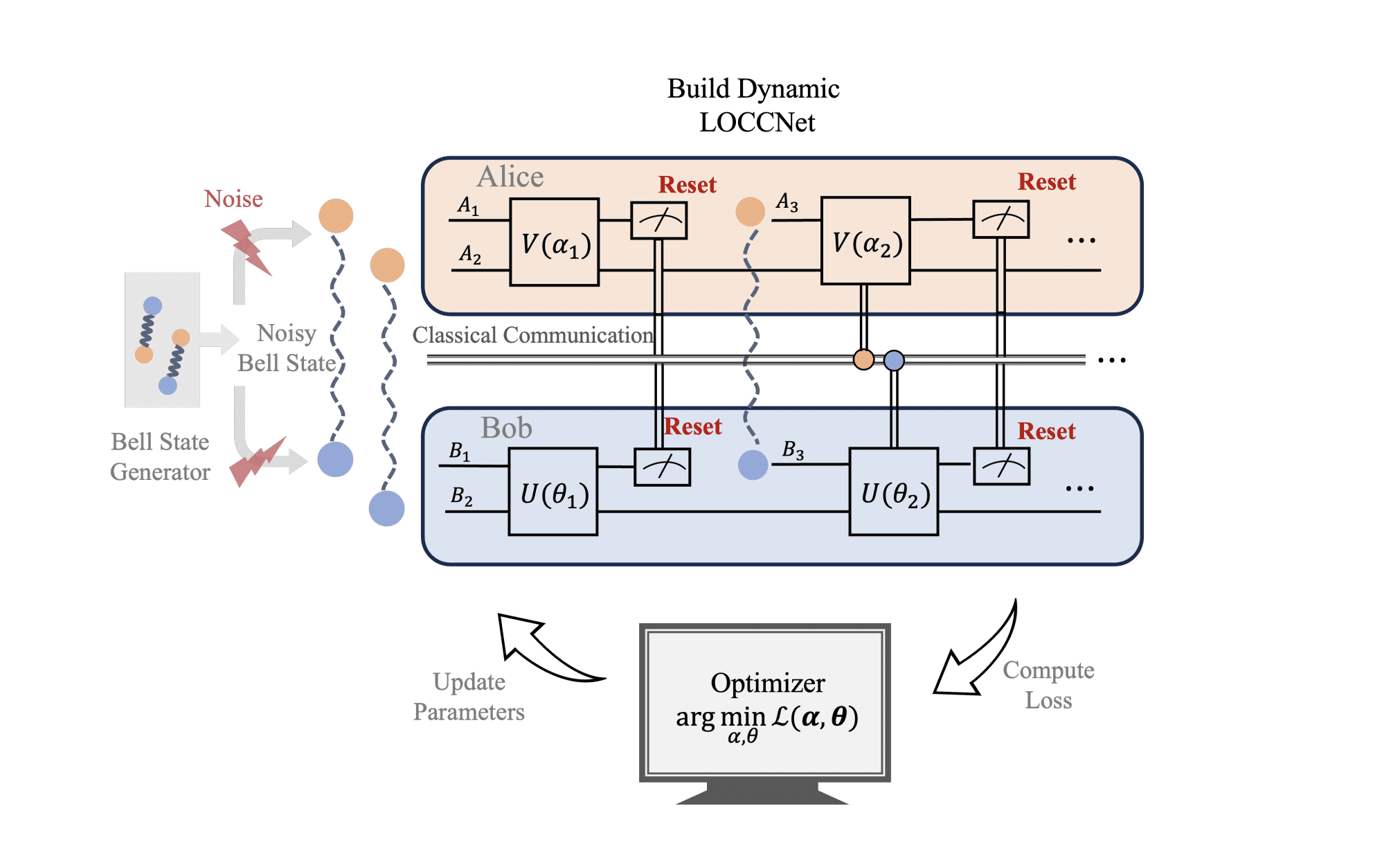
The challenge of building powerful quantum computers increasingly focuses on connecting limited numbers of qubits into effective networks, and researchers are exploring how to maximise computational power through distributed processing. Xia Liu, Jiayi Zhao, and Benchi Zhao, along with Xin Wang from The Hong Kong University of Science and Technology and The University of Hong Kong, present a new framework called dynamic LOCCNet, or DLOCCNet, which automates the design of protocols for connecting these quantum processors using local operations and classical communication. This innovative approach overcomes the difficulties of designing such protocols manually, and the team demonstrates its effectiveness in crucial quantum tasks like entanglement distillation and state discrimination. Importantly, DLOCCNet designs protocols that tackle larger, more complex problems with significantly reduced computational effort, offering a practical and scalable solution for current and near-future quantum devices and expanding our understanding of the potential of networked quantum computation.
Automated Entanglement Distribution for Scalable Quantum Computing
Distributed quantum computing offers a promising path towards building larger and more powerful quantum computers. This approach requires efficiently sharing entanglement between distant quantum processors, a challenging task due to the fragility of quantum states. Current methods often rely on complex, pre-defined procedures and specialized hardware, limiting their adaptability and scalability. Consequently, there is a growing need for automated techniques that can manipulate entanglement effectively within the constraints of today’s quantum technology. Manually designing and implementing the circuits needed for entanglement manipulation can be time-consuming and prone to errors, hindering the development of complex quantum applications. This research introduces a new architecture for dynamic LOCC (Local Operations and Classical Communication) circuits, automating the process of entanglement manipulation. The system combines graph theory, reinforcement learning, and automated circuit synthesis to generate circuits tailored to specific tasks, enabling more flexible and scalable distributed quantum computation.
A key challenge in distributed quantum computing is coordinating operations across multiple processors. This research addresses this by exploring local operations and classical communication (LOCC), where processors can only perform operations on their own qubits and communicate classical information. This work introduces dynamic LOCCNet (DLOCCNet), a framework to simulate and design LOCC protocols, demonstrating its effectiveness in entanglement distillation and distributed state discrimination, achieving solutions for larger problems than previously possible.
Distillation of Isotropic and Entangled Qutrit States
This research presents a detailed analysis of quantum state distillation protocols, a process used to purify noisy quantum states. The analysis focuses on both isotropic and maximally entangled states (Bell states) in both qubit (2-level) and qutrit (3-level) systems, investigating both static and dynamic protocols. The team employs a Deep Learning Optimized Concatenated Circuit Network (DLOCCNet) to achieve this dynamic adaptation, using fidelity as the primary metric for evaluating performance. Quantum state distillation is crucial for improving the reliability of quantum information processing.
The research explores how to take multiple noisy copies of a quantum state and, through a specific quantum circuit, obtain a single, high-fidelity copy. Isotropic states are used as a benchmark for testing distillation protocols, while Bell states are fundamental for many quantum information tasks. The research utilizes recurrence relations to analyze the performance of the distillation protocols, allowing for a theoretical prediction of fidelity after each iteration. The team demonstrates that DLOCCNet consistently outperforms static protocols, achieving higher fidelities and demonstrating successful distillation of maximally entangled states in qutrit systems.
This highlights the benefits of adapting the distillation circuit to the specific noise characteristics and input state, proving robust to different levels of noise. This work has several important implications for quantum information processing. Effective state distillation is crucial for enabling long-distance quantum communication and enhancing quantum computation by improving qubit quality. The use of deep learning to optimize distillation circuits demonstrates the potential of machine learning for quantum control, potentially extending to areas like quantum error correction and algorithm design.
DLOCCNet Enables Scalable Distributed Quantum Computation
This research introduces dynamic LOCCNet (DLOCCNet), a new framework designed to simulate and create protocols for distributed quantum computing. The framework allows multiple processors to work together using local operations and classical communication, successfully applying DLOCCNet to both entanglement distillation and distributed state discrimination, achieving improved performance compared to existing methods. The key advantage of DLOCCNet lies in its ability to balance expressibility and trainability, overcoming the “barren plateau” phenomenon that often hinders the training of complex quantum circuits. By decomposing large problems into smaller, recursively trainable components, the framework maintains practical implementability without sacrificing performance. The authors suggest a natural extension would be to implement and test these protocols on actual quantum hardware, potentially expanding the framework to address multipartite scenarios.
👉 More information
🗞 Dynamic LOCC Circuits for Automated Entanglement Manipulation
🧠 ArXiv: https://arxiv.org/abs/2509.07841