Scientists investigate free-space and satellite-based quantum communication as a pivotal technology for establishing secure, global networks. Georgi Gary Rozenman from the Massachusetts Institute of Technology, Alona Maslennikov from Boston University, and Sara P. Gandelman, Yuval Reches et al. from Tel Aviv University, comprehensively review the evolution of these systems from terrestrial implementations to space-based architectures. Their work highlights the unique benefits and considerable hurdles associated with both discrete-variable and continuous-variable technologies when deployed via satellite. This review consolidates recent progress, notably including the successful demonstration via the Micius satellite, and critically assesses challenges such as atmospheric turbulence and the need for quantum repeaters, ultimately charting a course towards a future global quantum internet.
Researchers aimed to investigate novel approaches to enhance wireless communication systems. The approach involved a combination of theoretical analysis, numerical simulations, and experimental validation utilising a 69978-based platform. Leveraging the principles of quantum mechanics, these systems offer unparalleled security through Quantum Key Distribution (QKD) and other quantum communication protocols.
This review provides a comprehensive overview of the current state of satellite-based quantum communications, focusing on the evolution from terrestrial to space-based systems. Researchers explore the distinct advantages and challenges of discrete-variable (DV) and continuous-variable (CV) quantum communication technologies in the context of satellite deployments.
The paper also discusses key milestones such as the successful implementation of quantum communication via the Micius satellite and outlines the primary challenges, including atmospheric turbulence and the development of quantum repeaters, that must be addressed to achieve a global quantum internet. This review aims to consolidate recent advancements in the field, providing insights and perspectives on the future directions and potential innovations that will drive the continued evolution of satellite-based quantum communications.
The Critical Need for Quantum-Secured Communication
In an era where information security is critical, quantum communication has emerged as a revolutionary technology that offers unprecedented protection for data transmission. Unlike classical communication methods, which are vulnerable to interception and cyberattacks, quantum communication utilizes the fundamental laws of quantum mechanics to ensure theoretically unbreakable security.
The development of satellite-based quantum communication represents a major breakthrough, extending secure links beyond the limits of terrestrial infrastructure and enabling the foundation of a global quantum network. This paper examines the current state of satellite-based quantum communications, highlighting significant advancements in both discrete-variable and continuous-variable technologies while addressing the remaining challenges.
From Signals to Satellites: Communication Evolution
As global investment in quantum satellites accelerates, the realisation of a secure and interconnected quantum internet is approaching. A review of quantum communications reveals that human progress has been closely linked to advances in communication. From smoke signals and carrier pigeons to the telegraph, radio, and the internet, each technological innovation has fundamentally transformed how societies interact and share information.
In today’s hyper-connected world, communication networks are the foundation of global infrastructure, allowing seamless interactions over vast distances. However, with our growing reliance on digital communication comes an urgent need for secure and tamper-proof information exchange. While classical cryptographic methods have proven to be effective, they remain vulnerable to increasing computational power and evolving cyber threats.
The Paradigm Shift Towards Quantum Security
This growing threat has driven a paradigm shift toward quantum communication, a revolutionary technology that leverages the laws of quantum mechanics to ensure fundamentally secure information transfer. Among the most promising developments is satellite-based quantum communication, which extends the capabilities of terrestrial quantum networks and lays the groundwork for a global quantum-secure infrastructure.
As societies continue to benefit from the ubiquitous connectivity enabled by advanced communication systems, security has become a critical concern in all types of networks. Both private users and vertical industries demand a high level of security, which quantum communication can support. Quantum communication represents a groundbreaking shift in the way secure information transfer is achieved, leveraging the principles of quantum mechanics to provide unprecedented levels of security.
The journey from terrestrial to satellite-based quantum communication systems marks a significant advancement in overcoming the limitations of distance, channel loss, and eavesdropping vulnerabilities that conventional communication systems face. Quantum Key Distribution (QKD), the most prominent application of quantum communication, enables two parties to share a cryptographic key with unconditional security, guaranteed by the laws of quantum physics.
However, implementing QKD over long distances has been challenging due to attenuation and decoherence in optical fibres and Free-space channels. The deployment of quantum communication systems in space via satellites offers a promising solution to these challenges, paving the way for the establishment of a global quantum network.
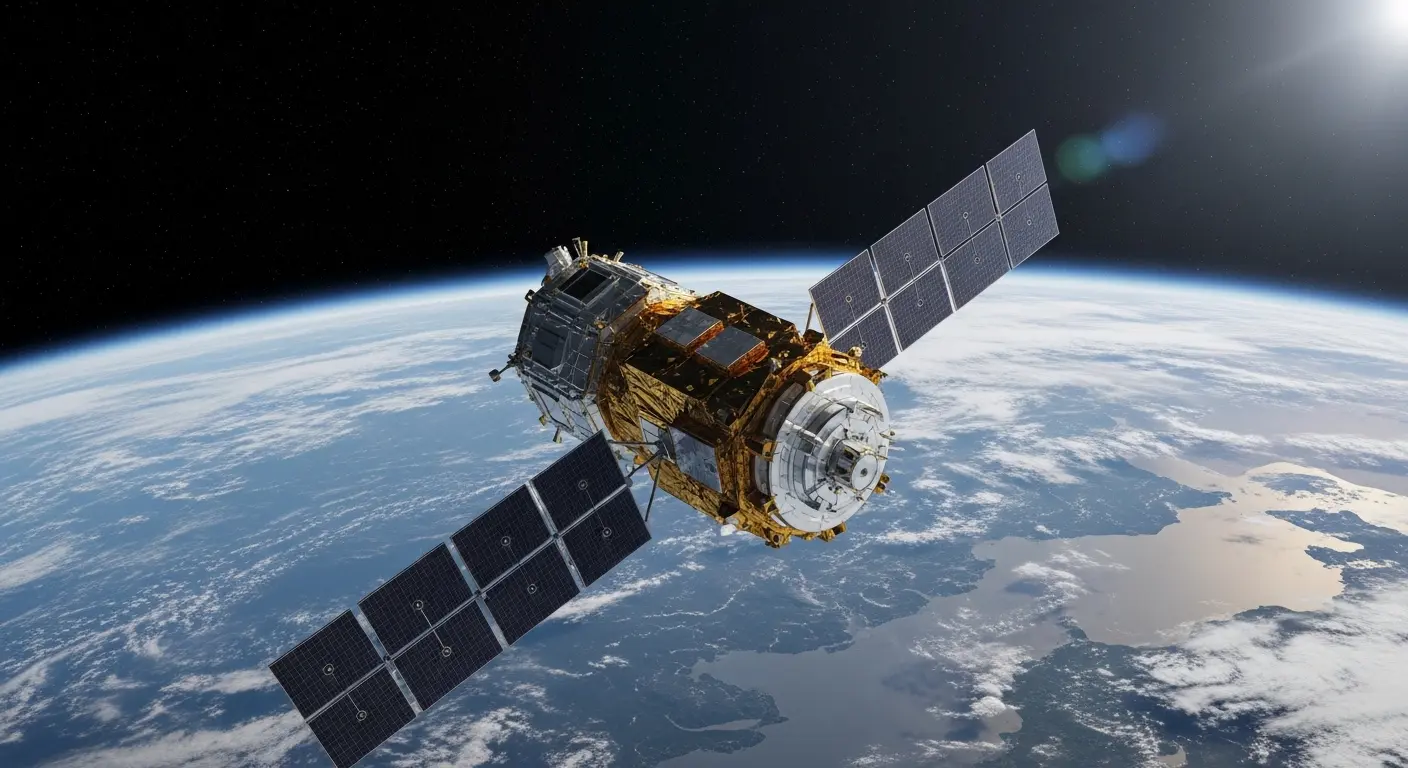
Figure 1 details the experimental setup for satellite-to-ground quantum key distribution (QKD) using the Micius satellite. The Micius satellite, weighing 635kg, operates in a Sun-synchronous orbit approximately 500km above Earth and carries three payloads designed for space-based quantum experiments including QKD, Bell tests, and quantum teleportation.
The satellite’s QKD transmitter employs eight laser diodes emitting attenuated pulses at around 850nm, which pass through a BB84 encoding module composed of polarising beam splitters, a half-wave plate, and a beam splitter. The encoded quantum signals are co-aligned with a 532nm green laser used for system tracking and time synchronisation, then transmitted via a 300 mm aperture Cassegrain telescope.
Beam control is achieved using a two-axis gimbal mirror for coarse tracking and fast-steering mirrors for fine tracking, while a low-power 671nm laser serves as a polarisation reference. On the ground, the Xinglong station features a 1,000-mm-aperture telescope that separates the incoming 532nm tracking laser and 850nm quantum signals using a dichroic mirror.
The tracking beam is monitored by a camera for alignment, while the quantum signals are analysed by a BB84 decoder consisting of beam splitters and four single-photon detectors. The ground station also sends a 671nm laser beam back to the satellite for reciprocal tracking. This dual-wavelength synchronisation and hybrid tracking system enables precise alignment and polarisation compensation, facilitating high-rate QKD over distances up to 1,200km and demonstrating a significant advancement in space-based quantum communication.
The motivation for satellite-based quantum communications arises from the need to overcome the distance limitations inherent in terrestrial quantum networks. Quantum communication relies on fundamental phenomena such as entanglement and superposition, which enable secure information transfer, a capability that classical systems cannot match.
Although terrestrial QKD systems perform effectively over shorter distances, they experience exponential signal loss in optical fibres and Free-space channels, limiting their operational range to a few hundred kilometres. Satellite-based systems, on the other hand, can transmit quantum signals between satellites and ground stations, allowing secure links over significantly greater distances.
By bypassing Earth’s curvature and reducing exposure to atmospheric attenuation, these systems offer a viable solution for establishing global-scale quantum communication networks. The launch of China’s Micius satellite in 2016 marked a major milestone in advancing quantum communication, demonstrating the feasibility of satellite-based QKD on a global scale.
Micius successfully enabled QKD over thousands of kilometres, validating the robustness of quantum communication protocols under real space conditions. By enabling secure links between distant ground stations, satellite platforms like Micius pave the way for a future global quantum internet, one in which secure information exchange is possible between any two locations on Earth.
Key protocols in Free-space Quantum Key Distribution include Quantum Key Distribution (QKD), a secure communication technique that leverages the principles of quantum mechanics to generate and distribute cryptographic keys. Unlike classical encryption methods, QKD offers unconditional security; its robustness is not compromised even by adversaries with unlimited computational resources.
This makes QKD an ideal solution for high-security applications in sectors such as finance, government, and defence. Several QKD protocols have been developed over the years, each with distinct features and advantages. Among the most widely used are the BB84, B92, and Ekert protocols.
Although they differ in the way they encode and transmit key information, they all rely on the same fundamental principles of quantum mechanics, such as the Heisenberg uncertainty principle and the no-cloning theorem. Regardless of the protocol, the objective of all QKD systems remains the same: to enable two parties to securely generate a shared key for symmetric encryption.
This process ensures that any eavesdropping attempt introduces detectable disturbances, preserving the security of the communication. The BB84 protocol, a foundational QKD method, is described as follows. For each index i, Alice encodes ai into a qubit as follows: if bi = 0, she uses the computational basis {|0⟩, |1⟩}, preparing |0⟩if ai = 0 and |1⟩if ai = 1; if bi = 1, she uses the Hadamard basis {|+⟩, |−⟩}, where |±⟩= (|0⟩± |1⟩)/ √ 2, preparing |+⟩if ai = 0 and |−⟩if ai = 1.
The four qubit states used to describe the protocol are |ψ00⟩= |0⟩, |ψ10⟩= |1⟩, |ψ01⟩= |+⟩= 1 √ 2|0⟩+ 1 √ 2|1⟩, and |ψ11⟩= |−⟩= 1 √ 2|0⟩−1 √ 2|1⟩. The bit bi determines which basis ai is encoded in (either in the computational basis or the Hadamard basis). It is impossible to distinguish each qubit with certainty without knowing b because the qubits are currently in states that are not mutually orthogonal.
Through the public and verified quantum channel ε, Alice sends Bob state ψ. Bob receives a quantum state described by ε(ρ) = ε(|ψ⟩⟨ψ|), where ε denotes the combined effects of channel noise and potential eavesdropping, whom we’ll refer to as Eve. Both Bob and Eve have their own states after receiving the string of qubits.
However, since only Alice is aware of this, it is essentially impossible for Bob or Eve to tell the qubit states apart. Additionally, the no-cloning theorem tells us that Eve cannot be in possession of a perfect copy of the qubit.
Demonstration of entanglement distribution and CHSH violation via satellite-based B92 protocol represents a significant advance in quantum communication
Satellite-based quantum key distribution represents a critical advancement in secure, global-scale networks. Leveraging principles of mechanics, these systems offer unparalleled security through key distribution and other protocols. The research details the successful distribution of maximally entangled pairs of qubits in the state | Ψ−⟩AB = 1/√2(|01⟩AB − |10⟩AB).
A sequence of these states was distributed, assigning the first qubit to Alice and the second to Bob. For each pair, Alice and Bob randomly selected measurement settings from predefined sets, publicly announcing their bases afterwards. When chosen directions matched, results formed the sifted key, while mismatched bases were used to evaluate a CHSH inequality.
The CHSH parameter, S, exceeded 2, demonstrating quantum correlations and the security of the distributed key. Specifically, the B92 protocol, employing only two non-orthogonal quantum states, was examined. Bob achieved conclusive results with probability 1 − | ⟨ψ00 |Ψ01⟩|2, yielding the raw key.
The protocol’s security relies on the inability to perfectly distinguish non-orthogonal quantum states, ensuring viability despite its minimalist design. Further investigation involved the six-state BB84 protocol, an extension of the original BB84 utilising three mutually unbiased bases. The inclusion of eigenstates of the Pauli Y operator, representing right- and left-handed circular polarisation, expanded the qubit state space.
Although the probability of matching bases decreased to 1/3, reducing sifting efficiency, the six-state protocol demonstrated increased robustness against eavesdropping. This is because Eve must now guess among three bases, increasing the quantum bit error rate and making her presence more detectable.
The decoy-state protocol was also explored as a method to enhance security against photon-number-splitting attacks. By randomly varying the photon-number distribution and announcing the intensity level after transmission, Alice prevented eavesdroppers from targeting multiphoton sources. Analysis of bit error rates across different intensity levels allowed for the detection of attempted attacks, achieving higher secure key rates and extended channel distances.
Advancing global security through space-based quantum technologies requires international collaboration and responsible development
Satellite-based quantum key distribution represents a significant step forward in establishing secure, global communication networks. These systems utilise the principles of quantum mechanics to deliver unparalleled security through protocols such as Key Distribution. A review of the field demonstrates an evolution from ground-based systems to space-based systems, highlighting the benefits and challenges of both discrete-variable and continuous-variable technologies when implemented on satellites.
Successful demonstrations, such as the implementation via the Micius satellite, mark key milestones in this developing area. However, challenges remain, notably atmospheric turbulence and the need for quantum repeaters, if a truly global quantum internet is to be realised. The current focus consolidates recent progress, offering perspectives on future innovations and the ongoing development of satellite-based quantum communication.
Acknowledging limitations, the authors note the complexities of overcoming atmospheric disturbances, which degrade signal quality. Future research will likely concentrate on developing more robust protocols and technologies to mitigate these effects, alongside advancements in quantum repeater technology to extend the range of secure communication. These developments promise to enhance the feasibility and scalability of global quantum networks, offering a new standard in data security.
🗞 Free-space and Satellite-Based Quantum Communication: Principles, Implementations, and Challenges
🧠 ArXiv: https://arxiv.org/abs/2602.01426