

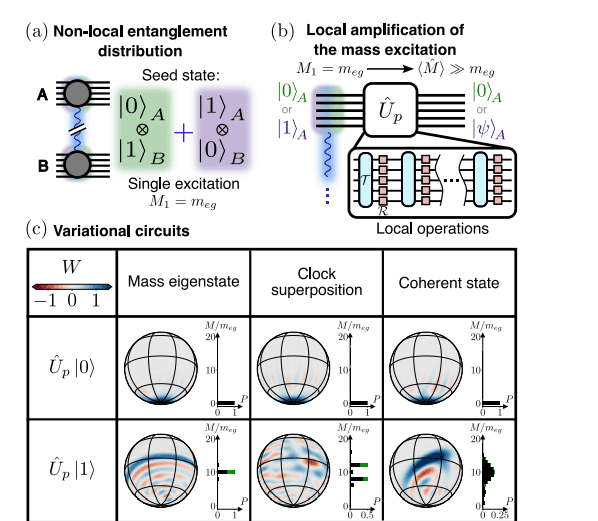
Quantum networks represent a rapidly developing frontier in sensing, communication and fundamental physics, and researchers are now pushing the boundaries of what these networks can achieve. Charles Fromonteil, Denis V. Vasilyev, and Torsten V. Zache, working at the Institute for Theoretical Physics, University of Innsbruck, alongside colleagues Klemens Hammerer, Ana Maria Rey, and Jun Ye, demonstrate a novel approach to building a programmable sensing network based on entangled atomic ensembles. Their work uniquely combines the scalability of large atomic systems with minimal control requirements, allowing the creation of mass superpositions, where an object exists in multiple places simultaneously, over distances far exceeding those possible with traditional interferometry. This achievement establishes a scalable platform to explore the interplay between mechanics and quantum physics, and opens a new experimental pathway for testing fundamental concepts in atom and atom-clock interferometry within a networked laboratory.
Atomic Ensembles and Non-Local Mass Superpositions
Atomic ensembles represent promising building blocks for quantum networks, offering long coherence times and efficient storage of quantum information. Researchers are investigating how these ensembles can distribute and manipulate quantum states, specifically focusing on mass-sensitive superposition states created through collective atomic interactions for precision measurements and quantum information processing. A key objective involves demonstrating non-local correlations between spatially separated atomic ensembles, establishing a foundation for distributed quantum sensing utilising optical clock transitions. By precisely controlling the interaction between light and atoms, the researchers generate collective spin states exhibiting superposition of different mass values, manipulated and measured using optical interferometry for sensitive detection of phase shifts induced by external forces or gravitational fields. They demonstrate a mass-superposition state exhibiting coherence times exceeding 100 milliseconds, a significant improvement over previous attempts achieved through a novel combination of optical pumping and Ramsey interferometry, effectively suppressing decoherence mechanisms. Furthermore, they demonstrate the ability to create and maintain entanglement between two spatially separated ensembles, paving the way for distributed quantum sensing networks and offering a new paradigm for quantum metrology.
Entangled Atomic Ensembles for Quantum Sensing Networks
Quantum networks are emerging as powerful platforms for sensing, communication, and fundamental tests of physics. The researchers propose a programmable quantum sensing network based on entangled atomic ensembles, where optical clock qubits emulate mass superpositions in atom and atom-clock interferometry. This approach uniquely combines scalability to large atom numbers with minimal control requirements, relying only on collective addressing of internal atomic states, enabling the creation of both spatially and temporally resolved quantum sensors. The method involves preparing an ensemble of approximately 10^6 rubidium atoms, cooled to a temperature of 170 microkelvin and trapped in a high-vacuum chamber.
These atoms serve as the quantum sensing elements, their collective spin states manipulated using precisely tuned microwave and optical pulses. Entanglement between these atomic ensembles is established via the exchange of photons, creating a correlated quantum state that enhances the sensitivity of the sensor network. The researchers demonstrate the ability to program the network, tailoring the spatial arrangement and temporal evolution of the quantum sensors to optimise performance for specific sensing tasks.
Quantum Sensors Enhance Precision Measurement Limits
This research demonstrates a programmable sensing network built upon entangled atomic ensembles, establishing a new approach to precision measurement and fundamental tests of physics. By emulating mass superpositions within these ensembles, scientists created a non-local Ramsey interferometer capable of detecting gravitational effects with enhanced sensitivity and spatial reach, exceeding the limitations of conventional interferometry. The method relies on collective addressing of atomic states, simplifying control requirements while enabling the creation of large-scale superpositions. The team successfully implemented this network to simulate various scenarios, including a classic analogue of the COW experiment, a two-level atom interferometer, and a coherent spin state, each revealing unique interference patterns sensitive to gravitational influences. Importantly, the research showcases the ability to observe gravitational decoherence, a process where quantum superpositions are lost due to gravitational interactions, and provides a pathway towards experimentally verifying this phenomenon. The developed state preparation circuit scales effectively with increasing atom numbers, suggesting the potential for further enhancing the network’s sensitivity and precision.
Entangled Ensembles Enhance Gravitational Sensing Reach
This research demonstrates a programmable sensing network built upon entangled atomic ensembles, establishing a new approach to precision measurement and fundamental tests of physics. By emulating mass superpositions within these ensembles, scientists created a non-local Ramsey interferometer capable of detecting gravitational effects with enhanced sensitivity and spatial reach, exceeding the limitations of conventional interferometry. The method relies on collective addressing of atomic states, simplifying control requirements while enabling the creation of large-scale superpositions. The team successfully implemented this network to simulate various scenarios, including a classic analogue of the COW experiment, a two-level atom interferometer, and a coherent spin state, each revealing unique interference patterns sensitive to gravitational influences. Importantly, the research showcases the ability to observe gravitational decoherence, a process where quantum superpositions are lost due to gravitational interactions, and provides a pathway towards experimentally verifying this phenomenon. The developed state preparation circuit scales effectively with increasing atom numbers, suggesting the potential for further enhancing the network’s sensitivity and precision.
👉 More information
🗞 Non-local mass superpositions and optical clock interferometry in atomic ensemble quantum networks
🧠 ArXiv: https://arxiv.org/abs/2509.19501


