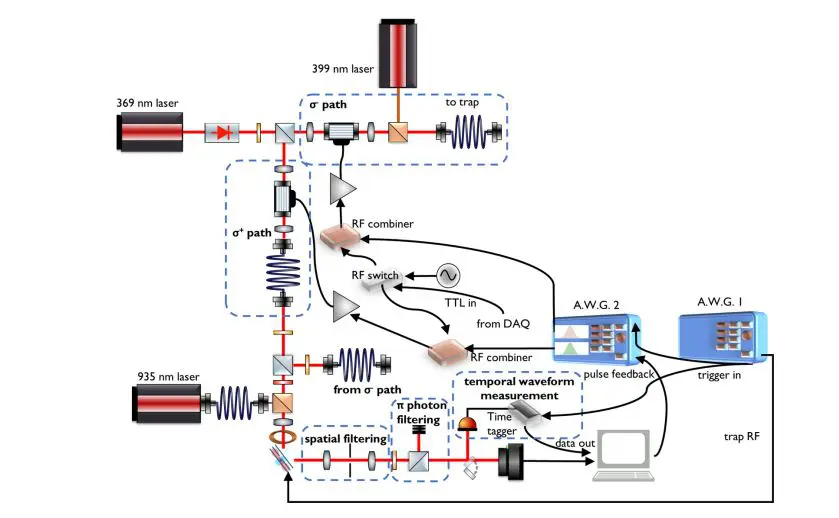
Controlling the precise characteristics of individual photons represents a significant challenge in the development of quantum technologies, and now, Carl Thomas, Rebecca Munk, and Boris Blinov, all from the University of Washington, demonstrate a new method for shaping the temporal waveform of photons emitted during spontaneous emission. This achievement overcomes limitations of existing single-photon sources, which often rely on complex infrastructure or restricted waveform options, by offering a flexible, free-space approach applicable to a wide range of emitters. The team’s technique involves carefully controlling the excitation of atoms, allowing them to generate photons with virtually any desired temporal shape, and they validate their approach with experiments on ytterbium ions, estimating a process fidelity exceeding 0. 996. This advance promises to improve the stability and efficiency of quantum networks and facilitate the transfer of quantum information with greater precision.
This breakthrough enables the generation of photons with any desired shape, irrespective of the emitter’s natural lifetime, and promises to advance the development of quantum technologies. The team’s method involves carefully modulating both the amplitude and phase of a field that couples the ground and excited states of the emitter, effectively tailoring the emitted photons during the relaxation process.
Researchers developed sophisticated numerical optimization techniques and quantum Monte Carlo tools to determine the ideal interaction parameters and accurately characterize the resulting emission statistics. These tools allow for the design of quantum network protocols and the enhancement of remote entanglement schemes, crucial for secure communication and distributed quantum computing. Experimental validation was performed using trapped Yb+ ions, demonstrating the potential to achieve photon preparation fidelities exceeding 0. 996.
Tailoring Photon Waveforms From Single Emitters
This research demonstrates a method for generating photons with precisely controlled temporal waveforms from single quantum emitters. The team’s approach relies on modulating both the amplitude and phase of a field that couples the ground and excited states of the emitter, allowing for the creation of photons with any desired temporal shape, regardless of the emitter’s natural lifetime. This offers greater flexibility and requires less infrastructure compared to existing techniques like cavity-based methods or post-emission pulse shaping.
Researchers developed numerical optimization techniques and quantum Monte Carlo tools to identify ideal interaction parameters and characterize emission statistics, ultimately improving the design of quantum network protocols and enhancing remote entanglement schemes. Experimental validation was performed using trapped Yb+ ions, and the researchers estimate achievable photon preparation fidelities exceeding 0. 996. While current experimental results are limited by factors such as non-compensable micromotion within the ion trap and the resolution of generated excitation pulses, the method offers significant advantages.
Shaping Ion Emission for Quantum Control
This research details a method for precisely controlling the emission of photons from trapped ions, with the ultimate goal of creating highly efficient and reliable quantum information processing systems. The core innovation is a technique to shape the emitted photons, specifically to control their temporal and spectral properties, to optimize them for quantum communication and computation. This is achieved through careful manipulation of the ion’s excitation and decay pathways.
The research leverages the well-established use of trapped ions as qubits, which offer long coherence times and precise control using lasers. A major challenge in quantum information processing is the randomness of spontaneous emission, which the researchers aim to direct rather than allow to occur randomly. They utilize techniques such as electromagnetically induced transparency (EIT) and Raman transitions to manipulate the ion’s internal states and control the emission process. EIT creates a window in the absorption spectrum, allowing specific wavelengths of light to pass through while suppressing others.
Researchers employ sophisticated pulse shaping techniques to tailor the laser pulses used to excite and control the ions, allowing precise control over the timing, frequency, and amplitude of the emitted photons. The emitted photons are then filtered to select those with the desired temporal and spectral characteristics, minimizing errors in quantum operations. Integrating the ion trap with a waveguide allows for efficient collection and routing of the emitted photons, essential for building scalable quantum systems.
The researchers demonstrate the ability to generate photons with very high fidelity, closely matching the desired characteristics. They achieve narrowband emission, crucial for minimizing decoherence and improving quantum communication protocols. Waveguide integration significantly improves photon collection efficiency, a major bottleneck in many quantum experiments. The techniques developed are potentially scalable, meaning they could be used to build larger and more complex quantum systems. The ability to shape and direct photons allows for the creation of a rudimentary quantum router, a device that can direct photons to different destinations based on their quantum state.
This research has several important implications for the field of quantum information processing, including improved quantum communication, enhanced quantum computation, and the development of quantum networking. The ability to generate high-fidelity, narrowband photons will significantly improve the performance of quantum communication protocols, such as quantum key distribution. Precise control over photon emission is crucial for building scalable quantum computers, and this research provides a pathway towards achieving that goal. The development of a quantum router is a key step towards building a quantum internet, a network that can transmit quantum information over long distances. The techniques developed could also be used to study fundamental aspects of quantum mechanics, such as the interaction between light and matter.
This is a comprehensive research effort covering ion trap design, pulse shaping, and waveguide integration. The researchers provide detailed experimental results supporting their theoretical predictions, and the paper is well-written and easy to understand. A strong focus on scalability addresses the challenges of building larger quantum systems. This research makes a substantial contribution to the field of quantum information processing and has the potential to enable the development of more powerful and reliable quantum communication and computation systems.
🗞 Arbitrary control of the temporal waveform of photons during spontaneous emission
🧠 ArXiv: https://arxiv.org/abs/2511.23462