The quest for large-scale quantum computing has reached a crucial milestone with the successful demonstration of fast photon-mediated entanglement generation using continuously cooled trapped ions. This breakthrough paves the way for quantum networking, a key component in achieving universal control over a larger Hilbert space. The achievement marks a significant step forward in the development of photonic interconnects between quantum processing nodes, which could enable remote entanglement distribution and greatly increase the collective power of quantum processors.
Can Quantum Networking Revolutionize Large-Scale Computing?
The quest for large-scale quantum computing has been a longstanding challenge, and recent breakthroughs in entanglement generation may hold the key. A team of researchers from Duke University and the Joint Quantum Institute has successfully demonstrated fast photon-mediated entanglement of continuously cooled trapped ions, paving the way for quantum networking.
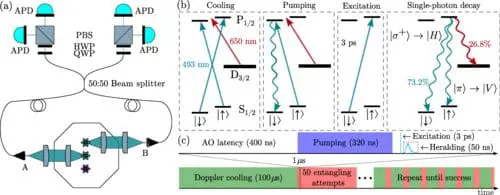
In their experiment, the scientists used two cotrapped atomic barium ion qubits to generate entanglement by collecting single visible photons from each ion through in-vacuo objectives. The photons were then interfered through an integrated fiber beamsplitter and detected in coincidence, projecting the qubits into an entangled Bell state with a fidelity lower bound of 94%. This achievement marks a significant milestone in the development of quantum networking.
The introduction of sympathetic cooling using ytterbium ions enabled continuous entanglement generation at a rate of 250 s-1, eliminating the need for recooling interruptions. This breakthrough has far-reaching implications for large-scale quantum computing, as photonic interconnects between quantum processing nodes may be the only way to achieve universal and fully connected control over a substantially larger Hilbert space.
What are the Benefits of Quantum Networking?
Quantum networking offers diverse opportunities in quantum sensing, communication, and simulation. Interconnects between quantum memories can enable remote entanglement distribution with high rates and near-unit fidelity, allowing for universal control over a larger Hilbert space. This, in turn, greatly increases the collective power of quantum processors.
The advantages of trapped ions as candidates for both quantum computing and networking are well established. Their natural homogeneity, isolation from their environment, and indefinite idle coherence times make them attractive for large-scale applications. Decades of technological development have led to demonstrations of high-fidelity state preparation and measurement (SPAM) and coherent operations in small systems.
Challenges in Large-Scale Quantum Computing
While significant progress has been made in small-scale quantum computing, scaling up to larger systems poses several challenges. One major hurdle is the overhead associated with transporting ions between interaction zones. This can dominate the time budget of current systems, limiting their size and complexity.
Another challenge is motional mode-crowding and crosstalk concerns, which become more pronounced as ion chains grow in size. To overcome these limitations, researchers have explored alternative approaches, such as shuttling smaller ion chains between interaction zones or using photonic interconnects to avoid overhead.
The Role of Photonic Interconnects
Photonic interconnects can play a crucial role in large-scale quantum computing by enabling the distribution of entangled photons between distant nodes. This can facilitate remote entanglement generation and enable universal control over a larger Hilbert space, greatly increasing the collective power of quantum processors.
The development of photonic interconnects has been proposed for various qubit platforms, including trapped ions, superconducting circuits, and diamond-based systems. The integration of these technologies could lead to the creation of large-scale quantum computers with unprecedented processing capabilities.
Future Directions
The successful demonstration of fast photon-mediated entanglement generation using continuously cooled trapped ions marks a significant milestone in the development of quantum networking. As researchers continue to push the boundaries of this technology, we can expect to see further advancements in the field.
Future directions may include exploring new materials and architectures for photonic interconnects, developing more efficient methods for entanglement generation and distribution, and scaling up the size and complexity of quantum processors.
Conclusion
The quest for large-scale quantum computing has taken a significant step forward with the successful demonstration of fast photon-mediated entanglement generation using continuously cooled trapped ions. This breakthrough has far-reaching implications for the development of quantum networking and could lead to the creation of large-scale quantum computers with unprecedented processing capabilities. As researchers continue to push the boundaries of this technology, we can expect to see further advancements in the field, ultimately enabling the realization of a quantum internet.
Publication Date: 2024-08-30
Authors: Jameson O’Reilly, George Toh, Isabella Goetting, Sagnik Saha, et al.
Source: Physical Review Letters
DOI: https://doi.org/10.1103/physrevlett.133.090802