Quantum Key Distribution offers a fundamentally secure method for sharing encryption keys, promising communications impervious to even the most powerful future computers. Haoran Zhang, Haotao Zhu, and Ruihua He, alongside colleagues including Lajos Hanzo, investigate the significant hurdles preventing the widespread adoption of this technology and outline pathways towards a truly global network. Their work addresses the practical limitations of current systems, such as performance and cost, while also considering the security challenges inherent in extending quantum communications over vast distances. By reviewing existing implementations and highlighting promising new protocols and devices, this research charts a course for realising the potential of worldwide, unconditionally secure communication.
Over the years, theoretical advances and experimental demonstrations have successfully transitioned QKD from laboratory research to commercial applications. This key can then be used with a classical encryption algorithm to encrypt and decrypt messages. The security of QKD relies on the fundamental laws of physics, specifically the no-cloning theorem and the disturbance caused by any attempt to eavesdrop on the quantum channel. Modern QKD protocols, such as BB84, encode information onto quantum states and transmit these states between parties. Alice sends quantum states to Bob, who measures them, and they compare a portion of their measurements over a classical channel to detect any eavesdropping attempts.
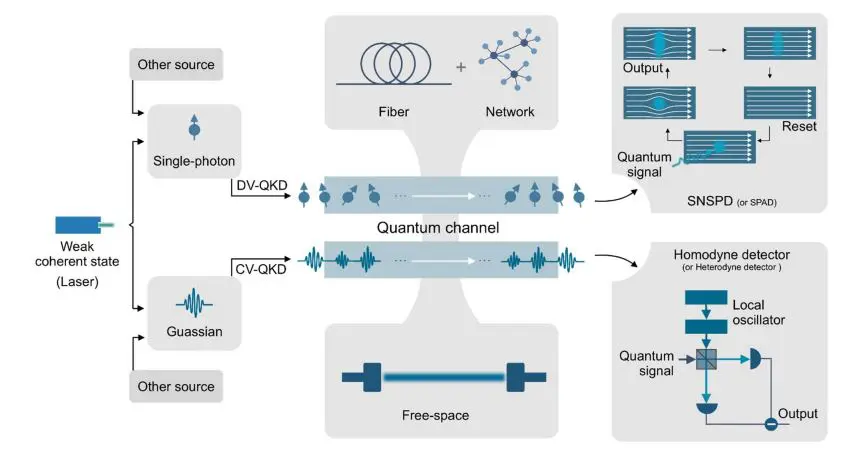
The field has evolved from initial fiber optic implementations, with significant progress in increasing transmission distances and key rates. QKD has also been demonstrated in free space, crucial for satellite-based QKD, and the Micius satellite has been instrumental in demonstrating intercontinental QKD. Crucial components of QKD systems include Single-Photon Detectors (SPDs), with Superconducting Nanowire Single-Photon Detectors (SNSPDs) increasingly used due to their high efficiency and low dark count rates. Efforts are now focused on building practical, integrated QKD networks, including metropolitan area networks, and integrating QKD with existing communication infrastructure.
Researchers are developing all-pass networks where QKD can
Researchers are developing all-pass networks where QKD can be seamlessly integrated without disrupting existing traffic, and quantum repeaters are essential for extending the range of QKD beyond current limitations. Several challenges remain, including distance limitations due to fiber attenuation and atmospheric turbulence, addressed by trusted nodes, quantum repeaters, and satellite-based QKD. Increasing the key generation rate is crucial for practical applications, driving improvements in detectors, modulation techniques, and protocols. Real-world implementations are susceptible to side-channel attacks and detector vulnerabilities, prompting certification and standardization efforts.
Innovative techniques like Twin-Field QKD are breaking the traditional rate-distance limit, and reducing the need for precise phase tracking further improves performance. QKD is a key building block for the future quantum internet, and standardization efforts are underway, with ETSI ISG-QKD playing a key role. Initial QKD systems were limited in range, but significant progress has been made in extending transmission distances. In 1993, a secure distance of 10 kilometers was achieved using the BB84 protocol, and by 2002, a plug-and-play system extended this to 67 kilometers. The introduction of the decoy state protocol further elevated practicality, exceeding 100 kilometers in secure distance, and in 2009, QKD reached 250 kilometers using ultra-low-loss optical fiber. The MDI-QKD protocol, proposed in 2012, drove long-haul advancements, leading to a 404-kilometer fiber-based QKD demonstration in 2016.
Satellite-based QKD was first achieved in 2017, alongside the first intercontinental quantum network utilizing satellite relay. The TF-QKD protocol, proposed in 2018, improved the relationship between key rate and transmission rate, and recent years have seen remarkable progress, with TF-QKD achieving 509 kilometers in 2020 and 830 kilometers in 2022 using ultra-low-loss fiber. In 2023, TF-QKD experiments exceeded 1000 kilometers, establishing long-haul QKD as a backbone for global quantum networks. Key numerical findings: * 10 kilometers: Secure distance achieved with the BB84 protocol in 1993. * 67 kilometers: Secure distance achieved with a plug-and-play system in 2002.
100 kilometers: Secure distance exceeded using the decoy state method
- 100 kilometers: Secure distance exceeded using the decoy state method. * 250 kilometers: QKD achieved over this distance in 2009, utilizing ultra-low-loss optical fiber. * 404 kilometers: MDI-QKD achieved over this fiber distance in 2016. * 509 kilometers: Distance achieved with TF-QKD in 2020, using ultra-low-loss optical fiber. * 830 kilometers: QKD demonstrated over this distance of optical fiber in 2022, using the TF-QKD protocol. This work comprehensively reviews current QKD implementations, focusing on protocols, devices, and the channels used to transmit quantum information.
🗞 Towards Global Quantum Key Distribution
🧠 ArXiv: https://arxiv.org/abs/2511.10982