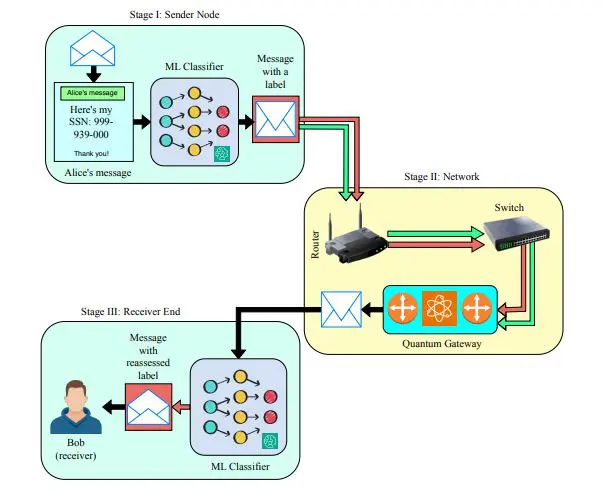
Quantum networks promise unparalleled security, but current designs struggle with the inherent noise and cost of scaling up, limiting their practical application. Nitin Jha, Abhishek Parakh, and Mahadevan Subramaniam, from Kennesaw State University and the University of Nebraska Omaha, address this challenge with a new approach to anonymous notification, a crucial element for secure quantum communication. Their research introduces an improved protocol that leverages the unique properties of quantum states to anonymously alert receivers to incoming messages, demonstrating significantly greater resilience to common channel noise than existing methods. This advancement not only strengthens the security of quantum-augmented networks, but also paves the way for more efficient data handling and reduced vulnerability to interference, representing a substantial step towards practical, scalable quantum communication infrastructure.
Anonymous Quantum Communication Beyond Key Exchange
Scientists are developing advanced quantum networks to enable secure communication, but current designs face challenges in scalability and practicality. This research focuses on enhancing these networks by enabling anonymous communication, ensuring that participants can exchange information without revealing their identities. The team builds upon established quantum key distribution and secure direct communication protocols to create a more robust and private system for quantum networks. The primary achievement of this work is a modified Quantum Anonymous Notification (QAN) protocol, designed to integrate seamlessly into broader quantum-classical augmented networks.
This protocol allows participants to send messages without revealing who sent them, achieved through a combination of quantum and classical techniques. The team aims for a system that is not only secure but also scalable to larger networks and resilient against various types of interference and noise. The approach leverages the strengths of both quantum and classical communication, using quantum techniques for secure key exchange and anonymous notification, while relying on classical methods for other communication aspects. This creates a network architecture that combines the benefits of both technologies.
The research utilizes multi-photon entanglement through GHZ and cluster states, building upon fundamental concepts in quantum information science, including quantum key distribution, secure direct communication, quantum secret sharing, and conference key agreement. This proposed system has several potential applications, including secure voting systems, privacy-preserving communication channels, enhanced security for smart grids and critical infrastructure, and the development of a more secure quantum internet. It also enables secure and anonymous data sharing among multiple parties. The team acknowledges some limitations, including the need for further analysis of entanglement fidelity under noisy conditions and more thorough testing of the system’s performance in different network configurations. Future work will focus on network simulations to assess performance in realistic environments, experimental implementation to validate security and performance, and exploration of new techniques to enhance scalability and robustness. Ultimately, this research presents a valuable contribution to the field of quantum communication, paving the way for a more secure and private quantum internet.
GHZ States Enhance Quantum Anonymous Notification
The research team has developed an improved Quantum Anonymous Notification (QAN) protocol designed to enhance security in quantum networks by preserving the anonymity of both sender and receiver. This protocol addresses limitations in existing methods, which often overlook the impact of noise and decoherence on entanglement fidelity. The core of the breakthrough lies in a modification to the standard QAN process, utilizing rotation operations on shared GHZ states to introduce a phase change that signals notification to the intended receiver. The team meticulously studied the protocol’s behavior under two types of noise models, demonstrating stronger resilience to false notifications compared to earlier approaches.
This involved distributing entangled GHZ states among network users, with each party receiving a qubit and its associated index. A crucial step involves distributing a secret angle across the network using quantum secret sharing, ensuring no single party learns its complete value. Each user then applies a local rotation to their qubit, with the notifier introducing a deliberate phase shift to signal the receiver. Measurements confirm that applying a Hadamard gate and performing measurements, followed by a private random permutation of the resulting bits, further enhances anonymity. The receiver can accurately detect a notification by calculating the post-measurement parity, while maintaining the privacy of all involved parties. This integration of the QAN protocol with Quantum Augmented Networks (QuANets) enables “switch independence”, allowing receivers to bypass compromised switches and reduce contextual leakage, thereby preserving end-point anonymity. The protocol’s effectiveness was validated through detailed simulations and analysis of potential attacks, confirming its robustness and practicality for future quantum communication systems.
Quantum Notification Protocol Enhances Network Security
This research presents an improved Quantum Anonymous Notification (QAN) protocol designed for integration with Quantum-Augmented Networks (QuANets), enhancing both security and scalability. The protocol utilizes quantum secret sharing to distribute a shared angle among network users, enabling anonymous notification of a receiver via pre-shared GHZ states. By modifying standard message packet structures, the system minimizes header information, thereby reducing the potential for compromised switches to gain contextual information and interfere with transmissions. The team demonstrated that the QAN protocol achieves a reliable notification-detection probability, even with a limited number of communication rounds, and exhibits a significantly lower false-positive rate compared to earlier approaches.
Analysis of potential attack scenarios confirms that the anonymity of sender-receiver pairs is maintained, even when considering compromised or semi-honest users within the network. The researchers acknowledge that future work could explore active attacks, such as rotation poisoning or targeted manipulation of quantum gates, and suggest mitigation strategies including certifications, signatures, and randomization of local bases to maintain network coherence and security. These advancements contribute to a more robust and scalable framework for secure communication than previously available.
🗞 An Improved Quantum Anonymous Notification Protocol for Quantum-Augmented Networks
🧠 ArXiv: https://arxiv.org/abs/2511.12313