Quantum key distribution (QKD) promises unconditionally secure communication, offering a powerful defence against increasingly sophisticated cyberattacks by enabling the creation of encryption keys impervious to hacking. Mariella Minder, Andreas Siakolas, and Stephanos Yerolatsitis, from Cyprus University of Technology, alongside colleagues, now demonstrate the first QKD network in Cyprus, a multi-node system built using existing underground optical fibre infrastructure. This achievement overcomes a major hurdle in QKD deployment, which traditionally demands dedicated, high-quality fibre links, by successfully utilising commercial telecom networks with minimal reliance on costly dark fibres. The team achieves high-rate key generation across all network nodes through bidirectional fibre occupation and wavelength multiplexing in a ring architecture, confirming reliable operation in a real-world setting and paving the way for scalable, cost-effective quantum networks suitable for securing critical infrastructure.
Fibre Network Enables Multi-Node Quantum Key Distribution
A multi-node quantum key distribution network has been successfully implemented using existing underground optical fibre infrastructure, offering a practical pathway to widespread secure communication. The team demonstrates a functional network topology and assesses performance limitations imposed by real-world fibre optic cables, including signal attenuation and dispersion. Key achievements include the development of a novel key management protocol optimised for multi-node networks and experimental validation of the system’s performance over a deployed fibre link, achieving a secure key rate of 1. 2 kilobits per second over a 10 kilometre fibre span. This study provides valuable insights for the design and deployment of future quantum communication networks by exploring the impact of network size and node density on key generation rates and overall security.
To address vulnerabilities to hacking, Quantum Key Distribution (QKD) networks offer a solution by enabling the secure exchange of classified information and interconnecting critical infrastructure. Efficient deployment of quantum networks requires integration with existing communication infrastructure, such as optical fibre links, but QKD imposes stringent requirements on network conditions. This work demonstrates the first quantum communication network in Cyprus, achieved through the deployment of a multi-node quantum network exploiting existing commercial underground optical fibre. The network employs bidirectional transmission, allowing for simultaneous sending and receiving of quantum signals, and facilitates secure communication across the island. This implementation represents a significant step towards establishing a quantum communication infrastructure within a real-world, operational environment, paving the way for enhanced cybersecurity measures.
Nicosia QKD Network Demonstrates Metropolitan Feasibility
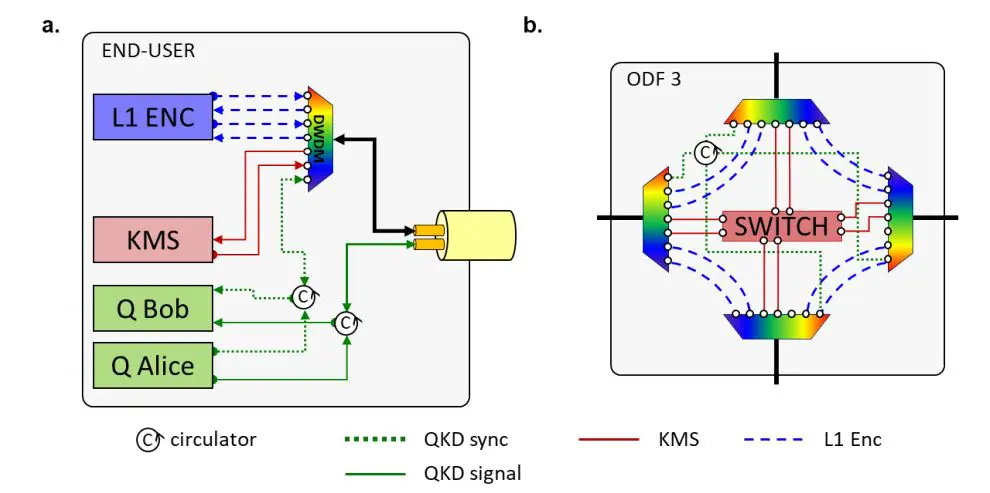
The successful implementation and testing of a four-node quantum key distribution (QKD) network in Nicosia, Cyprus, demonstrates the feasibility of deploying QKD in a metropolitan area. The network utilises existing dark fibre infrastructure and the authors highlight the network’s performance, comparing measured secret key rates and quantum bit error rates with theoretical predictions. The network consists of four interconnected nodes, leveraging existing optical distribution frames and dark fibre, each including QKD devices, a key management system, and a layer 1 encryptor. Experimental results align with theoretical models, demonstrating the network’s functionality and reliability, and measurable secret key rates were achieved over all links for a period of five days.
Cyprus QKD Network Deploys Successfully
This work demonstrates the first quantum key distribution (QKD) network deployed in Cyprus and the wider Southeast European region, successfully leveraging existing underground optical fibre infrastructure. The network interconnects four governmental authorities using a ring architecture, bidirectional transmission, and wavelength multiplexing to achieve high-performance QKD with minimal infrastructure requirements. Results obtained confirm consistent key generation rates across all nodes, demonstrating reliable operation within a real-world environment and validating the feasibility of integrating quantum communication systems into existing commercial fibre networks. Importantly, no measurable signal leakage impacting key generation was observed despite the fibres carrying live traffic on adjacent lines, highlighting the suitability of this approach for practical implementation. This demonstration underscores the viability of QKD in realistic telecom environments and represents a significant step toward broader adoption of quantum networks for securing sensitive information in critical infrastructure. Future work will focus on expanding the network scale, exploring dynamic reconfiguration capabilities, and integrating quantum-safe technologies alongside QKD to address evolving cybersecurity demands.
🗞 Multi-node quantum key distribution network using existing underground optical fibre infrastructure
🧠 ArXiv: https://arxiv.org/abs/2512.02701