

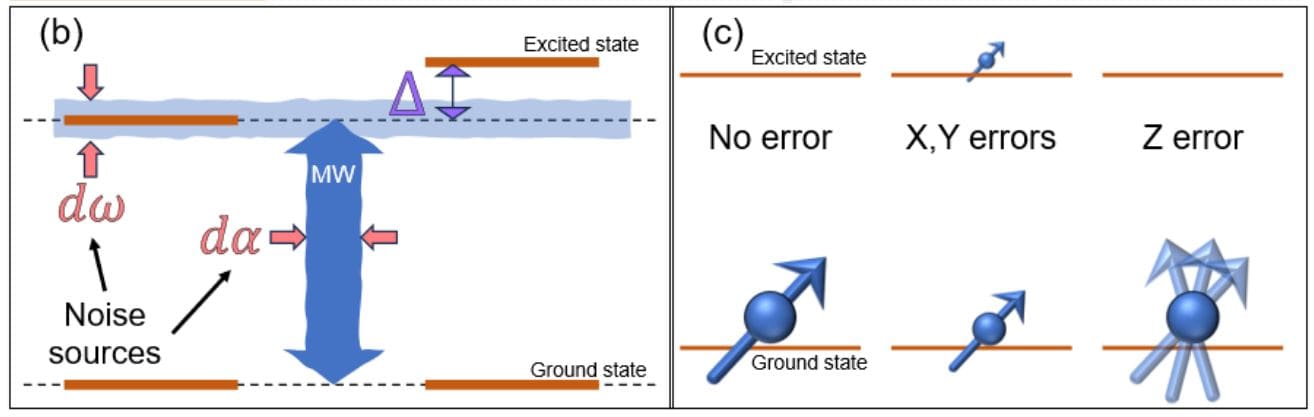
Achieving reliable quantum computation demands highly accurate quantum gates, but maintaining this accuracy in the face of real-world errors remains a significant hurdle for all quantum technologies. E. Poem, M. I. Cohen, and S. Blum, alongside colleagues, now demonstrate a breakthrough in error-protected quantum gates within a solid-state quantum network node. The team introduces Power-Unaffected, Doubly-Detuning-Insensitive Gates, or PUDDINGs, a novel theoretical framework for constructing gates that are simultaneously resistant to both random and systematic errors. Through a combination of room-temperature testing and theoretical projections, they achieve a record two-qubit error rate, significantly surpassing the thresholds required for advanced quantum error correction schemes and paving the way for practical, fault-tolerant quantum networks built on solid-state systems.
Researchers have demonstrated a breakthrough in error-protected quantum gates within a solid-state quantum network node, paving the way for more stable and scalable quantum computers. Through a combination of theoretical pulse engineering and experimental validation on a nitrogen-vacancy (NV) center in diamond, they achieve substantial improvements in gate performance.,.
Diamond NV Center Coherence and Gate Fidelity
Quantum computers rely on qubits, and maintaining the coherence of these qubits is crucial for performing complex calculations. Researchers are extensively studying nitrogen-vacancy (NV) centers in diamond as promising qubits due to their unique quantum properties. This research provides a comprehensive investigation of coherence and gate fidelity in diamond samples containing these NV centers. The study details the experimental setup and methods used to characterize coherence times and benchmark the performance of single- and two-qubit gates. Researchers measured various coherence times using techniques like Ramsey and Hahn echo experiments, and employed randomized benchmarking to assess gate performance. This work combines theoretical pulse engineering with experimental validation on a solid-state nitrogen-vacancy (NV) center in diamond, demonstrating substantial improvements in gate performance. Comprehensive randomized benchmarking of both single-qubit and two-qubit gates was performed, identifying and quantifying dominant error sources within the system. The team measured an improvement in the error per gate by up to a factor of nine when using PUDDINGs for single-qubit nuclear-spin gates at room temperature, despite a modest increase in gate duration.
For two-qubit conditional gates, experiments revealed a similar reduction in error rates, demonstrating the effectiveness of the PUDDING framework in suppressing both amplitude and frequency errors. By combining randomized benchmarking data with a detailed noise model, scientists projected the performance of PUDDINGs in isotopically purified diamond at cryogenic temperatures. These projections indicate a record two-qubit error per gate of 1. 2 × 10⁻⁵, corresponding to a gate fidelity of 99%. This level of performance is significantly below the thresholds required for advanced quantum error correction schemes, such as surface and color codes.
The development of PUDDINGs represents a viable pathway towards building fault-tolerant quantum networks, offering robust building blocks for future quantum technologies. The team’s measurements confirm that these gates are simultaneously insensitive to both power fluctuations and detuning errors, ensuring reliable quantum operations. This achievement marks the first experimental realization of error-protected conditional gates in solid-state systems, paving the way for more stable and scalable quantum computing architectures.,.
PUDDING Gates Achieve Ninefold Error Reduction
This research demonstrates a significant advance in the development of robust quantum gates, essential components for building practical quantum computers and networks. Scientists have successfully designed and experimentally validated a new framework for error-protected quantum gates using nitrogen-vacancy (NV) centers in diamond, achieving substantial improvements in gate fidelity. Through detailed error analysis and room-temperature randomized benchmarking, the team measured error reductions of up to a factor of nine compared to standard gate implementations.
Projections based on these results indicate that, when operated at cryogenic temperatures in isotopically purified diamond, PUDDING gates could achieve an error rate of 1. 2x 10⁻⁵, surpassing the thresholds required for advanced quantum error correction schemes like surface and color codes. These findings establish a new benchmark for gate fidelity in solid-state systems and demonstrate the potential of NV centers to support competitive performance alongside leading superconducting and trapped-ion platforms, while also offering unique advantages for quantum networking due to their optical connectivity and long-lived memories. Future work will likely focus on optimizing these aspects and exploring the application of PUDDINGs to other quantum hardware platforms. The convergence of precise pulse engineering, detailed noise modeling, and quantitative benchmarking presented here represents a crucial step towards building scalable, fault-tolerant quantum computers and networks, and the principles developed are expected to inform the design of robust gates across a wide range of quantum technologies.
👉 More information
🗞 Highly resilient, error-protected quantum gates in a solid-state quantum network node
🧠 ArXiv: https://arxiv.org/abs/2512.05322

