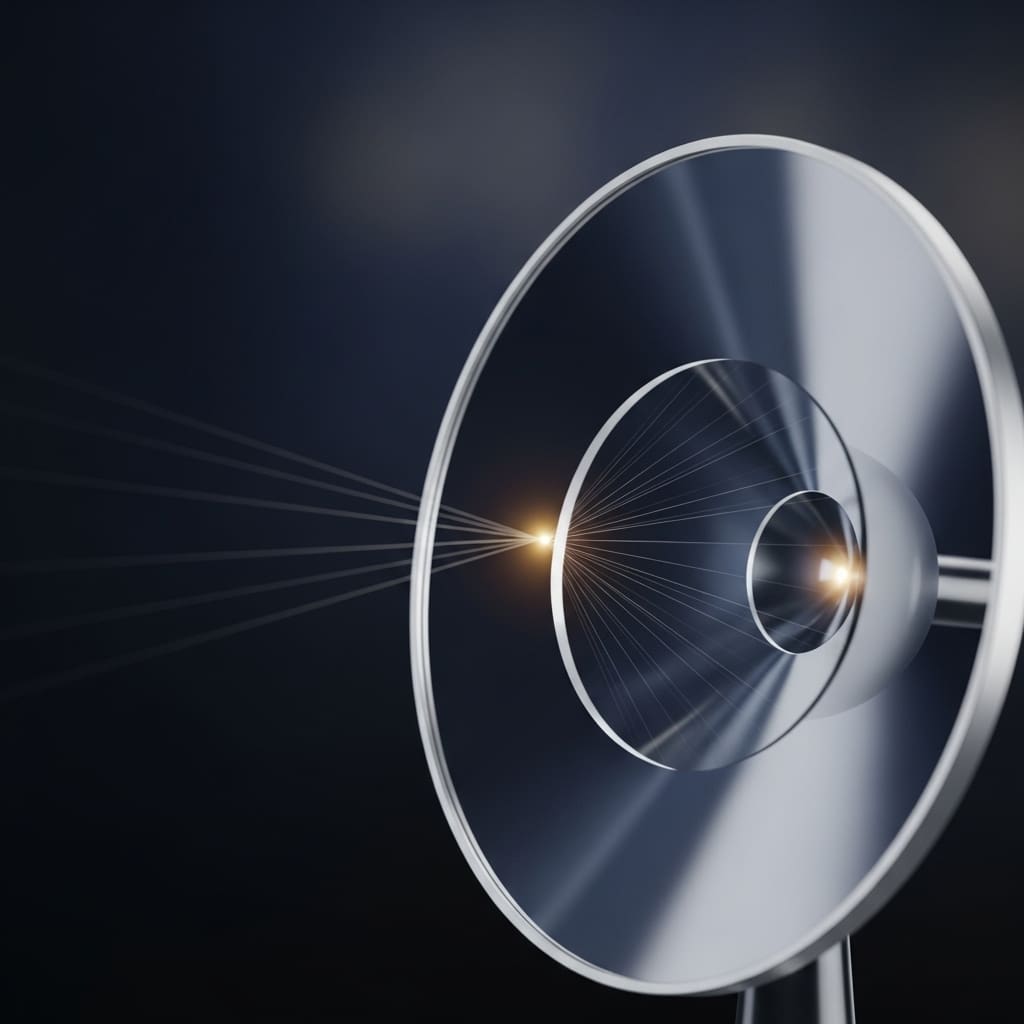
Scientists are tackling the challenge of building a quantum internet with a new, highly efficient node for quantum networks. A. Safari, E. Oh, and P. Huft, from institutions including (but not limited to) G. Chase, J. Zhang, and M. Saffman et al, have developed a compact, chip-based system utilising a parabolic mirror to trap and interface with single rubidium atoms , dramatically improving both photon collection and entanglement fidelity. This research is significant because it offers a robust, cavity-free design that sidesteps many of the complexities hindering scalable quantum networks, achieving a raw Bell state fidelity of 0.93 and paving the way for practical quantum repeaters and long-distance quantum communication.
Compact fibre-integrated node for atom-photon entanglement enables scalable
Scientists have demonstrated a novel neutral atom networking node combining high photon collection efficiency with exceptional atom-photon entanglement fidelity within a compact, fiber-integrated platform. The team achieved this breakthrough by employing a parabolic mirror to simultaneously form the atom trap and efficiently collect fluorescence from a single rubidium atom, intrinsically mode-matching the emitted photons to a single-mode fiber, a design rendering the system remarkably insensitive to minor imperfections or drifts. Core optical components, all millimeter-scale, were pre-aligned, rigidly bonded onto a monolithic in-vacuum assembly, and entirely interfaced via optical fibers, streamlining the setup and enhancing stability. With this innovative design, researchers measured an overall photon collection and detection efficiency of 3.66%, inferring an overall collection efficiency of 6.6% following single-mode fiber coupling, a substantial improvement over existing methods.
This work establishes a robust, cavity-free neutral atom interface operating near the theoretical limit dictated by the collection optics’ numerical aperture, providing a practical building block for scalable quantum network nodes and repeaters. The researchers generated atom-photon entangled states with a raw Bell-state fidelity of 0.93, and crucially, an inferred fidelity of 0.98 after correcting for atom readout errors, demonstrating high-quality entanglement essential for quantum communication. Notably, the same node design was successfully realized in two independent setups, confirming its reproducibility and robustness, and is compatible with the addition of high numerical aperture objective lenses for creating and controlling atomic arrays at each node. The parabolic mirror geometry, inspired by time-reversal symmetry, intrinsically mode-matches the emitted photons into the fiber, simplifying alignment and maximizing photon capture.
Experiments involved preparing a single rubidium atom in a specific quantum state before exciting it with a pulse, triggering the emission of a photon, the polarization of which becomes entangled with the atom’s internal state. Detection of the emitted photon, coupled through the single-mode fiber, allows for verification of the entanglement, with the fidelity assessed through careful characterization of the atom’s state and the photon’s polarization. The team’s meticulous approach to minimizing experimental errors and maximizing collection efficiency has resulted in a significant advancement in neutral atom quantum networking, paving the way for more complex and scalable quantum systems. This achievement opens exciting possibilities for building larger, more powerful quantum computers and secure communication networks.
Fiber-integrated rubidium trap and photon collection offer enhanced
Scientists engineered a compact, fiber-integrated platform for a neutral atom networking node, achieving high photon collection efficiency alongside high atom-photon entanglement fidelity. The core of this system utilizes a parabolic mirror to both form the rubidium atom trap and efficiently collect emitted fluorescence, intrinsically mode-matching the polarization of photons to the fiber, rendering the setup remarkably insensitive to minor imperfections or drifts. Millimeter-scale optical components were pre-aligned, rigidly bonded onto a monolithic in-vacuum assembly, and interfaced entirely via optical fibers, streamlining the experimental configuration. This design yielded an overall photon collection and detection efficiency of 0.63, translating to an inferred collection efficiency of 0.73 after single-mode fiber coupling.
Researchers generated atom-photon entangled states with a raw Bell state fidelity of 0.93, subsequently improving this to an inferred fidelity of 0.98 following atom readout. The same node design was independently realized in two separate setups, demonstrating comparable performance and compatibility with the addition of high numerical aperture objective lenses for creating and controlling atomic arrays at each node. To achieve linearly polarized dipole trapping, the team maximized the power measured at the output of a multi-mode fiber by rotating waveplates, ensuring an atom temperature below 20 μK with adiabatic cooling. Eight optical fibers within the in-vacuum assembly facilitated light input and output, exiting through Teflon plugs in Swageloks.
Experiments employed a magneto-optical trap (MOT) formed by two external beams aligned to pass through the parabolic mirror’s focus, overlapping with on-chip MOT beams at a 35° angle relative to the Macor plate normal, all MOT beams possessing a 0.5mm waist. Overlapping this cold atomic cloud with the parabolic mirror’s focus facilitated single-atom trapping, increasing the signal on single-photon counting modules (SPCMs). The apparatus eschewed a camera, relying solely on SPCM measurements to detect single atoms. Initial trap power of a couple of mW created a trap depth of approximately 1.5 mK, which was then adiabatically lowered to 500 μK for most of the experimental sequence.
To generate single photons, the study pioneered a scheme initially described in a prior publication, optically pumping the atom into |f = 1, mf = 0⟩ using π-polarized 795nm light delivered via a GRIN tube. A repump laser prevented population trapping in the f = 2 manifold, while chopping the trap light during optical pumping mitigated vector light shifts affecting pumping fidelity, resulting in an achieved fidelity of 0.987(12) verified by Rabi oscillations of the clock transition. The atom was then excited to |f’ = 0, mf = 0⟩ with a π-polarized pulse, and the resulting fluorescence, filtered to remove Raman scattering, was detected by the SPCM.
High-Fidelity Entanglement and Efficient Photon Collection are crucial
Scientists have demonstrated a novel neutral atom networking node exhibiting both high photon collection efficiency and high atom-photon entanglement fidelity within a compact, fiber-integrated platform. The research team achieved an overall photon collection and detection efficiency of 3.66%, inferring an overall collection efficiency of 6.6% following single-mode fiber coupling, a substantial advancement in light-matter interfacing. Experiments revealed the generation of atom-photon entangled states with a raw Bell-state fidelity of 0.93, which improved to an inferred fidelity of 0.98 after correcting for atom readout errors. This correction process meticulously accounted for imperfections in the atom state detection, yielding a more accurate representation of entanglement quality.
The core of this breakthrough lies in a design utilising a parabolic mirror for both trapping single rubidium atoms and efficiently collecting emitted fluorescence. This geometry intrinsically mode-matches the emitted photons to the fiber, rendering the system remarkably insensitive to minor imperfections or drifts, a critical feature for long-term stability and scalability. Measurements confirm that the system’s performance is largely dictated by the numerical aperture of the collection optics, indicating operation near the theoretical limit. The team constructed the optomechanical assembly from millimeter-scale components, pre-aligned and rigidly bonded on a monolithic in-vacuum assembly, and interfaced entirely via optical fibers, streamlining the setup and enhancing robustness.
Data shows the team successfully realised the same node design in two independent setups, both demonstrating comparable performance, validating the reproducibility and reliability of the approach. Furthermore, the design is compatible with the addition of high numerical aperture objective lenses, enabling the creation and control of atomic arrays at each node, paving the way for more complex quantum architectures. Analysis of single-photon detection timing revealed a fitted full width at half maximum (FWHM) of 18.7 ±0.2ns, aligning with the excited state lifetime, and an exponential decay time of 26.4 ±0.3ns. This robust, cavity-free neutral atom interface delivers a practical building block for scalable quantum network nodes and repeaters, offering a significant step towards realising long-distance quantum communication and distributed quantum computing . The work establishes a platform capable of generating high-fidelity entanglement, essential for applications ranging from secure communication to distributed sensing and enhanced computational power.
High-Fidelity Entanglement via Fibre Integration enables scalable quantum
Scientists have demonstrated a compact, fiber-integrated neutral atom networking node exhibiting both high photon collection efficiency and high atom-photon entanglement fidelity. The core of this achievement lies in a parabolic mirror which simultaneously traps a single rubidium atom and efficiently collects its fluorescence, intrinsically mode-matching emitted photons to a fiber. This design utilises millimeter-scale, pre-aligned components rigidly bonded within a vacuum assembly, simplifying interfacing with optical fibers. Measurements reveal an overall photon collection and detection efficiency of, translating to an inferred collection efficiency of after single-mode fiber coupling.
Researchers generated atom-photon entangled states with a raw Bell state fidelity of 0.93, improving to 0.98 after accounting for atom readout. The node’s robustness is highlighted by its insensitivity to magnetic noise and trap polarization, with atomic qubit rotation contributing only a minor portion to infidelity. While acknowledging contributions from factors like false photon detections and misalignment, the authors report successful implementation across two independent setups with comparable performance. This work establishes a practical, cavity-free neutral atom interface approaching the limits imposed by collection optics, a significant building block for scalable quantum networks and repeaters. Future research may focus on engineering parabolic mirrors with even higher numerical apertures, potentially achieving near-unit efficiency and further enhancing the light-matter interface. The current in-vacuum assembly is also designed to accommodate high-NA objective lenses, enabling the creation and control of atomic arrays at each node for distributed quantum information processing and scalable neutral atom quantum repeaters.
👉 More information
🗞 Efficient and compact quantum network node based on a parabolic mirror on an optical chip
🧠 ArXiv: https://arxiv.org/abs/2601.13420