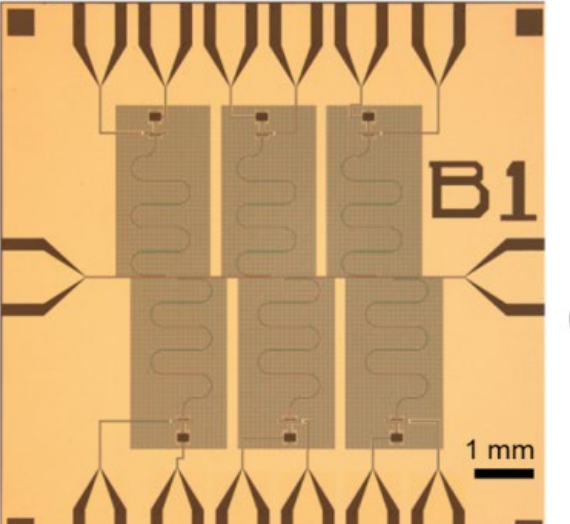
Superconducting circuits promise revolutionary advances in quantum computing and high-frequency electronics, but their sensitivity to magnetic fields currently limits performance. Bongkeon Kim, Chang Geun Yu, and Priyanath Mal, along with Yong-Joo Doh from the Gwangju Institute of Science and Technology, have addressed this challenge by fabricating and testing superconducting resonators from different materials, including niobium, niobium-titanium, and niobium-nitride. The team demonstrates that resonators made from a 45-nanometer-thick film of niobium-titanium maintain a high level of performance even in relatively strong magnetic fields, a crucial step towards building robust and reliable superconducting devices. This achievement offers a practical pathway for developing superconducting circuits that can operate effectively in real-world magnetic environments, paving the way for more versatile and powerful quantum technologies and hybrid circuits.
Superconducting coplanar waveguide resonators with high internal quality factors are essential for quantum information applications, but suffer performance degradation under magnetic fields due to energy loss. The team fabricated and characterised niobium (Nb), niobium titanium (NbTi), and niobium titanium nitride (NbTiN) superconducting coplanar waveguide (SCPW) resonators with varying film thicknesses, subjecting them to rigorous testing under different temperatures and in the presence of in-plane magnetic fields. This research focuses on achieving field resilience in these resonators, a critical factor for practical quantum technologies, by investigating different superconducting materials and optimising film thickness, ultimately contributing to the development of more robust and reliable quantum devices.
Superconducting Resonator Fabrication and Magnetic Field Response
Scientists engineered superconducting coplanar waveguide (SCPW) resonators from niobium (Nb), niobium titanium (NbTi), and niobium titanium nitride (NbTiN) to investigate magnetic field resilience, a crucial property for quantum information applications. The study focused on fabricating resonators with varying film thicknesses and then meticulously characterizing their performance under different temperatures and applied in-plane magnetic fields. Researchers employed thin-film deposition techniques to create the superconducting films, precisely controlling thickness to optimize resonator characteristics. To assess resonator quality, the team conducted temperature-dependent transmission measurements, systematically varying both temperature and magnetic field strength.
These measurements allowed scientists to determine the internal quality factor, a key metric indicating energy loss within the resonator, and to pinpoint the origins of performance degradation. Data obtained from these measurements aligned well with predictions from established theory, confirming the validity of the approach and enabling extraction of key parameters. Comparative analysis revealed that 45-nanometer-thick NbTi resonators maintained a high internal quality factor even when subjected to a magnetic field of 0. 4 Tesla, demonstrating superior performance compared to Nb and NbTiN counterparts.
This resilience stems from NbTi’s moderate kinetic inductance and its compatibility with established fabrication techniques, making it a practical material for building robust superconducting circuits. The team’s meticulous characterization of resonator performance under varying conditions provided crucial insights into the mechanisms governing magnetic field-induced losses, paving the way for the development of field-resilient devices. This work establishes NbTi as a promising platform for hybrid circuits operating reliably in challenging magnetic environments.
NbTi Resonators Exhibit High Internal Quality Factor
Superconducting coplanar waveguide (SCPW) resonators represent a crucial technology for quantum information processing, but their performance can be significantly diminished by magnetic fields due to energy loss. Researchers fabricated and meticulously characterized SCPW resonators constructed from niobium (Nb), niobium titanium (NbTi), and niobium titanium nitride (NbTiN) films of varying thicknesses, subjecting them to a range of temperatures and in-plane magnetic fields. Comparative analysis demonstrated that 45-nanometer-thick NbTi resonators maintained a high internal quality factor of 1. 01 × 10⁴ at an applied magnetic field of 0.
4 Tesla. This performance exceeds previously reported values for NbTi and molybdenum rhenium alloys, establishing NbTi as a promising material for resonators demanding both high performance and resilience in magnetic environments. Detailed analysis of the resonators at varying temperatures revealed systematic shifts in resonance frequency and reductions in internal quality factor at higher temperatures, consistent across all materials tested. Fitting experimental data to established theoretical models allowed precise determination of key resonator parameters, including the complex-valued quality factor and coupling quality factor.
The team achieved a fitted internal quality factor of 1. 67 × 10⁴ for a NbTi resonator with a 45-nanometer film thickness, alongside a coupling quality factor of 1. 51 × 10³ and a loaded quality factor of 1. 38 × 10³. These results highlight NbTi SCPW resonators as strong candidates for advanced quantum devices, including spin-based systems and field-resilient quantum circuits.
Niobium Titanium Resonators Excel in Magnetic Fields
This research successfully demonstrates the fabrication and characterization of superconducting coplanar waveguide resonators based on niobium, niobium titanium, and niobium titanium nitride films. The team systematically investigated resonator performance across varying film thicknesses, temperatures, and magnetic fields, confirming agreement with established theoretical models of superconducting behavior. Notably, 45-nanometer-thick niobium titanium resonators exhibited an optimal balance between high internal quality factor and resilience to magnetic fields, maintaining performance at a field strength of 0. 4 Tesla.
These findings establish niobium titanium as a promising material for building robust superconducting circuits, particularly for applications requiring operation in magnetic environments, such as hybrid quantum information systems. The researchers determined that the critical current density of niobium titanium nitride was the lowest among the materials tested, resulting in the greatest sensitivity to magnetic fields, while niobium titanium offered improved robustness against misalignment. This work provides a strong foundation for developing advanced superconducting technologies with enhanced performance and reliability.
🗞 Field-resilient superconducting coplanar waveguide resonators made of Nb, NbTi, and NbTiN
🧠 ArXiv: https://arxiv.org/abs/2509.20782