

The fundamental nature of relationships between entities remains a central question in physics, and recent work by Kassahun H. Betre from San Jose State University and Nathan Lewis from Mission College investigates this through a novel approach to quantum graph theory. They explore the quantization of multigraphs, networks allowing multiple connections between points, treating these relationships not simply as representations of particle interactions, but as dynamical elements in their own right. This research establishes a framework for representing both labelled and unlabelled multigraphs within a quantum mechanical context, revealing that removing the distinction between individual points dramatically alters the system’s behaviour. The team demonstrates that unlabelled graphs exhibit genuine phase transitions, marked by changes in specific heat and critical slowing, unlike their labelled counterparts which resemble a well-known model of random graphs without such transitions, offering a potentially powerful new lens through which to study complex systems and, ultimately, the foundations of gravity.
Multigraph Dynamics and Monte Carlo Simulation
The study pioneers a method for quantifying labeled and unlabeled finite multigraphs, treating them as fundamental dynamical elements rather than simply representations of relationships between particles. Researchers developed a framework to represent these multigraphs, enabling analysis of their Hilbert space realizations. This involved defining a Hilbert space and focusing on simple graphs, exploring their behavior using both a free Hamiltonian and an Ising-type Hamiltonian with interactions between neighboring edges. To explore these models, scientists employed a Metropolis algorithm, modified to account for graph symmetries, and utilized orbital Markov chain Monte Carlo methods.
This sampling technique was validated through comparisons with exact computations of partition functions for N = 7, 8, 9, and 10, ensuring accurate representation of the system’s statistical properties. The free Hamiltonian was investigated, with a rescaled form, H0, defined to ensure extensivity with the number of vertices, N. Researchers analytically computed the labeled partition function, revealing its connection to a single edge state raised to the power of the total number of possible edges. Analysis demonstrated its equivalence to the Erdős, Rényi, Gilbert model of random graphs, a significant finding given the extensive literature surrounding this well-known model.
The team calculated the free energy, internal energy, and specific heat per vertex, finding them analytic in β, indicating the absence of a phase transition in the labeled graph system. However, transitioning to unlabeled graphs revealed qualitatively different behavior, with the partition function computed using Pólya’s enumeration theorem and the cycle index of the pair group S(2) N. This enabled the identification of proper phase transitions in both the free and ferromagnetic Ising models, characterized by divergence in specific heat and critical slowing near the critical temperature, signaled by an order parameter defined as the fraction of vertices in the largest connected component.
Multigraph Hilbert Space and Random Graph Connection
Scientists successfully developed a method for quantifying the Hilbert space of multigraphs, representing relationships between elements as fundamental degrees of freedom. This work establishes a framework for treating these relationships mechanically, leading to the realization of Hilbert spaces that describe relations themselves. Investigations focused on simple graphs using both free and Ising-type Hamiltonians, revealing that removing distinctions between vertices leads to qualitatively different outcomes. The team found that the free theory of labeled simple graphs corresponds directly to the Erdős, Rényi, Gilbert model of random graphs, which exhibits no phase transition, possessing analytic free energy.
In contrast, unlabeled graphs demonstrate proper phase transitions in both the free and ferromagnetic Ising models, characterized by divergence in specific heat and critical slowing. The observed phase transition is defined by an order parameter representing the fraction of vertices within the largest connected component, signifying a genuine phase transition. Further analysis involved examining the action of the symmetric group on tensor product Hilbert spaces, leading to the development of symmetrizers and antisymmetrizers that project physical states onto invariant subspaces. These projections result in unique physical states fully described by the number of particles in each single-particle state, allowing a transition from occupation set basis to the familiar occupation number basis.
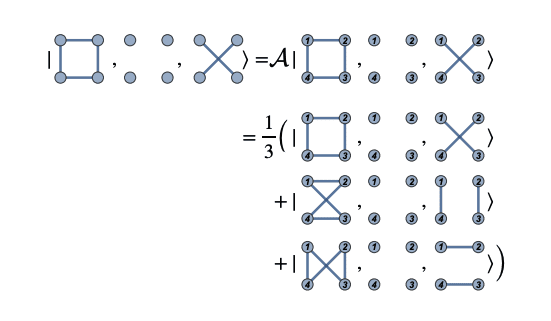
Calculations reveal that for N particles and D states, the number of symmetric basis kets is given by N+D−1 choose N, while fully antisymmetric states are limited to D choose N when D is greater than or equal to N. Researchers then extended this framework to unlabeled quantum multigraphs, imposing restrictions on the symmetric group’s action to ensure physical states transform only by a phase. This led to the discovery that the action of the symmetric group on quantum multigraphs results in a block diagonal representation, with each block corresponding to a multigraph isomorphism class. Within each block, a one-dimensional irreducible representation is found, either the trivial representation or the sign representation, defining the physical Hilbert space of unlabeled quantum graphs.
Quantum Multigraphs Exhibit Phase Transitions
This work presents a novel approach to understanding the fundamental building blocks of spacetime by treating quantum multigraphs as dynamical degrees of freedom. Researchers developed a Hilbert space framework for these multigraphs, allowing for the exploration of their quantum properties and potential dynamics, extending previous work on quantum graphity. Investigations into both labeled and unlabeled graphs, using free and Ising-type Hamiltonians, revealed key distinctions in their behavior. Notably, the study demonstrates that unlabeled graphs exhibit phase transitions, characterized by diverging specific heat and critical slowing, which are absent in the labeled graph model. This phase transition is linked to the fraction of vertices within the largest connected component, signifying a fundamental shift in the system’s organization. The team acknowledges that the current models are simplified representations and do not fully capture the complexity of spacetime, and future research will focus on exploring more realistic interactions and extending the framework to include gravity.
👉 More information
🗞 Dynamical Quantum Multigraphs
🧠 ArXiv: https://arxiv.org/abs/2509.08296


