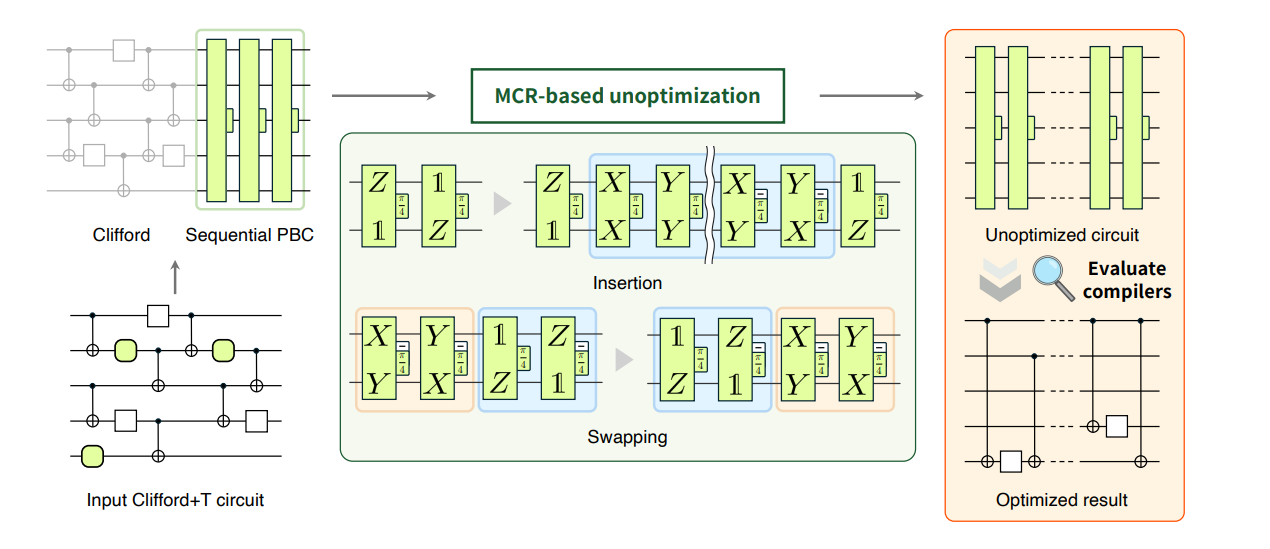
Reducing the number of complex ‘T gates’ represents a critical challenge in building practical quantum computers, and researchers are continually seeking new ways to optimise quantum circuits. Yusei Mori, Hideaki Hakoshima, and Keisuke Fujii, from The University of Osaka and RIKEN Center for Quantum Computing, now demonstrate a previously unrecognised principle for simplifying these circuits. The team discovered a novel mathematical relationship, termed the multi-product commutation relation, which allows for the rearrangement of quantum operations in a way that reduces the total number of T gates required. Through a clever technique of intentionally adding complexity to existing circuits, they prove that current quantum compilers fail to exploit this simplification, revealing a significant opportunity to improve performance and accelerate progress towards fault-tolerant quantum computation.
T-Gate Reduction Via Pauli Commutation Relations
Quantum computation relies on universal gate sets, and the Clifford+T gate set is widely used due to its relatively shallow circuit depth. However, the non-Clifford T-gate significantly increases circuit complexity, and reducing its count remains a central challenge in quantum algorithm compilation and hardware implementation. This work introduces a novel multi-product commutation relation that enables the cancellation of T-gates in sequential Pauli-based computation. The method systematically transforms quantum circuits by exploiting commutation relations between Pauli operators and T-gates, effectively reducing the overall T-count without altering the computed result.
Specifically, the research demonstrates that by rearranging Pauli operators and strategically applying commutation rules, certain T-gates can be eliminated or replaced with lower-cost Clifford gates. The team rigorously proves the validity of this transformation and quantifies the potential T-count reduction achievable through this approach. This new commutation relation offers a significant advancement in quantum circuit optimisation, paving the way for more efficient and scalable quantum computations.
Multi-Component Reduction Optimizes Quantum Circuit Complexity
This research introduces the multi-component reduction (MCR) algorithm, a new technique for simplifying quantum circuits and reducing the number of T-gates required for computation. This is crucial for running algorithms on near-term quantum computers, which have limited qubit counts and are prone to errors. The MCR algorithm focuses on identifying and reducing redundant components within the circuit, offering a novel approach to quantum circuit optimisation. The team benchmarked MCR against established quantum circuit optimisation techniques, including methods based on polynomial-time T-depth optimisation, Reed-Muller codes, ZX-calculus, and alphatensor.
They have also implemented MCR as a software tool and made it publicly available, facilitating further research and development. The potential applications of MCR extend to various quantum algorithms, including the Variational Quantum Eigensolver (VQE), the Quantum Approximate Optimization Algorithm (QAOA), quantum machine learning, and time evolution algorithms. The researchers used benchmark circuits from the Reversible Logic Synthesis suite and those generated from quantum algorithms to evaluate MCR’s performance. The primary metric used was the reduction in T-gate count, alongside circuit depth and runtime. This work builds on concepts from quantum information theory, graph theory, and formal methods to justify the effectiveness of MCR, and suggests it could be used with error mitigation techniques in partially fault-tolerant architectures. By advancing quantum compilation, MCR has the potential to enable larger and more complex algorithms and accelerate the pace of quantum computing research, bridging the gap toward fault tolerance and paving the way for more powerful and reliable quantum computers.
Multi-Product Commutation Reveals Compiler Limitations
This work introduces the multi-product commutation relation (MCR), a new technique for rewriting quantum circuits composed of Clifford and T gates. The researchers demonstrate that MCR enables equivalent transformations involving multiple rotation gates, capturing commutativity beyond what simpler rules achieve. To assess its impact, they developed a method called quantum circuit unoptimization, which intentionally adds redundancy to circuits while maintaining equivalence and a guaranteed optimal T-count. This allows for quantitative evaluation of how effectively compilers can eliminate redundant gates.
Through numerical experiments, the team found that existing compilers struggle to optimize circuits transformed using MCR-based unoptimization, suggesting that current compilation strategies do not fully incorporate this commutation rule. The researchers validated this finding by comparing optimization results with and without MCR-based swaps, showing a clear difference in performance. The authors acknowledge that the number of possible MCR-based rewrites increases rapidly with the number of qubits, potentially limiting scalability. Future work may focus on developing more efficient methods for identifying and applying these transformations, or on integrating MCR-aware techniques directly into existing compilers, highlighting an unexplored area in quantum compilation and offering a pathway toward more efficient quantum circuits.
🗞 Nontrivial multi-product commutation relation for reducing T-count in sequential Pauli-based computation
🧠 ArXiv: https://arxiv.org/abs/2509.20052