Twisted bilayer graphene, a material exhibiting remarkable superconducting properties, continues to fascinate physicists seeking to understand the origins of its behaviour, and Shi-Chao Fang and Xin-Yi Liao from Nanyang Institute of Technology, along with their colleagues, have now shed new light on the interplay between magnetism and superconductivity within this complex system. The team employed a powerful computational technique, quantum Monte Carlo simulation, to investigate how electron interactions and the precise twist angle between the graphene layers influence the emergence of superconductivity. Their results demonstrate that a specific type of electron pairing, known as chiral d+id-wave, dominates the superconducting state, and crucially, that manipulating the twist angle can significantly enhance this pairing, potentially leading to materials with even higher superconducting transition temperatures. This research advances our fundamental understanding of strongly correlated materials and offers a pathway towards designing novel superconductors with improved performance.
Conducting research into pairing mechanisms within twisted bilayer graphene, and understanding how the twist angle influences superconductivity, forms the central focus of this investigation. The study initially explores how electron-phonon coupling modulates superconductivity, demonstrating its significant role within the system.
Magic Angle Graphene Superconductivity Investigation
This extensive research details the superconducting properties of twisted bilayer graphene (TBG) and related moiré materials. The core research area investigates the mechanisms behind superconductivity in TBG, specifically focusing on how factors like twist angle, electron density, and external fields influence the superconducting transition temperature. It also explores the role of strong electron correlations and magnetism in these materials. Key findings demonstrate that superconductivity emerges at specific magic angles in TBG, where the moiré pattern creates flat bands and enhances electron correlations, leading to a high density of states near the Fermi level and promoting electron pairing.
The superconducting transition temperature is highly sensitive to both the twist angle and the electron density, and fine-tuning these parameters is essential to achieve optimal superconductivity. The research also highlights a complex interplay between superconductivity and magnetism, with evidence suggesting that magnetism can both suppress and, in some cases, enhance superconductivity. The presence of correlated insulating states near the superconducting dome is also discussed. The moiré pattern created by twisting the graphene layers is fundamental to the emergence of flat bands and the resulting superconducting behavior.
The research utilizes a combination of theoretical modeling, including mean-field theory, dynamical mean-field theory, and density functional theory, alongside computational simulations to understand the underlying physics. These findings are supported by experimental observations from various groups, including transport measurements, scanning tunneling microscopy, and spectroscopic studies. The paper aims to provide a comprehensive understanding of the complex physics governing superconductivity in TBG and related moiré materials. It seeks to unravel the mechanisms responsible for the emergence of superconductivity, identify the key factors that control the transition temperature, and explore the interplay between superconductivity, magnetism, and electron correlations. The ultimate goal is to guide the design of new materials with even higher transition temperatures and improved superconducting properties.
Twist Angle Drives Chiral Superconducting Pairing
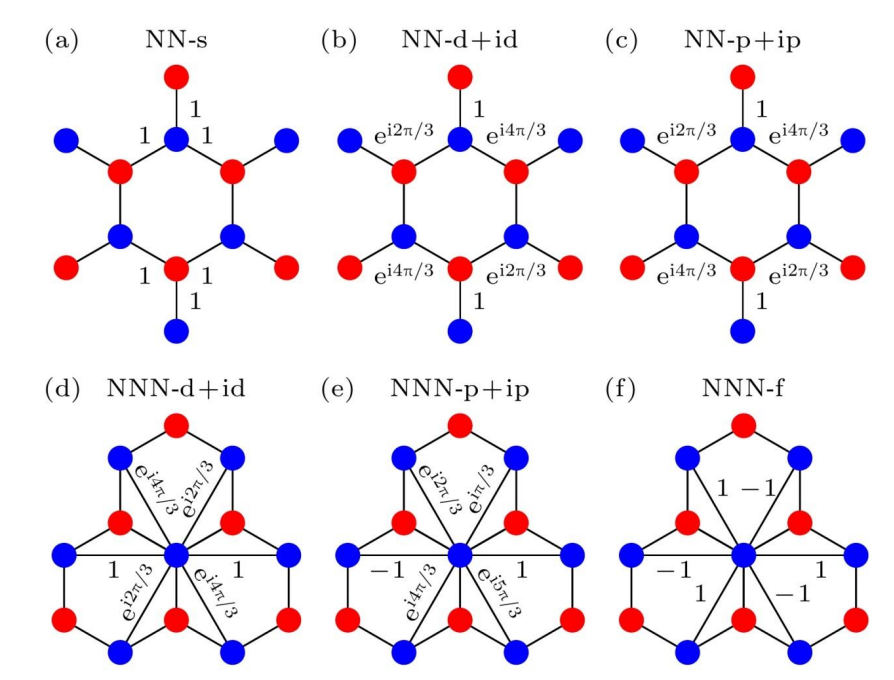
Scientists achieved a comprehensive understanding of superconductivity in twisted bilayer graphene through large-scale quantum Monte Carlo simulations of the effective two-orbital Hubbard model. The research focused on the interplay between correlated states and the superconducting pairing mechanism, revealing the significant role of electron-phonon coupling in the system. Numerical results demonstrate that the superconducting state is dominated by chiral nearest-neighbor d+id electron pairing symmetry, and nearest-neighbor attractive Coulomb interactions substantially enhance the effective long-range pairing correlation function of this chiral wave. Investigations into the influence of the twist angle on superconductivity revealed a critical relationship between angle and pairing strength.
As the twist angle deviates downward from 1. 08°, the effective pairing correlation function of the chiral nearest-neighbor d+id wave increases substantially, suggesting a pathway to higher superconducting transition temperatures. Conversely, angles exceeding 1. 08° exhibit a decline in this correlation function, indicating an optimal range for maximizing superconductivity. These findings demonstrate that reducing the twist angle may lead to enhanced superconducting properties within the twisted bilayer graphene system.
Further analysis explored the connection between magnetism, flat-band structures, and superconductivity. Observations of enhanced spin structure factor near the Γ point in the Brillouin zone confirm that increased antiferromagnetic correlations are essential for both enhancing the superconducting transition temperature and stabilizing the chiral nearest-neighbor d+id wave. These results provide guidance for identifying twist-angle systems with potentially higher superconducting transition temperatures and contribute to a more comprehensive understanding of strongly correlated systems like twisted bilayer graphene.
Twist Angle Modulates Graphene Superconductivity
This research presents a detailed investigation into the pairing mechanisms driving superconductivity in twisted bilayer graphene, employing large-scale quantum Monte Carlo simulations. The team demonstrates that electron-phonon coupling significantly modulates superconductivity, and identifies chiral nearest-neighbor pairing symmetry as dominant within the system. Importantly, the study reveals that deviations from a 1. 08° twist angle substantially enhance the effective pairing correlation function, suggesting a pathway towards identifying configurations with potentially higher superconducting transition temperatures.
However, the researchers acknowledge a significant challenge in accurately determining pairing symmetry from correlation functions alone. Their analysis indicates that the non-interacting components of the system strongly influence observed pairing symmetries, potentially obscuring the effects of electron interactions. The team addressed this by examining the evolution of pairing symmetries in the absence of interactions, confirming that triplet nearest-neighbor pairing remains prominent even without Coulomb interactions. This suggests that the observed pairing symmetry is fundamentally linked to the electronic structure of the non-interacting system, rather than solely arising from interactions. Future work will focus on analyzing pairing symmetry based on the effective pairing correlation function, building on recent experimental and theoretical advances in understanding electron-phonon coupling in one-dimensional copper-based superconductors.
🗞 Quantum Monte Carlo study of magnetism and chiral d+id-wave superconductivity in twisted bilayer graphene
🧠 ArXiv: https://arxiv.org/abs/2511.06631