Understanding the behaviour of electrons in complex materials remains a central challenge in physics, particularly when seeking to unlock the secrets of high-temperature superconductivity. Etienne Granet, Sheng-Hsuan Lin, and Kevin Hémery, alongside colleagues at Quantinuum, now demonstrate a significant step forward by directly observing superconducting pairing correlations using a trapped-ion quantum computer. The team successfully simulates the Fermi-Hubbard model, a cornerstone for understanding strongly correlated materials, and measures these elusive pairings in multiple regimes, including those relevant to nickelate superconductors. This achievement overcomes previous limitations in detecting off-diagonal correlations and preparing superconducting states, proving that quantum computers can reliably create and probe the key features of these complex materials and paving the way for a deeper exploration of superconductivity.
Trapped-Ion Quantum Simulation of Condensed Matter Models
This research details experiments performed on Quantinuum’s Helios quantum computer to simulate complex condensed matter physics models, including the Hubbard model and the Toric Code. The primary goal is to demonstrate the ability of trapped-ion quantum computers to solve problems intractable for classical computers and to explore the limits of current hardware. The team focused on developing techniques for circuit compilation, optimization, and error mitigation to achieve accurate simulations, benchmarking their results against theoretical predictions from methods like Quantum Monte Carlo to validate their findings. Researchers successfully simulated the half-filled Hubbard model on a 6×6 lattice, measuring energy density and double occupancy to confirm agreement with theoretical calculations.
They then extended their simulations to explore the effects of doping on the system’s properties, measuring the single-particle gap and spectral function, and investigated a bilayer Hubbard model, simulating a two-layer system to understand interlayer interactions and the emergence of correlated states. Furthermore, they demonstrated the ability to prepare and measure the Toric Code, a model for quantum error correction, and measured its logical error rates. A major focus of the work was error mitigation, employing techniques such as Zero-Noise Extrapolation, Probabilistic Error Cancellation, and Symmetry Verification to reduce the impact of noise on simulation results. They also implemented readout error mitigation and dynamical decoupling to further improve accuracy. The experimental setup utilized Quantinuum’s Helios trapped-ion quantum computer, and researchers carefully calibrated the qubits and gates to optimize performance. The results demonstrate a significant step towards building practical quantum simulators and achieving quantum advantage.
Simulating Correlated Materials on Trapped-Ion Qubits
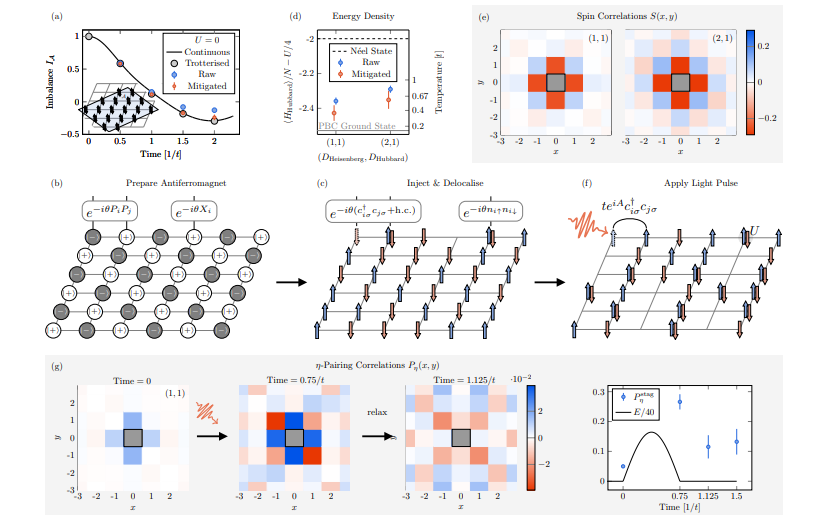
This study pioneers a novel approach to simulating strongly correlated materials using Quantinuum’s Helios trapped-ion quantum computer, featuring 98 highly connected qubits. Researchers developed a method to reliably create and probe states exhibiting superconducting pairing correlations, a significant step towards understanding superconductivity with quantum systems. They began by benchmarking the computer’s capabilities at half-filling, densely packing a 6×6 lattice with fermions and measuring the system’s evolution. To prepare low-energy states at higher interaction strengths, the team engineered a ground state preparation technique based on injecting states with locally fixed fermionic parity.
This involved first preparing an approximate ground state of the Heisenberg model, then delocalizing the fermions using a carefully designed circuit. Researchers adapted and extended local fermionic encodings and developed new error mitigation strategies to improve the fidelity of the simulations. The study demonstrates the induction of non-equilibrium pairing correlations in a half-filled square lattice, even though the ground state is not superconducting. Furthermore, the team prepared an approximate ground state of a doped model, observing pairing correlations with d-wave symmetry, and successfully simulated a bilayer Hubbard model relevant to nickelate superconductors, revealing s-wave pairing in the limit of strong interlayer spin-exchange coupling. These results, enabled by theoretical advancements and improved techniques, represent a significant breakthrough in utilizing quantum computers to explore the complex physics of superconductivity.
Superconducting Correlations Measured in Quantum Simulation
Scientists have achieved a significant breakthrough in simulating strongly correlated materials using a trapped-ion quantum computer, demonstrating the measurement of superconducting pairing correlations in three distinct regimes of the Fermi-Hubbard model. Experiments performed on Quantinuum’s Helios platform successfully detected non-equilibrium pairing induced by an electromagnetic field within a half-filled square lattice model. The team prepared an approximate ground state of a doped model, observing d-wave pairing correlations, and prepared low-energy states of a bilayer Hubbard model, relevant to nickelate superconductors, and measured s-wave pairing. The research involved preparing a 6×6 lattice densely packed with fermions and evolving the system to measure the imbalance, a key indicator of pairing.
By injecting states with locally fixed fermionic parity and utilizing new time evolution circuits, the team created low-energy states and subjected them to electromagnetic pulses, resulting in a measurable increase in pairing correlations. Measurements of spin-spin correlations within the doped model confirmed d-wave symmetry, while the bilayer model exhibited s-wave pairing, demonstrating the ability to simulate different superconducting states. The average standard error on the mean for key measurements was consistently low, validating the precision of the results. These findings represent a crucial step towards exploring superconductivity with quantum computers and understanding the mechanisms behind unconventional superconductivity.
Simulating Superconductivity with Trapped Ions
Scientists have successfully simulated the Fermi-Hubbard model, a cornerstone for understanding strongly correlated materials including high-temperature superconductors, using a trapped-ion quantum computer. This work demonstrates the reliable creation and probing of states exhibiting superconducting pairing correlations, a significant step towards exploring superconductivity with quantum systems. Specifically, the team observed non-equilibrium pairing, d-wave correlations in a doped model, and s-wave correlations in a bilayer system relevant to nickelate superconductors, across multiple regimes of the model. Researchers developed techniques to coherently inject states with fixed fermionic parity into their quantum encoding, enabling access to and exploration of superconducting phases.
While the simulations were successful, the authors acknowledge that the accumulation of errors from the hardware currently limits the duration of adiabatic evolution, a key technique used in the simulations. Future work will focus on mitigating these errors, potentially through improved gate fidelity, advanced error correction codes, or algorithmic refinements. The demonstrated techniques are adaptable to other geometries and Hamiltonian terms, offering the potential to introduce dopants coherently and further expand the scope of quantum simulations of complex materials. This research establishes a promising platform for gaining a deeper microscopic understanding of superconductivity and potentially informing the design of future superconducting materials.
🗞 Superconducting pairing correlations on a trapped-ion quantum computer
🧠 ArXiv: https://arxiv.org/abs/2511.02125