

Quantum communication networks promise unconditionally secure communication, and continuous-variable quantum key distribution (CV-QKD) offers a particularly promising approach due to its compatibility with standard optical technology and potential for high data rates. However, the practical implementation of CV-QKD faces challenges from signal loss and noise, which can compromise security. Zhiyue Zuo from Central South University, Masoud Ghalaii from Manchester Metropolitan University, and Stefano Pirandola from the University of York, now present a comprehensive framework for assessing the security of CV-QKD protocols under realistic conditions. Their work considers various levels of trust in the communication channel, encompassing both fibre optic cables and free-space links, including satellite-based communication, and reveals critical trade-offs between key generation rate, system noise, communication distance, and the level of trust placed in the network infrastructure. Importantly, the team demonstrates that even with limited trust, free-space communication via satellite can outperform traditional ground-based quantum repeaters, offering a viable path towards long-distance, secure quantum networks.
Realistic Threats to Continuous-Variable QKD
Future quantum communication networks, or a quantum Internet, require robust and practical quantum key distribution (QKD) protocols. Current QKD security analyses often simplify threat models, potentially overlooking real-world limitations and potential attacks. This work investigates realistic threat models for continuous-variable QKD (CV-QKD) systems, considering both fiber and free-space channels. The research quantifies the impact of imperfections, including detector noise, signal loss, and imperfect state preparation, on CV-QKD security. The approach develops a comprehensive framework for modelling attacks against CV-QKD systems, incorporating both collective and individual attack strategies.
This framework accounts for statistical fluctuations inherent in quantum measurements and the limitations of practical devices. Researchers then derive rigorous security bounds, expressed as achievable key rates, for different system parameters and attack strategies. The analysis considers coherent state QKD and its variations to provide a comprehensive assessment of security performance. Specific contributions include a novel security analysis for CV-QKD systems operating with correlated Gaussian noise, a common characteristic of real-world detectors, and details the impact of signal loss on the achievable key rate, demonstrating the trade-offs between transmission distance and security. The research also introduces a method for optimizing system parameters, such as signal strength and modulation variance, to maximize the key rate while maintaining a desired level of security.
Continuous-Variable Quantum Key Distribution Advances
Continuous-variable (CV) quantum key distribution (QKD) offers a powerful setting for secure quantum communications, utilizing room-temperature off-the-shelf optical devices and the potential for high rates. However, the achievable performance of CV-QKD protocols is fundamentally limited by their vulnerability to both signal loss and noise. This study provides a general framework for analyzing the composable finite-size security of CV-QKD with Gaussian-modulated coherent-state protocols (GMCS) under various levels of trust regarding signal loss and noise.
Realistic CV-QKD Security Analysis for Networks
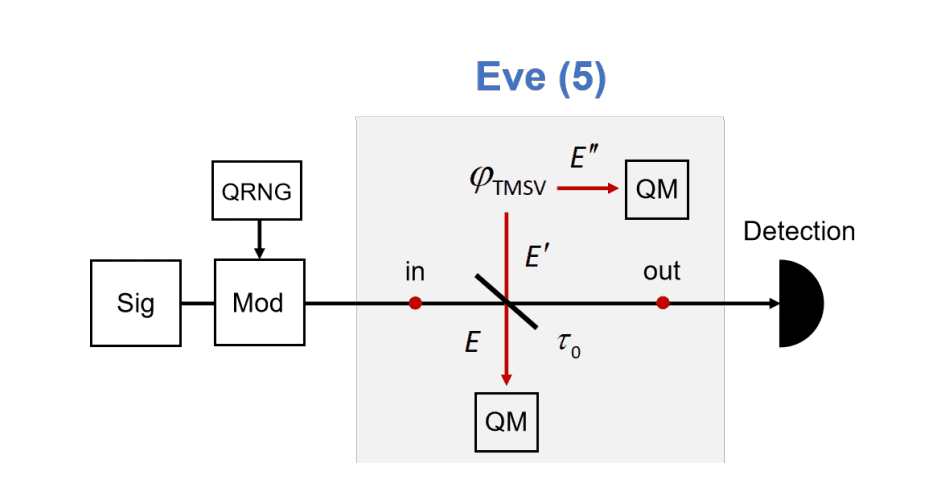
This research presents a comprehensive framework for evaluating the security of continuous-variable quantum key distribution (CV-QKD) protocols, accounting for realistic imperfections in quantum communication systems. The team developed a method to assess security under varying levels of trust regarding signal loss and noise, encompassing scenarios with both passive and active eavesdropping attempts. This analysis extends to both fiber-based and wireless communication channels, including satellite links, providing a versatile tool for designing practical quantum networks. The results demonstrate that maintaining robust security against untrusted loss at the transmitter is particularly challenging, yet satellite-based quantum communication can outperform ground-based systems utilizing ideal quantum repeaters, highlighting the potential of satellite links as a viable component of future quantum networks. The authors acknowledge that the security analysis relies on accurate modeling of system noise and that further research is needed to address the complexities of real-world implementations, with future work focusing on optimizing protocols to mitigate the trade-offs between key rate, trust level, noise, and communication distance.
👉 More information
🗞 Realistic Threat Models for Fiber and Free-Space Continuous-Variable Quantum Key Distribution
🧠 ArXiv: https://arxiv.org/abs/2510.06971


