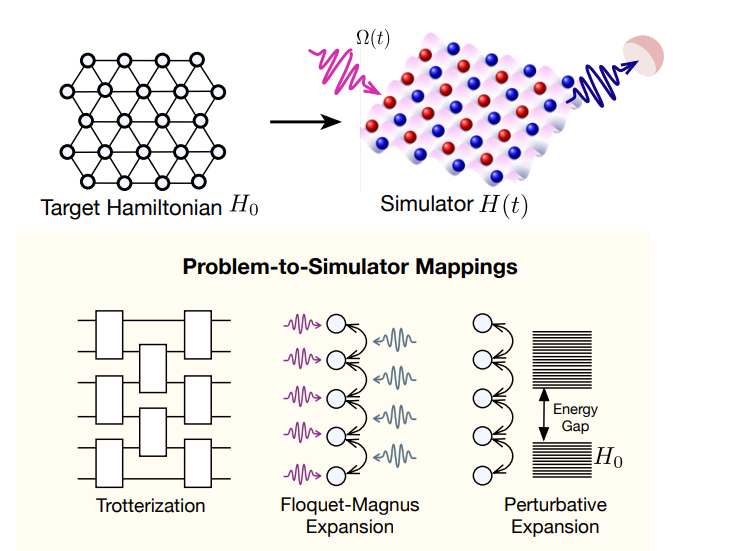
Understanding the behaviour of complex quantum systems presents a significant challenge for physicists, often requiring the use of quantum simulators to model their dynamics. Rahul Trivedi and J. Ignacio Cirac, from the Max Planck Institute of Quantum Optics and the Munich Center for Quantum Science and Technology, investigate how accurately these simulators can perform calculations despite inherent noise. Their work challenges the expectation that longer, more precise simulations are automatically more vulnerable to errors, demonstrating that common problem-to-simulator mappings actually maintain stability even with noisy components. The team proves that local observable quantities can be determined to a precision that depends only weakly on both system size and the rate of noise in the simulator, offering crucial theoretical support for the feasibility of using quantum simulators to tackle complex problems in many-body physics.
Perturbative Quantum Simulation and Error Bounds
This work presents a detailed mathematical analysis of errors in quantum simulation, establishing rigorous bounds on the accuracy of approximating complex quantum systems with simpler, implementable ones. The research focuses on simulating the dynamics of a target quantum system using a different Hamiltonian, a fundamental challenge in quantum computing. Scientists employed a perturbative expansion, a technique for approximating the target system with a more manageable form, and then developed a comprehensive error analysis to quantify the accuracy of this approximation. The core achievement is an error bound that defines the difference between the results obtained from the simulation and the true dynamics of the target system.
This bound depends on factors such as the level of noise in the simulation, the order of the perturbative expansion, the spatial dimension of the system, and the duration of the simulation. The analysis reveals that increasing the order of the expansion, reducing noise, or shortening the simulation time all contribute to minimizing the error, with researchers identifying an optimal simulation time for a given level of noise and expansion order. The analysis systematically addresses the problem by defining the simulation task and the error to be analyzed, then expressing the implementable Hamiltonian as a perturbative expansion around the target system. The error is decomposed into components arising from the expansion, noise, and simulation time, and each component is rigorously bounded using mathematical techniques. Combining these individual bounds yields an overall error bound, allowing for the identification of parameters, such as simulation time, to minimize the error.
Noise Resilience in Quantum Lattice Simulations
Researchers have demonstrated a surprising resilience in quantum simulations, revealing that commonly used methods for mapping complex problems onto quantum hardware remain remarkably stable even in the presence of noise. The study focuses on simulating the dynamics of local observables in lattice models, a crucial task in many-body physics, and challenges the expectation that increased simulator runtime would inevitably amplify the effects of noise. The team proved that these mappings can determine local observables with a precision that scales sublinearly with the noise rate, independent of system size. To achieve this, scientists rigorously analyzed the theoretical limits of error propagation within these mappings, specifically examining how noise affects the accuracy of simulating quantum systems.
The methodology involved establishing upper bounds on observable errors, focusing on their relationship with system size, evolution time, and the rate of noise within the simulator, combining techniques from convex optimization and tensor networks to provide a comprehensive understanding of error behavior. The team demonstrated that the observed stability is not merely a consequence of careful parameter tuning, but a fundamental property of the mappings themselves. Furthermore, the research extends beyond digital simulations, exploring the stability of analogue quantum simulators. By establishing connections to concepts from mathematical physics, such as automorphic equivalence and quasiadiabatic continuation, the study provides a deeper theoretical foundation for understanding the resilience of these simulations, paving the way for more reliable and efficient quantum simulations.
Local Observables Stabilize Noisy Quantum Simulations
This research demonstrates that simulating physical dynamics on quantum simulators, even with imperfect hardware, can yield reliable results for local observable properties. Contrary to expectations that increased simulator run-time would amplify the impact of noise, the team proves that these mappings remain stable, allowing for precision in determining local observables that scales sublinearly with the noise rate. This stability arises because the accumulation of errors with system size, typically seen when examining full quantum state fidelity, is avoided when focusing on local observables in geometrically local models due to their inherent light cone structure. The findings suggest a potential advantage for quantum simulators over classical algorithms, particularly as noise rates are reduced through hardware improvements or quantum error correction. While achieving errors of approximately one percent currently requires noise rates around 0. 1%, recent advances in quantum error correction indicate that such rates may be attainable in logical qubits with even limited error correction rounds, providing theoretical support for trusting local observable measurements in near-term, “pre-fault tolerant” quantum experiments.
🗞 Noise robustness of problem-to-simulator mappings for quantum many-body physics
🧠 ArXiv: https://arxiv.org/abs/2509.17579