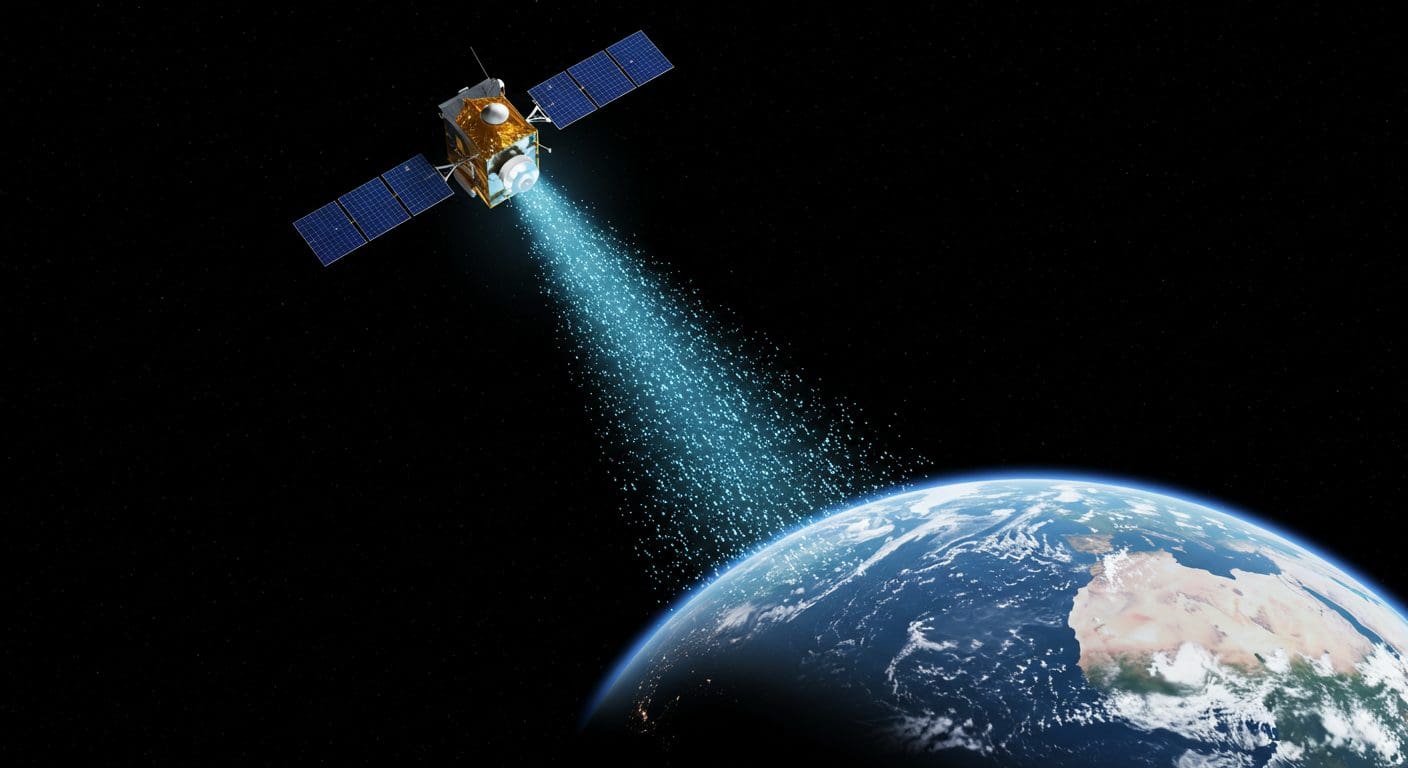
Atmospheric turbulence presents a major obstacle to secure quantum communication via free-space, specifically for measurement-device-independent quantum key distribution (MDI-QKD). Heyang Peng, Seid Koudia, and Symeon Chatzinotas address this challenge by developing a new model that accurately represents how turbulence affects polarized light signals. Their work consolidates several disruptive effects of turbulence, including signal fading and beam drift, into a manageable framework, allowing for precise calculation of key generation rates. This refined model, which maps turbulence as a predictable rotation of light polarization, significantly improves the ability to design robust and adaptable quantum communication links, paving the way for global-scale quantum networks that can function reliably even in challenging weather conditions.
Turbulence-induced polarization decoherence significantly impacts Free-Space Optical (FSO) Measurement-Device-Independent Quantum Key Distribution (MDI-QKD). The research addresses this challenge with a model consolidating several atmospheric effects, including phase perturbations, Gaussian beam spreading, beam drift, aperture truncation, and scintillation, into closed-form parameters: the depolarization factor, the decoherence factor, and the detection probability. By mapping turbulence to a quantifiable rotation of polarization states, the team derives an analytic Symmetric Key Rate (SKR) expression compatible with existing MDI-QKD security analyses. This model performs well under clear, overcast, and hazy weather conditions, offering computational efficiency and experimental verifiability for real-time link adaptation, and is illustrated through numerical simulations on a ground-to-satellite link.
Atmospheric Turbulence Mitigation for Satellite QKD
Researchers are actively developing strategies to establish secure quantum communication links between satellites and ground stations, a field challenged by atmospheric effects and the need for sensitive detectors. A primary obstacle is atmospheric turbulence, which causes beam wander, broadening, scintillation, and polarization distortion. To overcome these challenges, the team explores techniques such as adaptive optics, which corrects for wavefront distortions, and spatial mode diversity, which uses multiple light pathways to increase link robustness. Polarization encoding and control, diversity techniques employing multiple beams or wavelengths, and advanced modulation and coding schemes are also investigated to enhance signal reliability.
Careful analysis of signal losses and gains throughout the system is crucial for optimizing performance. The research considers various QKD protocols, including Measurement-Device-Independent (MDI) QKD, which enhances security by removing vulnerabilities related to detector attacks, and both Continuous-Variable (CV) and Discrete-Variable (DV) QKD approaches. Satellite-relayed networks, utilizing satellites as trusted nodes or relays, are also explored to extend the range of QKD networks. Accurate channel modeling, simulating beam propagation through turbulence, and statistical analysis are essential for characterizing system performance.
Machine learning techniques may also play a role in predicting channel conditions and optimizing system parameters. System considerations include operating QKD systems during daylight hours, optimizing ground station design for maximum signal reception, minimizing the size and power consumption of satellite payloads, and designing scalable and secure QKD networks. This research aims to develop the technologies and techniques needed to build a secure and reliable global quantum communication network based on satellites, a highly complex but potentially revolutionary field.
Turbulence Model Predicts Quantum Key Rates
Researchers have developed a comprehensive model to accurately predict the performance of quantum key distribution (QKD) systems operating through atmospheric turbulence, a major obstacle for free-space optical communication. This new approach consolidates multiple atmospheric effects, including phase distortions, beam spreading, and scintillation, into a unified framework describing polarization decoherence and depolarization. The model effectively maps turbulence to a quantifiable rotation of polarization states, enabling precise analytical predictions of secret key rates (SKR). Results show that under clear conditions, turbulence dominates SKR degradation within the first 20 kilometers, while atmospheric attenuation becomes the primary limitation beyond that distance.
Larger receiver apertures consistently improve SKR by enhancing light collection. The team found that increasing the elevation angle shortens the turbulent path, leading to noticeable improvements in SKR, particularly over shorter distances. Furthermore, the research highlights the critical role of adaptive optics (AO) in mitigating turbulence. Stronger AO pre-compensation significantly extends the viable range of QKD systems, enabling SKR up to 100 kilometers in clear weather and 50 kilometers in overcast conditions with a 0. 7-meter aperture.
Without AO, the polarization channel rapidly degrades, quickly exceeding the quantum bit error rate (QBER) cutoff and eliminating SKR. The simulations validate the model’s predictions against existing analyses of decoy-state MDI-QKD systems, confirming its ability to accurately capture SKR trends. While the model provides a robust framework, researchers acknowledge limitations including the simplified representation of atmospheric parameters and the need for empirical calibration of certain parameters with site-specific measurements. Future work will focus on incorporating more detailed atmospheric models and refining the model with real-world data to further enhance its predictive capabilities and pave the way for secure, global-scale quantum communication networks.
Turbulence Model Predicts QKD Key Rate
This research introduces a new model to accurately predict the performance of quantum key distribution (QKD) systems operating through atmospheric turbulence, a significant challenge for free-space optical communication. The team developed a composite channel model that simplifies the complex effects of turbulence, including phase shifts, beam spreading, and scintillation, into a few key, measurable parameters: a depolarization factor, a decoherence factor, and detection probability. This model effectively captures how turbulence degrades polarization, a crucial aspect of secure quantum communication. The resulting closed-form expressions allow for rapid calculation of the secret key rate, a measure of communication security, across various turbulence conditions and distances.
Unlike computationally intensive simulations, this model enables real-time link adaptation, supporting dynamic adjustments to optimize performance in changing atmospheric conditions, particularly for ground-to-satellite communication. The authors acknowledge limitations including the phenomenological nature of one parameter and the independent treatment of certain turbulence effects, suggesting future work to refine the model with empirical calibration and a more comprehensive approach to spatial and polarization modelling. They also note the model is calibrated for weak scintillation, and stronger turbulence cases may require further investigation. This research provides a valuable tool for designing and optimizing QKD systems for deployment in real-world atmospheric conditions, bringing secure quantum communication closer to reality.
👉 More information
🗞 Security Analysis of MDI-QKD in Turbulent Free-Space Polarization Channels-A Composite Channel Framework
🧠 ArXiv: https://arxiv.org/abs/2509.02087