The creation of tailored environments for studying the behaviour of light, specifically through ‘photonic gases’, represents a significant challenge in modern physics, and researchers are now pushing the boundaries of what is possible. Julian Schulz, Kirankumar Karkihalli Umesh, and Sven Enns, alongside colleagues at RPTU University Kaiserslautern Landau and the University of Bonn, demonstrate a new technique using three-dimensional micro-printing to fabricate exceptionally precise potential landscapes for these gases. This innovative approach surpasses current methods by at least an order of magnitude in terms of potential size, definition, depth, coupling strength, and the number of coupled potentials it can create. By successfully constructing complex structures, including box, harmonic, double-well potentials and even topological lattices at the scale of light’s wavelength, the team opens new avenues for exploring the physics of open systems and potentially solving complex problems in areas like magnetism and materials science.
Direct Laser Writing of Light Trapping Potentials
This research details a novel technique for creating highly customizable and precise trapping potentials for photon Bose-Einstein Condensates (BECs). Scientists developed a method to directly write complex three-dimensional profiles onto mirror surfaces using direct laser writing, enabling the creation of arbitrary potential landscapes for photons. This represents a significant advancement over traditional microfabrication techniques, allowing for the creation of steep and deep potentials crucial for confining and controlling photon BECs. The team successfully fabricated and tested several potential landscapes, including box potentials demonstrating thermal occupation of modes and macroscopic population of the ground mode, double-well potentials exhibiting significantly larger coupling rates between the wells compared to previous work, and a one-dimensional lattice based on the Su-Schrieffer-Heeger model with 20 sites.
This lattice serves as a proof-of-principle for exploring more complex lattice structures and topological physics with photons. The technique offers high resolution and precise control over the potential shape, opening up exciting possibilities for exploring complex quantum phenomena, including topological physics, many-body interactions, and non-equilibrium dynamics. The research has implications for various applications, including quantum simulation, quantum information processing, and the development of new quantum devices.
Micro-Printed Potentials for Photonic Gases Demonstrated
Scientists engineered a novel method for creating precisely defined potentials for photonic gases using three-dimensional micro-printing, also known as direct laser writing. This technique overcomes limitations of previous approaches by achieving potential sizes, definitions, depths, coupling strengths, and numbers of coupled potentials at least an order of magnitude greater than previously possible. The process begins by applying a UV-sensitive photoresist onto a substrate, then focusing a femtosecond pulsed laser into the material to initiate a polymerization reaction. By moving the focal volume, scientists precisely expose and harden chosen volumes of the photoresist, subsequently washing away the unexposed material to leave behind the desired micro-structure.
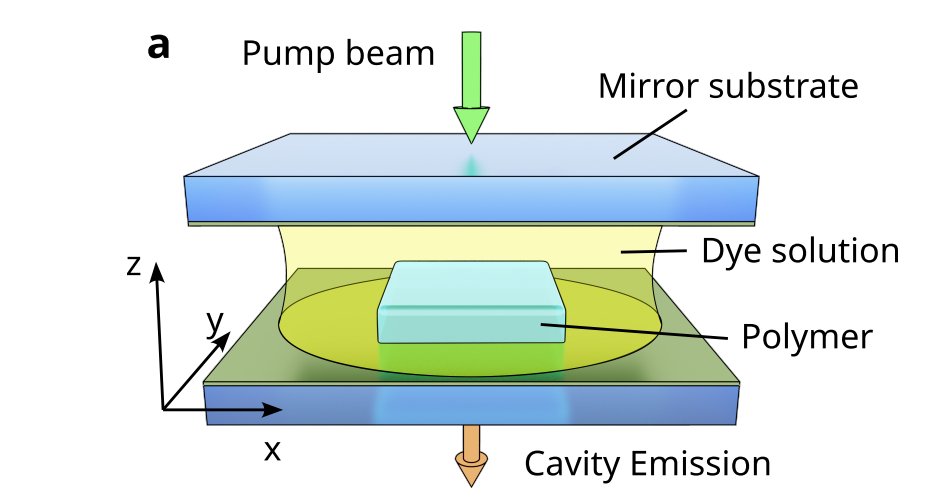
To observe the behavior of a photon gas, the team realized thermalization within a micro-cavity filled with a dye solution, Rhodamine 6G in ethylene glycol, excited with a 532nm pump laser. Highly reflective cavity mirrors, boasting a finesse of approximately 10 5 at wavelengths between 570nm and 600nm, hold the photons long enough to thermalize to room temperature. The narrow separation of the cavity mirrors restricts the emission spectrum, effectively creating a two-dimensional photon gas. Scientists then utilized direct laser writing to create specifically coated dielectric mirrors as substrates for printing polymeric structures that form the desired potentials. By imaging the radiation emitted through one of the cavity mirrors, they analyzed the distribution of photons within the created potential. Observations within a box potential revealed confinement in both position and momentum space, consistent with a two-dimensional bosonic gas, and macroscopic occupation of the ground state, indicative of a phase transition to a Bose-Einstein condensate as the photon number increased.
Precisely Defined Photonic Potentials Fabricated in 3D
Scientists have achieved a breakthrough in controlling light by fabricating three-dimensional micro-structures within micro-cavities, enabling the creation of precisely defined potentials for photonic gases. This work surpasses existing technologies by at least an order of magnitude in potential size, definition, depth, coupling strength, and the number of coupled potentials. The team successfully created a range of potentials, including box, harmonic, and double-well configurations, as well as lattices with complex topological properties, all on the scale of the wavelength of light. The core of this achievement lies in a novel fabrication technique utilizing direct laser writing, which allows for the creation of polymer structures directly onto dielectric mirrors.
These mirrors form a high-finesse cavity, maintaining a finesse of approximately 10 5 while transmitting over 80% of the pump laser light at 532nm. By locally altering the optical path length between the mirrors, the team imposed predetermined potentials on the photon gas contained within the cavity. Experiments demonstrate the ability to confine light within a fabricated box potential with an edge length of 10μm, revealing confinement in both position and momentum space, matching the predicted behavior of a two-dimensional bosonic gas. Increasing the photon number reveals macroscopic occupation of the ground state, indicative of a phase transition to a Bose-Einstein condensate. Further investigations into double-well potentials demonstrate a high coupling rate between the wells, crucial for studying lattice physics, and promise to enable exploration of complex quantum phenomena with photons.
Photonic Gas Confinement via Micro-Printed Potentials
This research demonstrates a significant advance in the creation of precisely shaped potentials for photonic gases, achieved through innovative three-dimensional micro-printing techniques. The team successfully created a range of potentials, including box, harmonic, and double-well configurations, as well as lattices with complex topological properties, surpassing previous capabilities in size, depth, and coupling strength. Observations within a box potential revealed thermal occupation of modes and macroscopic population of the ground mode with increasing photon numbers, while double-well potentials exhibited significantly enhanced coupling rates, demonstrating effective confinement of the photonic gas. As a proof of principle, the team investigated the Su-Schrieffer-He.
🗞 3D micro-printing: An enabling technique for arbitrary potential landscapes for photonic quantum-gases
🧠 ArXiv: https://arxiv.org/abs/2510.21444