

Uncertainty is a fundamental aspect of many systems, from decision-making processes to the representation of knowledge in artificial intelligence, and researchers continually seek more accurate ways to model it. Nicola Fabiano, from the “Vinča” Institute of Nuclear Sciences and University of Belgrade, along with colleagues, proposes a new approach to understanding uncertainty by moving beyond traditional fuzzy metric spaces. The team argues that uncertainty arises not from imprecision imposed on classical objects, but is intrinsic to the states themselves, and can be elegantly described using the established mathematical framework of complex Hilbert spaces. This innovative framework defines distance between states using the Hilbert norm, directly linking it to the fundamental principles of mechanics and offering a more robust and predictive way to represent ambiguous information, model concepts, and handle complex compositional structures than existing fuzzy logic methods.
Frameworks commonly treat uncertainty as an external layer of imprecision imposed upon classical entities, a mismatch for domains where indeterminacy is intrinsic, such as quantum systems or cognitive representations. Researchers now argue that fuzzy metrics are unnecessary; instead, the well-established structure of complex Hilbert spaces, the foundational language of quantum mechanics, provides a natural, rigorous, and non-contradictory metric space where quantum states themselves define the “points”. The distance between these states is directly encoded by the Hilbert norm, which connects to state distinguishability via the Born rule, offering a novel approach to representing uncertainty inherent in quantum and cognitive systems.
Quantum States Define Uncertainty’s Metric Space
This paper demonstrates that the Hilbert space of quantum states provides a superior and more fundamental framework for modeling uncertainty compared to fuzzy metric spaces. The authors contend that fuzzy logic attempts to solve a problem already elegantly solved by quantum mechanics. They propose that, instead of defining points in a space classically, quantum states (|ψ⟩) serve as the fundamental points defining the metric space. Quantum mechanics inherently possesses uncertainty as a core principle, while fuzzy logic adds fuzziness through arbitrary rules. Quantum mechanics provides a complete mathematical framework, including Hilbert space, inner products, and operators, eliminating the need for these arbitrary rules.
Quantum mechanics allows for phenomena impossible in fuzzy logic, such as interference, superposition, and entanglement, leading to richer representations and more powerful models. The authors demonstrate a formal equivalence between their quantum metric space and kernel methods, specifically Gaussian kernel SVMs, suggesting a path towards true quantum machine learning algorithms. They propose that the apparent fuzziness of human reasoning isn’t inherent in reality, but a consequence of quantum coherence being lost in macroscopic systems, a process called decoherence. By framing machine learning within this quantum framework, scientists can unlock new possibilities and develop more powerful and accurate models.
Hilbert Space Captures Inherent Quantum Uncertainty
Scientists demonstrate that the established mathematical structure of complex Hilbert spaces provides a natural and rigorous framework for modeling uncertainty, effectively bypassing the need for fuzzy metric spaces. The work reveals that uncertainty isn’t an external layer of imprecision, but rather an inherent property of states themselves, represented as points within these Hilbert spaces. Crucially, the distance between these states is directly encoded by the Hilbert norm, which aligns with the fundamental Born rule governing state distinguishability, establishing a strong connection between mathematical representation and physical reality. This approach inherently captures non-classical uncertainty without relying on fuzzy logic, arbitrary rules, or membership degrees, offering a more coherent and predictive model.
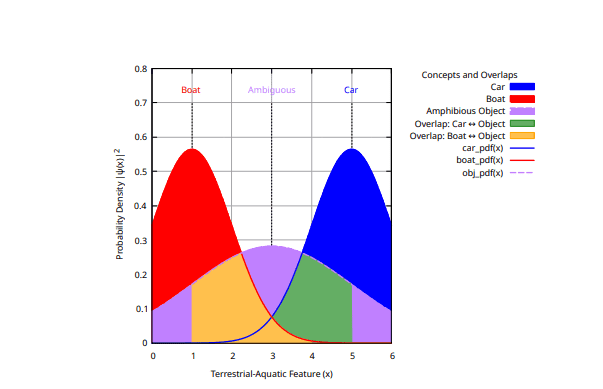
The team modeled artificial intelligence concepts as Gaussian wavefunctions, showcasing the power of this geometric approach to represent complex information. They classified ambiguous inputs by calculating overlap integrals between these wavefunctions, demonstrating a method for discerning subtle differences in state representation. Unlike fuzzy methods, this framework naturally handles interference effects, distributional shape, and the compositionality of concepts through the inherent geometry of state vectors, providing a richer and more nuanced representation of information. This research establishes a foundational shift in how uncertainty is understood and modeled, demonstrating that fuzzy metric spaces are superseded by the more robust framework of state geometry. The team’s work provides a mathematically sound and ontologically coherent approach to understanding uncertainty, whether in the behavior of electrons, the function of neurons, or the operation of neural networks.
Hilbert Space Defines Intrinsic Uncertainty
This research demonstrates that the mathematical structure of Hilbert spaces, central to quantum mechanics, provides a complete and rigorous framework for representing intrinsic uncertainty, effectively superseding the need for fuzzy metric spaces. By identifying quantum states as the fundamental “points” within this space, the team eliminates the reliance on fuzzy logic, arbitrary rules, and membership functions, instead leveraging the established principles of the Born rule and Hilbert norms to define distance and probability. This approach naturally incorporates interference, distributional shape, and compositional structure through the geometry of state vectors, offering a more coherent and predictive model of uncertainty. The team successfully modeled artificial intelligence concepts as Gaussian wavefunctions and classified ambiguous inputs using overlap integrals, showcasing the power of this state-based geometry.
Importantly, this work is not merely an extension of fuzzy logic, but a fundamental replacement, grounded in the well-established predictive power of quantum mechanics. Acknowledging the limitations of directly observing quantum coherence in macroscopic systems, the authors suggest that apparent “fuzziness” in human reasoning may stem from decoherence, rather than inherent indeterminacy in reality. Future research directions include extending this framework to multi-dimensional feature spaces using tensor products, modeling concept hierarchies with symmetrized or antisymmetrized states, and implementing quantum-inspired classifiers on conventional hardware using state vector embeddings. This work positions quantum mechanics not solely as a theory of the atomic realm, but as a potentially universal framework for understanding uncertainty across diverse systems, from electrons to neurons and neural networks.
👉 More information
🗞 Quantum Metric Spaces: Replacing Fuzzy Metrics with the Hilbert Space Structure of Quantum States
🧠 ArXiv: https://arxiv.org/abs/2509.15945

