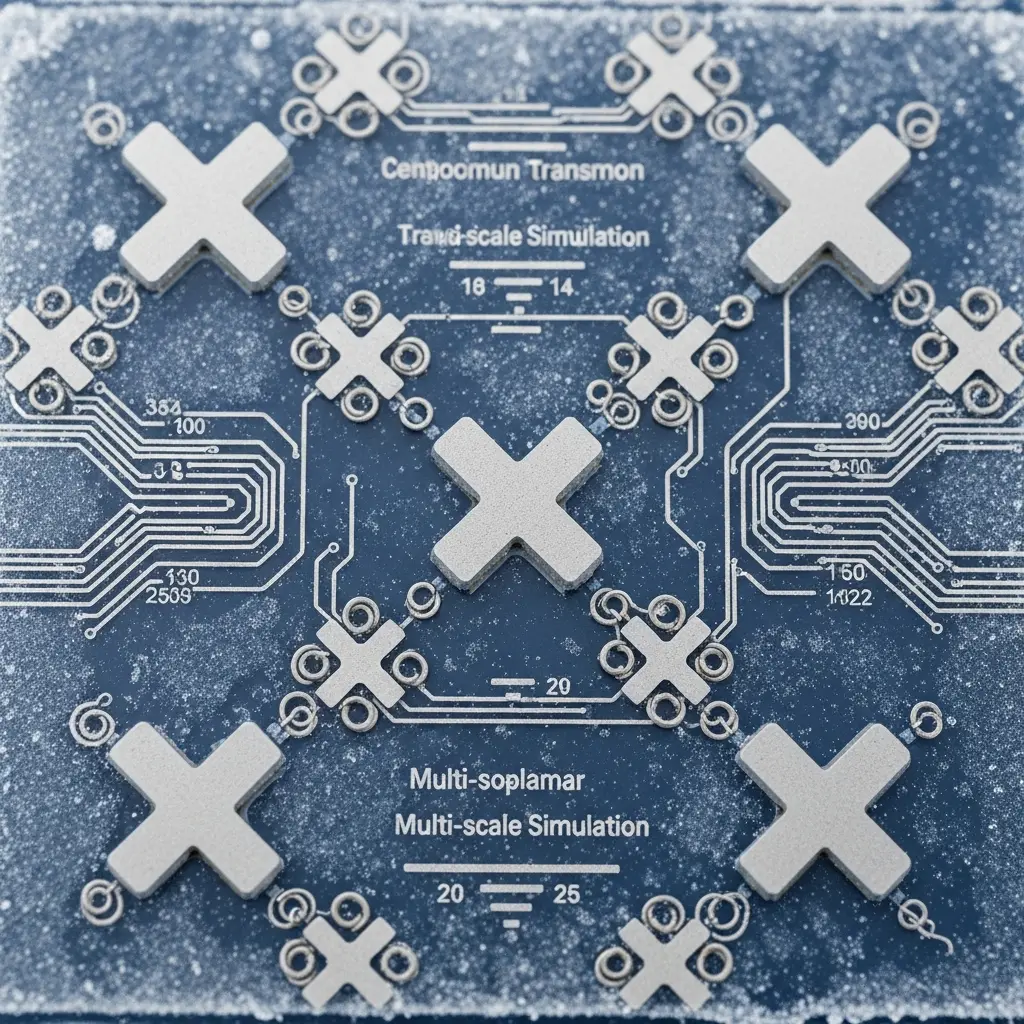
Computational electromagnetics, the modelling of electromagnetic effects in physical systems, underpins the design of numerous technologies, but faces increasing challenges when applied to cutting-edge devices. Samuel T. Elkin, Ghazi Khan, and colleagues from Purdue University and Google Quantum AI address this issue with a comprehensive review of available computational methods for modelling superconducting circuit quantum devices. These devices, spanning nanometre to centimetre scales and utilising unconventional materials, push the limits of existing techniques, often leading to increased simulation times or reduced accuracy. This work provides a practical guide for researchers, outlining the fundamental principles of key computational electromagnetics methods and offering insights into overcoming the specific hurdles encountered when modelling these complex, multiscale systems, ultimately paving the way for the design of more sophisticated quantum devices.
Electromagnetic Effects Limit Superconducting Quantum Devices
Superconducting circuit quantum devices represent a leading platform for realising quantum computation, however, their performance is fundamentally limited by electromagnetic effects. Accurate modelling of these effects is therefore crucial for device design and optimisation. This review examines the opportunities and challenges associated with utilising computational electromagnetics (CEM) methods for modelling these complex systems, focusing on practical considerations for researchers employing CEM techniques in the context of superconducting quantum circuits. The increasing complexity of quantum devices, incorporating features such as 3D architectures and multiple coupled elements, necessitates advanced modelling approaches, as traditional circuit analysis techniques often fall short in capturing the full range of electromagnetic behaviour, particularly at higher frequencies and smaller scales.
CEM methods, including finite element analysis, time domain finite difference, and integral equation methods, offer a powerful alternative by directly solving Maxwell’s equations, enabling the accurate prediction of parasitic effects, signal integrity, and coupling between different circuit components. A key challenge lies in balancing accuracy and computational cost, as simulating realistic devices with all relevant details requires significant computational resources, often limiting the size and complexity of the models. Researchers employ various techniques to mitigate this issue, including model reduction, symmetry exploitation, and high-performance computing. Furthermore, the accurate characterisation of material properties at cryogenic temperatures and microwave frequencies is essential for reliable simulations, requiring careful consideration of loss tangents, surface roughness, and dielectric properties. This review details the strengths and weaknesses of different CEM methods for specific applications in superconducting quantum device modelling, exploring techniques for validating simulation results against experimental measurements and discussing emerging trends in the field, such as the integration of CEM with machine learning algorithms. The aim is to provide a practical guide for researchers seeking to leverage the power of CEM to advance the development of quantum technologies.
Multiscale Simulations Reveal Accuracy Limitations in FDTD
Researchers have achieved significant advancements in computational electromagnetics (CEM) methods, essential for designing increasingly complex technologies. This work focuses on the challenges of modeling superconducting circuit devices, which present unique difficulties due to their unconventional material properties and the wide range of scales involved, from nanometers to centimeters. The team investigated how fundamental CEM techniques perform when applied to these multiscale devices, revealing limitations in simulation times and accuracy. Investigations into Finite Difference Time Domain (FDTD) methods demonstrated that while implicit methods offer unconditional stability, their accuracy diminishes rapidly with larger time steps, specifically, the widely used alternating-direction implicit FDTD (ADI-FDTD) method suffers from truncation errors proportional to the square of the time increment and spatial derivatives of the fields.
This effectively limits the achievable time step relaxation, insufficient to overcome computational challenges. Turning to Finite Element Methods (FEM), the team highlighted its superior capability for modeling complex geometries compared to FDTD, as FEM approximates the solution to the governing equations, allowing for more accurate discretization of complex shapes and reducing staircasing errors. Through careful formulation and implementation, FEM frequently achieves excellent agreement with measured results for fabricated devices. The research details the process of converting a continuous partial differential equation into a finite-dimensional matrix equation, crucial for understanding the opportunities and challenges of applying FEM to practical superconducting circuit design, expanding the unknown function using a set of basis functions with unknown expansion coefficients, ultimately leading to a discrete system of equations. This detailed analysis provides a foundation for improving the design of increasingly sophisticated superconducting circuit devices.
CEM for Superconducting Circuit Design
This work presents a comprehensive review of computational electromagnetics (CEM) methods, essential tools for designing technologies that rely on electromagnetic effects. Researchers systematically examine fundamental CEM techniques, highlighting their strengths and weaknesses when applied to the increasingly complex design of superconducting circuit devices. The study emphasizes that these devices, characterized by features spanning nanometer to centimeter scales and unconventional material properties, present significant challenges to conventional CEM methods, potentially leading to increased simulation times or inaccurate results. The investigation details how techniques like domain decomposition methods can address these challenges by dividing large problems into smaller, parallelizable sub-problems, thereby alleviating memory constraints and improving computational efficiency.
While acknowledging the effectiveness of these approaches, the authors caution that the performance of specific methods, such as PEEC solvers, can vary considerably depending on the approximations and specializations employed. They also note that the size of the interface problem in domain decomposition methods, though smaller than solving the entire system directly, can still pose computational demands. Future research, the authors suggest, should focus on refining these techniques to further enhance their ability to model increasingly sophisticated superconducting circuits. The authors emphasize the need for careful testing and validation when applying these techniques to new designs.
🗞 Opportunities and Challenges of Computational Electromagnetics Methods for Superconducting Circuit Quantum Device Modeling: A Practical Review
🧠 ArXiv: https://arxiv.org/abs/2511.20774