

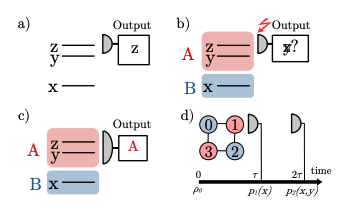
The behaviour of quantum systems, typically understood through their interaction with an external environment, presents a complex challenge for physicists attempting to model their evolution. Recent research investigates an unexpected phenomenon: the emergence of ‘memory’ effects—departures from standard Markovian dynamics where future behaviour depends on past states—not through environmental interaction, but within isolated, closed systems subjected to measurement. Jorge Tabanera-Bravo and Aljaž Godec, both from the Mathematical Biophysics group at the Max Planck Institute for Multidisciplinary Sciences, alongside colleagues, explore this counterintuitive behaviour in their article, “Purely quantum memory in closed systems observed via imperfect measurements”. Their work details how the act of measurement itself, particularly when utilising imperfect techniques such as von Neumann or Lüders measurements—methods that yield coarse-grained outcomes and varying degrees of coherence preservation—can induce memory effects, and introduces the concept of a purely quantum memory lacking a classical analogue. The study utilises a lattice walk model to illustrate these findings, offering insights into the implications for understanding dissipative dynamics and decoherence.
Quantum measurement fundamentally reshapes our understanding of dynamics and thermodynamics, challenging established paradigms and opening new avenues for technological advancement. Researchers actively investigate how measurement processes, particularly imperfect ones, induce memory effects within closed quantum systems, defying conventional expectations of Markovian behaviour and prompting a re-evaluation of established principles. This body of work details a comprehensive exploration of these interconnected phenomena, revealing the profound influence of measurement on energy transfer, work extraction, and the overall efficiency of quantum devices, ultimately demonstrating that observation actively participates in shaping the observed.
The research establishes that measurement isn’t a passive act of recording system properties, but an active intervention fundamentally altering the system’s dynamics and introducing correlations mimicking memory, even in the absence of external influences. Scientists demonstrate that imperfect measurements—those failing to fully resolve the system’s state—create memory effects, where evolution depends not only on the present state but also on past interactions. This contrasts sharply with Markovian dynamics, where the future state solely stems from the present. In Markovian systems, past states are irrelevant given complete knowledge of the present, a principle challenged by these findings.
Quantum thermodynamics emerges as a significant application area,
Quantum thermodynamics emerges as a significant application area, with multiple studies examining the potential for measurement-driven quantum engines and refrigerators, pushing the boundaries of efficiency. Researchers explore how leveraging quantum coherence—the superposition of quantum states—and entanglement—a correlation between quantum particles—alongside carefully designed measurement protocols, enhances thermodynamic processes, suggesting pathways for developing more efficient energy harvesting and conversion technologies. Investigations actively explore maximizing steady-state entanglement within autonomous quantum thermal machines, demonstrating the potential for self-sustaining quantum devices with improved operational characteristics, surpassing the limitations of classical counterparts.
Researchers consistently demonstrate that quantum measurement isn’t merely an observational act, but an integral component influencing energy transfer, work extraction, and the overall efficiency of quantum devices. Several studies establish a direct link between the precision and nature of measurement—specifically contrasting von Neumann and Lüders measurements—and the emergence of memory effects within closed quantum systems, challenging conventional understandings of quantum dynamics. Von Neumann measurements project the system onto an eigenstate of the measured observable, while Lüders measurements provide a more general update, potentially leaving the system in a mixed state.
The identification of purely quantum memory effects, arising from imperfect measurements on closed systems, represents a novel contribution, challenging conventional understandings of Markovian dynamics and offering new perspectives on dissipative processes. The collection underscores the importance of open quantum systems and the role of decoherence, crucial for developing practical quantum technologies. Studies on thermalization and the interaction between systems and their environment are essential for understanding and mitigating decoherence—the loss of quantum information—contributing to a more nuanced understanding of its origins and potential remedies.
Foundational texts, such as Nielsen & Chuang’sQuantum Computation
Foundational texts, such as Nielsen & Chuang’s Quantum Computation and Quantum Information and Cohen-Tannoudji et al.’s Quantum Mechanics, provide the theoretical framework underpinning these advancements, while the Colloquium by Streltsov et al. establishes quantum coherence as a valuable resource for quantum information processing. This work highlights that stronger conditions ensure Markovian behaviour under certain measurement schemes, specifically those preserving correlations, revealing a nuanced interplay between observation and system evolution.
Future research should focus on developing more sophisticated measurement techniques that minimize disturbance to the system while still providing accurate information, enabling the realization of more efficient and robust quantum technologies. Scientists should also explore the potential of using measurement-based control to manipulate quantum systems in novel ways, opening up new possibilities for quantum computation and communication. Furthermore, a deeper understanding of the interplay between measurement, entanglement, and decoherence is crucial for overcoming the challenges of building large-scale quantum systems.
🗞 Purely quantum memory in closed systems observed via imperfect measurements
🧠 DOI: https://doi.org/10.48550/arXiv.2506.13689


