Researchers from Northwestern University and Purdue University have used passive optimization and machine learning techniques to enhance the efficiency of quantum memory devices, a crucial component of future quantum networks. The team demonstrated a nearly six-fold enhancement in quantum memory efficiency, showing coherent and single-photon-level storage with a high signal-to-noise ratio. The study has significant implications for the development of quantum networks, suggesting that machine learning could play a key role in the development of future quantum technologies. The researchers believe their optimization technique can be applied to most solid-state quantum memories.
What is Quantum Optical Storage and Why is it Important?
Quantum optical storage is a technology that uses quantum mechanics to store and retrieve data. It is a crucial component of future quantum networks, which are expected to revolutionize the way we process and transmit information. However, solid-state quantum memories, which are a type of quantum optical storage, have been facing challenges in terms of low storage efficiency. This article discusses a study conducted by researchers from the Department of Electrical and Computer Engineering and Applied Physics Program at Northwestern University and the Elmore Family School of Electrical and Computer Engineering at Purdue University. The researchers have used passive optimization and machine learning techniques to enhance the efficiency of quantum memory devices.
Quantum memory devices with high storage efficiency and bandwidth are essential for the development of future quantum networks. Solid-state quantum memories can provide broadband storage, but they primarily suffer from low storage efficiency. The researchers have demonstrated a nearly six-fold enhancement in quantum memory efficiency using passive optimization and machine learning techniques. They have also shown coherent and single-photon-level storage with a high signal-to-noise ratio. The optimization technique presented in this study can be applied to most solid-state quantum memories to significantly improve the storage efficiency without compromising the memory bandwidth.
How Does Quantum Optical Storage Work?
Quantum optical storage works by using the atomic frequency comb technique, which has become the primary storage protocol in solids due to its broadband and low-noise properties. Typically, a two-pulse train pumping sequence is used to perform spectral tailoring and create an atomic frequency comb. Improving optical depth using impedance-matched resonators can be used to improve storage efficiency at the expense of lowering the memory bandwidth. Optimizing the pumping and preparation sequence is also crucial for better spectral tailoring, leading to higher storage efficiency.
In the case of laser-cooled atoms, machine learning optimization has been deployed to enhance atom trapping and cooling. Such optimization has not been explored in the context of solid-state quantum memories. In this study, the researchers performed machine learning optimization of atomic frequency comb quantum storage in a Tm3+ YAG crystal. Tm3+ ions in solids have optical transition wavelengths close to those of Rubidium atoms, making them good candidates for building hybrid quantum networks.
What are the Key Findings of the Study?
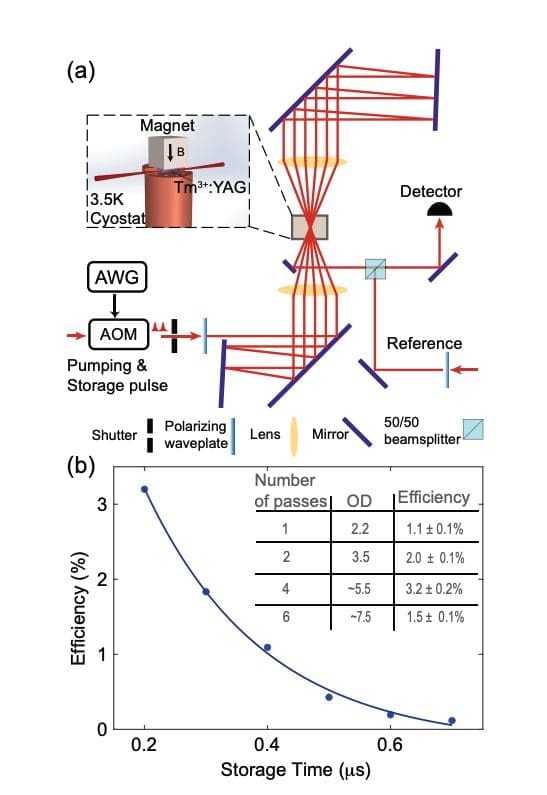
The researchers first passively enhanced the optical depth without compromising bandwidth by routing the laser beam multiple times through the crystal. They then ran a genetic algorithm to design a more efficient spectral preparation sequence. They showed that the combination of these techniques could lead to a significant improvement in storage efficiency. They also demonstrated coherent and single-photon-level storage with a high signal-to-noise ratio.
The experimental setup included a Tm3+ YAG crystal with dimensions 45*10mm. The laser beam propagated parallel to the [110] axis with linear polarization. A permanent magnet produced a magnetic field of 600 G along the [001] axis, lifting the degeneracy of Tm3+ ions with a nuclear spin of 1/2. One of the two ground states could serve as a shelving state for spectral preparation. With spectral hole burning, its hole and side holes due to inhomogeneous broadening were separated by 375 MHz, indicating that the excited state is split by 375 MHz and the ground state splitting is determined to be 173 MHz.
What are the Implications of the Study?
The study has significant implications for the development of quantum networks. The researchers have demonstrated that it is possible to significantly improve the storage efficiency of solid-state quantum memories without compromising the memory bandwidth. This could potentially lead to the development of more efficient quantum memory devices, which are a crucial component of future quantum networks.
The researchers have also shown that machine learning techniques can be used to optimize the performance of quantum memory devices. This opens up new possibilities for the application of machine learning in the field of quantum information processing. It also suggests that machine learning could play a key role in the development of future quantum technologies.
What are the Future Directions of the Research?
The researchers suggest that the optimization technique presented in this study can be applied to most solid-state quantum memories. This indicates that there is potential for further research in this area. Future studies could explore the application of these techniques to other types of quantum memory devices. Additionally, more research could be done to further improve the storage efficiency of quantum memory devices using machine learning techniques. The researchers also suggest that further experiments could be performed using Tm3+ YAG Crystal, Tm3+ YGG Crystal, Tm3+ LiNbO3 crystal, and Tm3+ ions doped in Lithium Niobate on Insulator.
Publication details: “Machine-Learning-Enhanced Quantum Optical Storage in Solids”
Publication Date: 2024-04-05
Authors: Yisheng Lei, Haechan An, Zongfeng Li, Mahdi Hosseini, et al.
Source: arXiv (Cornell University)
DOI: https://doi.org/10.48550/arxiv.2404.04200