

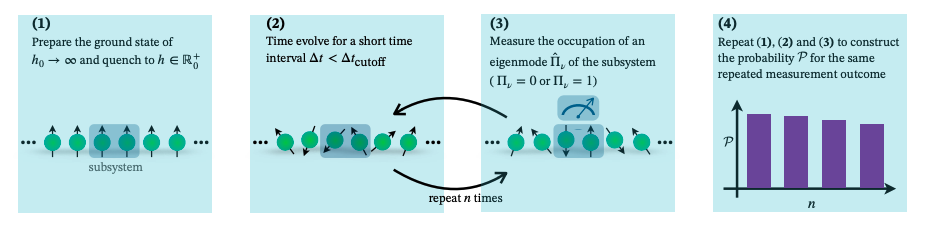
The fundamental act of measurement in quantum mechanics, traditionally posited as an instantaneous ‘projection’ onto a defined state, remains a subject of intense scrutiny, despite its central role in the theory. Researchers now present a novel protocol designed to empirically test this postulate, moving beyond theoretical debate to propose a method utilising repeated measurements of locally accessible quantities. This approach, feasible with current analog quantum platforms such as Rydberg atom arrays and ultracold gases trapped in optical lattices, investigates whether observed measurement statistics align with the standard projection postulate or deviate in ways suggesting alternative interpretations of the measurement process. Leonard Werner Pingen, from Ludwig-Maximilians-Universität München, collaborates with Mattia Moroder of Trinity College Dublin and Sebastian Paeckel, also of Ludwig-Maximilians-Universität München, to detail their findings in a paper entitled ‘Probing the Physical Reality of Projective Measurements’. Their work introduces a continuous description of measurement, predicting statistically distinct outcomes compared to the conventional, instantaneous collapse model, and suggesting a pathway to validate or refute a cornerstone of quantum theory.
Researchers are currently investigating the foundations of quantum measurement through a novel protocol, which challenges conventional understandings of how quantum systems interact with measurement processes and reveals potential deviations from established postulates. This investigation centres on repeated local measurements of quantum systems, utilising analogue quantum platforms such as Rydberg atom arrays and ultracold gases confined within optical lattices, to analyse the statistical outcomes and discern subtle differences from predictions based on the standard projective measurement model. The projective measurement model posits that measurement forces a quantum system into a single, definite state, thereby collapsing its wave function.
The study establishes a rigorous test of the validity of this postulate, eschewing complex state preparation or global control in favour of readily attainable local observables. Researchers demonstrate that repeated-measurement statistics (RMS) deviate significantly from predictions based on the standard model, arising from a continuous description of the measurement process. This continuous description assumes the coherent portion of the quantum state evolves continuously rather than collapsing instantaneously, offering a nuanced understanding of quantum state evolution during measurement and opening avenues for exploring alternative theoretical descriptions.
Researchers verify long-rangequantum entanglementthrough these repeated local measurements,
Researchers verify long-range quantum entanglement through these repeated local measurements, establishing a rigorous test to differentiate genuine quantum correlations from those attributable to decoherence, a process where quantum systems lose coherence due to interaction with the environment. The focus is on establishing statistical evidence against purely local explanations of observed correlations within a quantum system. The study employs a series of measurements utilising rotated projectors to probe for correlations incompatible with classical, decohered states, exceeding defined thresholds for measurement success probabilities. Notably, the team reports exceeding 0.22 for finding the quantum state within the subspace S+, as well as specific values (0.37, 0.61, 0.62) for measurements taken at different time points. These thresholds, coupled with the minimum acceptance probability Pmin, serve as criteria for validating the protocol and bolstering confidence in the observed entanglement.
To enhance the protocol’s robustness against noise and improve its sensitivity to entanglement, researchers optimise subspaces from S+ and S- to ˜S+ and ˜S-. This optimisation acknowledges a crucial trade-off between error tolerance (ϵ) and protocol robustness. Reducing ϵ increases sensitivity to entanglement but also amplifies vulnerability to noise, while increasing it diminishes sensitivity. This necessitates a careful balance to achieve optimal performance. Future work will likely focus on refining the optimisation of these subspaces, investigating the applicability of this protocol to diverse quantum platforms, and exploring the implications of the observed measurement statistics for alternative interpretations of quantum mechanics, particularly those lacking wavefunction collapse.
The study establishes that any modification to standard
The study establishes that any modification to standard quantum theory which omits explicit wavefunction collapse should replicate the qualitatively different measurement statistics observed in this continuous description. This implies that the observed deviations from the projective model serve as a potential signature of physics beyond the standard quantum framework.
🗞 Probing the Physical Reality of Projective Measurements
🧠 DOI: https://doi.org/10.48550/arXiv.2506.20618


