The emergence of unusual electronic properties in advanced materials drives ongoing research into novel topological phases of matter, and recent discoveries in multi-gap systems have revealed particularly promising behaviour. Martin Guillot, Cédric Blanchard, and Martina Morassi, alongside Aristide Lemaître, Luc Le Gratiet, and Abdelmounaim Harouri, now present a breakthrough in directly measuring the non-Abelian quantum geometry and topology within these complex materials. Their work pioneers a new orbital-resolved polarimetry technique, allowing scientists to probe the full electronic structure of a synthetic lattice and access previously hidden properties, including non-Abelian quaternion charges and curvature. This achievement unlocks the experimental investigation of a broad range of phenomena, from superconductivity to optical responses, and establishes a crucial link between topology, geometry, and non-Abelian physics in advanced materials.
Engineered 2D Material Exhibits Robust Topology
This research presents a comprehensive study of a specifically engineered 2D material system designed to host non-trivial topological states and potentially realize exotic quasiparticles. The researchers achieved precise control over the orbital composition of electronic states through a combination of lattice engineering, using a circular pillar structure, and external control, tuning ellipticity and strain. They employed advanced orbital tomography techniques to map the band structure and identify topological features, demonstrating a clear connection between the material’s geometry, orbital composition, and the emergence of robust topological states. Furthermore, they demonstrated the ability to manipulate these states through external control, opening the door to potential applications in quantum computing and spintronics.
The team developed a sophisticated orbital tomography technique to map the spatial distribution of electronic orbitals within the material, allowing them to determine the orbital composition of the electronic states and understand their contribution to the band structure. By carefully designing the lattice structure and controlling the ellipticity and strain, the researchers engineered the band structure of the material, creating specific band crossings and gaps essential for realizing topological states. The results demonstrate the emergence of non-trivial topological states, characterized by robust edge states protected from backscattering, making them ideal for quantum computing applications. The identification of quaternion charge associated with the band nodes is a key indicator of these topological states.
Researchers also demonstrated the ability to manipulate the topological states by tuning the ellipticity and strain, allowing them to control the properties of the edge states and potentially create new functionalities. The system can be described using an effective two-band Hamiltonian, simplifying analysis and providing insights into the underlying physics, corroborated by tight-binding simulations. This work represents a significant advancement in materials characterization, providing a powerful tool for understanding the relationship between orbital composition and electronic properties. The ability to engineer the band structure with such precision is a major achievement, opening new possibilities for designing materials with tailored electronic properties. The clear demonstration of topological states in this material system is a significant contribution to the field, and the tunability of these states, combined with their potential for quantum computing applications, makes this research particularly promising.
Direct Measurement of Non-Abelian Quantum Geometry
Recent work has pioneered the direct measurement of the non-Abelian quantum geometric tensor, a crucial step in understanding complex topological phases of matter. Scientists achieved this breakthrough by developing a novel orbital-resolved polarimetry technique to probe the full Bloch Hamiltonian of a six-band two-dimensional synthetic lattice. This innovative approach provides direct experimental access to non-Abelian quaternion charges, Euler curvature, and the non-Abelian metric associated with all bands, revealing fundamental geometric properties of the system. The team constructed a honeycomb lattice of semiconductor optical resonators, carefully designed to support discrete optical modes.
Experiments focused on three fundamental modes, a single radial mode and two degenerate out-of-phase modes, within each lattice site. By diagonalizing the Hamiltonian, researchers obtained six energy bands and corresponding Bloch eigenvectors, essential for characterizing the system’s quantum behavior. A key innovation was the introduction of a basis of six hybrid orbitals, allowing for individual probing of each orbital with minimal overlap, a significant improvement over previous methods. Measurements confirmed the band dispersion and revealed the location of nodes within the p-bands, along with their associated quaternion charges.
The team reconstructed the k-dependent off-diagonal matrix elements of the Hamiltonian in the hybrid orbital basis, mapping the real and imaginary parts of each component as a function of momentum. This detailed mapping provides a comprehensive understanding of the system’s geometric properties and confirms the presence of non-Abelian behavior. By employing a spatial light modulator and carefully modulating the amplitude and phase of the emitted light, scientists were able to selectively probe different sub-areas of each lattice site. Analysis of the energy- and momentum-resolved photoluminescence intensity maps, guided by a derived equation relating the signal to the Bloch eigenvector amplitudes, enabled the full tomography of the Bloch eigenvectors. These results unlock the experimental probing of multi-gap systems, bridging topology, geometry, and non-Abelian physics, and paving the way for future investigations into novel quantum materials and devices.
Direct Measurement of Non-Abelian Geometric Tensor
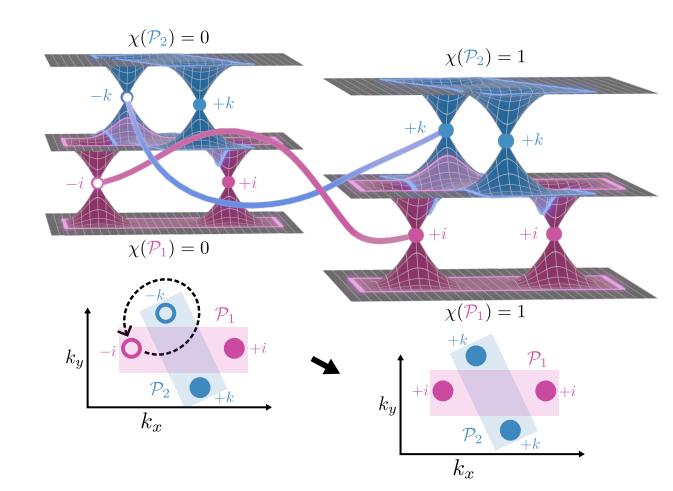
This research presents the first direct measurement of the non-Abelian geometric tensor, a key property predicting the behaviour of electrons in complex materials. Scientists achieved this breakthrough by developing a novel orbital-resolved polarimetry technique to examine a six-band two-dimensional synthetic lattice, allowing them to directly observe non-Abelian quaternion charges, Euler curvature, and the associated geometric properties of all bands within the system. These measurements reveal how the arrangement of band touching points influences the Euler class, a characteristic that determines the stability of these points against disruption within the material. The findings unlock new avenues for exploring a wide range of phenomena in multi-gap systems, including superconductivity, optical responses, and unusual transport properties.
Researchers acknowledge that their current approach relies on a specific lattice structure and may have limitations when applied to systems with significantly different characteristics. Future work will focus on controlling the movement of band touching points and demonstrating their braiding, a process where they are interchanged, by carefully tuning the lattice parameters. This platform also provides a foundation for investigating non-Hermitian and nonlinear topological phenomena, and could potentially be extended to explore materials like those found in Moiré structures, which may exhibit similar complex topologies.
🗞 Measuring non-Abelian quantum geometry and topology in a multi-gap photonic lattice
🧠 ArXiv: https://arxiv.org/abs/2511.03894